
The 10 worst places in England for potholes revealed

Not only do potholes cause damage to our vehicles, but they can, and do, cause accidents, either from drivers hitting the potholes themselves or swerving to avoid them.

A Sunday Mirror investigation has now revealed the 10 worst places in Britain for potholes and they say road quality is better in Chile, Oman and Peru after freezing weather at the end of February resulted in even further damage to our roads.

Most affected roads in England

Mellor Brook Bypass, in Balderstone, Lancashire topped the list as the worst offender, with 545 pothole complaints made. The second most affected road, bringing in 216 complaints, was Seven Hills Road, in Elmbridge, Surrey, and the A345 in Wiltshire took third place for the number of reports made for potholes, with 208 complaints.

Top 10 worst roads for potholes

  1. Mellor Brook Bypass, Balderstone, Lancashire – 545 complaints
  2. Seven Hills Road, Elmbridge, Surrey – 216 complaints
  3. A345 in Wiltshire – 208 complaints
  4. Selsfield Road, West Hoathly, West Sussex – 200 complaints
  5. Main Road, Moulton, Cheshire – 185 complaints
  6. A595 in Cumbria – 171 complaints
  7. Attercliffe Road in Sheffield – 169 complaints
  8. A38 Kingsbury Road in Birmingham – 169 complaints
  9. Richmord Avenue, Telford, Shropshire – 168 complaints
  10. The road from West Serstone to Down St Mary in Devon – 162 complaints
  11. Before the Sunday Mail’s research, Asphalt Industry Alliance said 24,500 miles of local roads will shut for repairs in the next year – and it will take at least 14 years to get rid of the backlog, costing £9.3billion.

    The Government had planned to spend £296m from the Pothole Action Fund between 2016 and 2021 — enough to cover repairs for around six million potholes — but after the harsh winter weather earlier this year; the government increased it by £100m.

A national disgrace

In the first four months of 2018, The Automobile Association (AA) received more insurance claims due to potholes than in the whole of 2017 and say they’re rescuing record numbers of drivers whose tyres or wheels get damaged by potholes.

Janet Connor, Director of Insurance for the AA, said: “This year we are seeing a growing number of pothole claims described as: ‘car severely damaged and un-driveable’ which didn’t happen at all last year.

“Even the Secretary of State for Transport, who in March announced £100million funding to be sunk into road repairs, admitted we haven’t spent enough on the country’s roads since the 1980s.

“That fund is welcome but no-where near enough. The pothole epidemic has become nothing short of a national disgrace.”

According to the AA, average repair bills are £1,000, adding up to £4.2million, from drivers damaging their bodywork, axles, steering, suspension, tyres, and underbodies, with motorists losing control and having collisions.

They say typical pothole damage involves one or two tyres and sometimes a wheel rim and the damage doesn’t justify drivers having to pay the excess on a policy and lose their no-claims bonus or risk a price increase upon renewal. Due to this, most drivers cover the costs themselves and don’t make a claim.

Councillor Martin Tett, of the Local Government ­Association (LGA), said: “Only long-term, consistent and fairer investment in local roads can let councils embark on the improvements so desperately needed.”

He said the LGA has asked the Government to reinvest two pence per litre of existing fuel duty, to generate £1billion a year for councils to use for repairing local roads and to fill potholes.

Drivers aren’t the only victims of potholes. The Department for Transport figures show, between 2007 and 2016, 22 cyclists dying and 368 receiving serious injuries, due to accidents involving defective road surfaces.

Action after hitting a pothole

You must decide for yourself whether to put in a claim to your council for pothole damage. In the short-term, it puts councils under financial pressure and uses the taxpayers’ money, but if the public doesn’t make claims, roads may not get repaired when they should.

One member of the public hit the headlines this month after he contacted a council chief about damages he incurred from hitting a pothole.

Claimant, Jonathan Symms, received a response to his email to Sir Richard Leese explaining that due to the council making compensation payments for pothole damage, it was taking away resources they could spend on vital road repairs.

Sir Richard said, in an email to Mr Symms that, “The idea that councils have to take responsibility for every bit of people’s activity can’t be right – or the fact council services, including the limited money we have to repair roads, should be put at risk.”

If a member of the public makes a report of a pothole or the council discover one during road inspections and you hit the pothole before it’s repaired, you’re within your rights to seek compensation but, according to Government guidelines introduced in October 2016, potholes 40mm or below don’t qualify.

If your vehicle had a pre-existing problem, and the pothole made this worse, you can still claim but you won’t get the full repair costs back.

Local authorities aren’t liable to pay out on claims if they weren’t aware of the pothole beforehand, i.e., nobody had reported it to them and road inspections missed it. By law, councils have to carry out road inspections and repairs. So, if your claim gets rejected you can ask to see details of the council’s road inspection reports and try for a reclaim.

If you hit a pothole, pull over as soon as it’s safe and check for any damage to your wheels and tyres and, if safe to do so, take notes of the whereabouts of the pothole and photographs, too — include something in the photo to show scale, such as your foot. If you have witnesses, try to collect their contact details.

Even if you don’t spot immediate damage, listen for vibrations and watch for your steering wheel not centring, or the car pulling to one side. If any of these things occur, have your vehicle checked by a garage as soon as possible and ask your mechanic to put any findings in writing. Don’t ignore tracking or steering damage as both can be dangerous and expensive.

Get several quotes for repair work and keep every quote, invoice, and receipt if you’re intending to make a claim. Even if you’re not intending to make a claim, report the pothole to your council. Contact Highways England about potholes on motorways and A roads.

What condition are the roads where you live? Have you encountered damage to your vehicle because of a pothole? Did you make a claim to your council? Do you think the public should make claims for pothole damage? Let us know in the comments.
Despite OPEC agreement, petrol prices may not drop

In recent news, there has been much talk about OPEC and how they are falling short of output. However, recent talks last Friday brought relief for industry analysts across the world as OPEC agreed to up output by one million barrels per day.

Who are OPEC and what does this mean?

OPEC is the Organization of Petroleum Exporting Countries, a collective of the biggest oil exporting countries, including major players like Iran, Saudi Arabia as well as smaller countries like Angola and Gabon. This international cartel controls most of the world’s reserves of crude oil, and therefore any decisions by them are felt by petrol retailers across the globe.

This announcement comes 18 months after OPEC slowed oil production to help reduce the glut they created by flooding the market back at the beginning of 2017. While it seems that target wasn’t properly met, production was at 158% at some points, OPEC has now agreed to target 100% compliance, meaning an increase of approximately one millions barrels per day (bpd) in the second half of 2018.

Analysts not optimistic

However, leading industry analysts are not as positive about the agreement as Donald Trump is.

Joe McMonigle, an energy analyst at HedgeEye, said: “I suspect we will eventually get some calculations from Opec but [the] lack of details is bullish, not bearish for oil prices.” He, along with other industry analysts, predicted that the actual output would fall short of the OPEC agreement of 1m bpd, and be nearer to 800,000 bpd.

While any increase is a good increase, for the consumer it may be that the growth is not enough to stop the oil prices rocketing with a loss in production from countries like Venezuela.

Khalid al-Falih, the energy minister for Saudi Arabia, was hopeful about the increase and said “Saudi Arabia is unique. All of our spare capacity is available at short notice.” He also noted that prices wouldn’t be affected until the end of summer as it can take weeks for a price fall to be indicated by retailers.

Iran, however, is not as positive as their production is set to be hit by the latest US sanctions on them in the US move to politically and economically isolate Iran. The US have been threatening countries, companies and banks that handle Iranian oil with sanctions and penalties if they don’t stop handling Iranian oil, such as being frozen out of the US market. While most European countries have started to reduce their import from Iran, it seems that the US wants an all or nothing deal, something that will most probably not help the price of petrol over the coming months.

What does this mean for you?

As you’ve probably already seen the price of petrol is high at the moment, although it has fallen slightly recently. Hopefully, this increase in production means that the price of oil, and therefore petrol will decrease slightly in the coming weeks although this is not certain. OPEC production could merely offset the losses in production and future supply in South America, the Middle East and Africa, meaning that consumers will feel no actual change.

Prices at the pump are at an all-time high since November 2014 but with supermarkets such as Asda announcing two price cuts over the last few weeks it seems that some relief is likely for consumers at the pumps.

While the effects of the OPEC announcement may not be felt until it is too late, you may be able to get on by until then. By using a technique called hypermiling, you can make the most out of every penny you put in the fuel tank.

One way to hypermile is to drive at consistent speed. The most fuel economic speed is around 55 mph, and while this is not always possible, the faster you drive, and the quicker you accelerate causes you to waste fuel. Slowly accelerate out of junctions and build up speed gently rather than zooming away.

Driving to the conditions is also very important. At the moment the UK heatwave is causing roads to become slippier and councils are sending out the gritters to help combat the melting roads. Drive carefully, as you would on an icy road at the moment to prevent slipping. As the roads are slippier, you may notice that you go faster down hills and along roads, so use the gears carefully to stop you from using excess fuel.

In regards to the pump prices, there’s not much you can do unless you own an oil producing country! However, by using the PetrolPrices app you can see the fuel costs wherever you are at any given point!

Do you think that the price of petrol will go down? Will we ever see relief in the sky-high prices at the pumps? Let us know below

Roadwork permits found to cut driver disruption

Roadworks are an unfortunate but necessary part of modern life; traffic volume has increased to record levels year-on-year – estimates say that we travelled 324.3 billion miles last year, and building future-proof infrastructure all adds up to the £4.3 billion cost to the UK’s economy.

We’ve discussed lane rental schemes before, but a new report by Ecorys, working in conjunction with the government, has suggested that these schemes are working, and could significantly cut down on roadwork delays – by as much as three days.

However, a separate report estimates that the time to clear the carriageway maintenance backlog would be fourteen years, and with more than half of any local authority’s maintenance budget spent on structural maintenance, our road network isn’t going to improve anytime soon.

More councils to adopt

Currently, around 65% of all UK authorities use a permit scheme for contractors; the contractor applies for the permit as part of the tendering process, and this could cost as much as £2,500 per day for the permit, but operating at off-peak times would reduce that cost, and there is the added incentive to finish sooner.

As we spoke about before, lane rental schemes are being adopted alongside the permit scheme, so contractors who work during peak times can be charged for use of the lane or very busy road, to encourage after-hours work or during quieter times to ease disruption.

Roads Minister, Jesse Norman has said that permit schemes such as this have been proven to cut down on the time taken for the works, meaning fewer disruptions and a reduced burden on the economy, the government will be encouraging the last 35% of local authorities to introduce such schemes in a bid to lessen the disruption to the motorist. Plans are also being looked at to encourage the contractors to work under pavements rather than roads, in a further bid to keep the country moving.

Conflict of interest

Despite the Government telling us that these new permit schemes will reduce overall roadwork congestion, there does seem to be a conflict of interest that hasn’t yet been cleared up.

Currently, road repairs/maintenance and improvements are covered through a combination of Government money, street or highways authority, this accounts for around 55% of all roadworks. Any further works such as a utility company wanting to lay new pipes/cables will be subject to the permit; about 45% of all roadworks.

Third-party contractors working on behalf of the authority may not be subject to the permits, meaning there will be no discernible improvement, and should the Government insist on all contractors (including those sub-contracting to the authority) being part of the permit scheme, this will surely mean an increase in road-repair cost, which is of course, tax-payer funded.

Roadworks – the scourge of modern society

Since 2015, there has been a 21% increase (average) in roadworks, and at least one third of all car journeys are affected by them, so it comes as no surprise that the Government are trying to ease congestion, along with the permit scheme, there is talk of raising the speed limit through roadworks from 50 mph to 60 mph and limiting the length of motorway works.

This can only be good news for the motorist, but both of these planned measures aren’t without drawbacks; around 20% of roadworkers have suffered an injury whilst at work, with 54% reporting near misses with vehicles, and the cost to continually prepare, setup and breakdown roadworks is phenomenal – widening a 51-mile stretch of the M6 costs around £1,000 per inch currently, an increase in setup costs could double that figure.

Avoiding roadworks

Over 100 billion vehicle miles are affected by roadworks, and when you’re stuck in them, it feels like you’re in them for exactly that length, but there are a number of resources that can help you figure out where roadworks are happening or planned to happen, some even give you estimated time of delay.

If it’s a daily commute, you’ll know where they are, possibly how to avoid them, and what extra time to allow for, but if you’re planning on heading somewhere new, you should look at sites such as roadworks.org for up to the minute information. Alternatively, many navigation systems have this feature built-in, but learning to trust it can be a new experience.

Despite the raft of new ideas or legislation, traffic is on the increase – motorway traffic alone has increased 44.1% in the last 20 years and is set to rise a further 2% each year, this means that road maintenance or upgrading will be a constant process, perhaps learning to live with traffic is the only viable solution.

According to studies from GoCompare, the average motorist spent 31 hours stuck in traffic in 2017. Cutting down the roadworks would greatly help to reduce this number and help free up time for other things, like spending time with family.

How long does your daily commute take? Can you see a better way of speeding up road repairs? Would you pay extra to have a roadwork-free journey to work? Let us know in the comments.

Cyclists and pedestrians given priority over cars in bold move

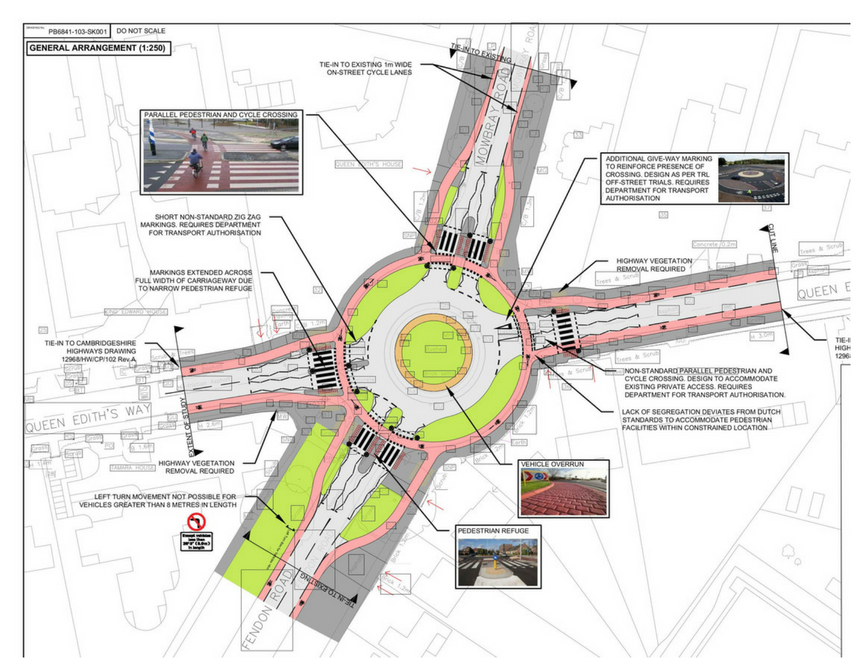
Cambridge County Council has announced they are building a new £1 million roundabout that gives the right of way to pedestrians and cyclists and placed drivers as the lowest priority at a junction. The roundabout will be located on Fendon Road and Queen Edith’s Way and is aimed to improve safety, with the work beginning next year. However, most drivers around the Cambridgeshire area are apprehensive about the change.

Improving safety

The council were given £550,000 from the Department for Transport (DfT) towards the project with a further £250,000 being contributed from developers. The funding is part of a new £7 million allocated for the 2018-19 Cycle City Ambition Safety program which Cambridge is one of seven cities to be participating – others including Bristol, Manchester, Birmingham, and Norwich.

For the Cambridgeshire side of the scheme, only those within the Greater Cambridge cycle city area were eligible for consideration. This particular roundabout was chosen as there have been 14 cyclist car collisions in recent years. 67 per cent of respondents to a survey said cycling and walking improvements were needed on Queen Edith’s Way, with 32% reporting they felt unsafe cycling there, 7% very unsafe; while 24% felt safe, and 5% very safe.

Dutch style roundabout

The bicycle-friendly roundabout is also known as the Dutch roundabout as it was in Holland that the idea was first implemented. The idea is that the most vulnerable people on the road – pedestrian and cyclists – prefer roundabouts over intersections with signals and this led to the reconstruction of many intersections in Holland to become roundabouts.

One of the key factors of the roundabout style is that the carriageway width is reduced to make for slower approach and departure speeds, meaning drivers go slower while approaching and being on the roundabout.
There is an allowance for larger or longer vehicles to use the over-runnable strip in the middle of the road where needed.

Pedestrians have zebra crossings at each of the roundabout entry/exit arms, and there will be cycle paths with contrasting red tarmac to give them equal priority with people on foot.

Reaction to the change

Rebecca Ashton head of driver behaviour at IAM RoadSmart welcomed the move and said that a Dutch-style roundabout separates vehicles from vulnerable road users and this was a benefit for the people of Cambridge. She added that it would be interesting to see how it benefits all road users and if they might be worth trying in other areas of the country.

Drivers were a little less enthusiastic about the concept. Some pointed out the complicated design of the roundabouts that could possibly lead to accidents. More people were keen for the council to spend money improving the overall road network rather than focusing solely on the Dutch style roundabout idea.

Ian Bates, Chair of the Economy and Environment Committee for the local council said that the council was excited to have the funding for the project. It would be a first not only for Cambridge, but for the UK that would ‘improve the experience for everyone using the roundabout’ by increasing the room for safe travel.

One interesting idea against the concept argues that cyclists cause pollution – by causing vehicles to sit idling at the side of the road while waiting for them to pass. Lord Robert Winston restated the idea earlier this year in which he said that Dutch-style roundabouts led to more pollution, meaning cars took longer to complete a journey and at slower speeds. This is often said to cause more pollution and lead to worse engine efficiency.

Cycling centre

Cambridge is often known as the cycling centre of the UK with as many as one in four people using a bike to travel to work, the highest rate in the country. There are some 80 miles of bike lanes with many routes connecting to surrounding areas. The railway station has room for around 3,000 bikes to be parked.

In spring, there are around 20,000 people who ride across the River Cam daily while in autumn, the number of cyclists entering or leaving the city is approximately 7,000 a day. And the busiest roads see about 4,000 cyclists a day using them. The relatively flat land of the city and the cycle network makes it a top place for leisure and work travel by bike.

More to come

It seems the idea of a Dutch-style roundabout won’t remain one that is exclusive to Cambridge either. Southwark Council has announced their first Dutch-style roundabout which will be finished in April 2019 between Fountain Drive and Sydenham Hill. Currently, the spot has two roundabouts following each other but no real facilities for pedestrians or cyclists. The new design will solve this problem.

Campaigners hope that by making roundabouts more cyclist and pedestrian friendly, more people will start walking or riding around the city areas. This will have benefits for their health and also cut down the number of cars on the road, reducing pollution and congestion. Whether the new design of roundabout will help with this or create new problems only time will tell.

Have you encountered a Dutch-style roundabout while driving on the continent? Do you think the move will help or hinder overall road traffic? Do you think this will help cyclists on roads? Let us know below

Asda cuts fuel prices by up to 3p a litre in new price war

Last week, we reported on the top five hardest hit areas for increased petrol and diesel prices, after May saw the steepest price hike for 18 years. PetrolPrices reported that, in some places, motorists paid between 7.5-7.7 pence extra on a litre of fuel, despite the wholesale cost falling.

This week, there’s good news for motorists as news came of supermarkets reducing their fuel prices in what some are describing as a new ‘price war’.

Why have prices dropped?

The drop in the wholesale price of fuel is due to rumours that oil-producer Opec will lift the restriction on production and the increased level of drilling and oil production by the US and Russia.

Even though the wholesale price of fuel has been 2.5 pence lower since the 24th of May, motorists hadn’t seen the reduction in price reflected at the pumps until Asda took the lead, cutting their pump prices last week by up to 3p a litre.

Due to the supermarket setting a price cap across all its forecourts, drivers can expect to pay up to 125 pence per litre for unleaded and 128 pence per litre for diesel across any of Asda’s 318 forecourts. A price cap merely limits the top price rather than setting a fixed price across all forecourts.

Tesco, Morrisons, and Sainsbury’s have followed Asda’s lead and have cut their forecourt prices, too. Unfortunately, we’ll have to wait to hear any announced cuts from other retailers although motorists may notice a slight drop over the next few days.

Did the price actually change?

On the day the news broke that Asda was slashing their prices — Wednesday the 13th of June — their petrol prices were 128.9 pence per litre, yet two days later it was up to 132.3 pence per litre, only to come down to 128.2 pence per litre three days afterwards. Diesel got cut from 134.9 pence per litre to 132.4 pence per litre.

Sainsbury’s was charging an average of 129.8 pence per litre last Wednesday. Since then the price has come down to 128.9 pence per litre. Yet diesel is up from 130.9 pence per litre to 132.2 pence per litre.

At Morrisons, petrol came down from 132.9 pence per litre to 129.1 pence per litre, but their diesel price went up from 131.9 pence per litre to 132.6 pence per litre.

Tesco’s pump prices have gone up — though Tesco said they’ll cut them. Their petrol increased from 130.5 pence per litre to 130.8 pence per litre. Diesel too increased from 132.9 pence per litre to 133.6 pence per litre.

Also in the news

Cyclists and pedestrians given priority over cars in bold move

Have an article you’d like to see? Submit an idea here.

Welcome relief

After the RAC described May’s rise in fuel prices, as “a hellish month for motorists”, their Senior Press Officer, Rod Dennis, said: “At last, retailers have done the right thing and started to cut prices at the pumps. From our data, we could see no justification for them holding on to savings that they have been benefiting from for three weeks.

“With petrol prices rising at their fastest rate in 18 years last month, millions of households and businesses will have been feeling the effect of having to spend more on what is an essential purchase for many.

“Today’s cuts should bring some welcome relief. It is absolutely right that at times when wholesale prices are falling, forecourt prices follow suit.”

Roger Burnley, Chief Executive for Asda, said: “We know that the cost of living is centre of mind for our customers and we will always do whatever we can to reduce that burden.”

Although the price cut is welcome news to drivers, many will be cynical. After such a hike in recent prices, a cut of 2-3 pence on a litre isn’t much to celebrate. Other drivers will be angry it’s taken so long for forecourts to pass on the savings; three weeks after the wholesale price of fuel dropped.

With petrol and diesel often in the top three of a household’s biggest budget expenses, is this price reduction enough?

Getting the most from your car

With more of UK motorists saying fuel prices are making car ownership more prohibitive by the year, what can the average driver do to reduce what they pay out in petrol and diesel costs?

PetrolPrices is on a mission to save motorists money. We collect around 8,000 price updates each day, covering 98% of the UK’s fuel market. If you want to cut your fuel cost by, on average, £220 a year, become a PetrolPrices member by downloading the app, today.

Be on the alert of supermarkets offering discounted fuel vouchers at the till, for use at their own pumps. This can shave off a fair amount on a full tank of fuel. Often, both supermarkets and other fuel retailers also have loyalty card schemes. Every time you fill up your tank, you collect points, which you can use for later purchases of fuel.

If you always pay off your credit card balance each month, consider one that gives you cash back when you use it at petrol stations. Beware though, if you carry a balance on your credit card — the interest will cancel any savings made.

The faster you drive, the faster you consume fuel, so try to leave plenty of time before making journeys, to prevent being rushed. Figures by The Department for Transport show drivers use up to 25% more fuel travelling at 80mph instead of 70mph and 9% more fuel driving at 70mph than at 60mph.

The most fuel-efficient way to drive is smooth. This means being gentle with the accelerator, brakes, and steering — it’s a more relaxing way to drive, too. By focussing on the distance, you can better tell what will happen, adjust your driving, and maintain your flow.

What do you think about this so-called ‘price war’? Will the price cuts make a real difference to you or isn’t it enough of a reduction? Do you see the competition between fuel retailers driving the prices down further? Let us know in the comments.

98% of hybrid cars don’t meet official fuel economy figures

A recent study has revealed that car manufacturers are still massaging their emissions figures, and whilst that may not be the most shocking news you’ll hear today, the extent of the cheating could be; it was found that some cars are as much as 63% down on their claimed mpg figures.

The findings are made worse when you consider that these figures specifically relate to vehicles bought for their green credentials – hybrids.

Just one in 39 hybrid models currently available actually achieves the manufacturers claimed mpg, although on average, a typical hybrid will return around 70% of the claimed figure.

The Volkswagen fallout

The buying public really first found out about emissions cheating as a result of the Volkswagen scandal in 2015, and although trade insiders widely understand that it was happening on a regular basis, with many of the manufacturers, it seems that Volkswagen paid the price.

The reason why the Volkswagen scandal was so detrimental to the brand was that they had set out to deliberately cheat on emissions testing – going so far as to having software that reacted to an emission testing situation, whereas for many of the other manufacturers, it was purely down to the vehicle being tested in absolute optimal conditions; the results were the same but achieved differently.

The ‘dieselgate’ scandal with Volkswagen led to new legislation being introduced – Worldwide Harmonised Light Vehicle Test Procedure (similar to the existing tests, but faster and more dynamic – using a range of engine loads/speeds, gearchanges and temperatures) and the Real Driving Emissions (RDE) which involves driving a vehicle on open roads, including motorways and urban areas for 90 minutes, both tests should see a significant improvement in the truth regarding claimed emissions.

Why hybrids?

From the 1st September 2018, all new vehicles will have undergone the WLTP testing, and the RDE testing will come into effect on the 1st September 2019 – this should stop the wild exaggerations of manufacturers, in the meantime, however, there is still the matter of 63% less fuel economy for some hybrids.

The study by HonestJohn is based upon 148,000 real-world fuel tests, and whilst it was expected that the regular diesel and unleaded figures would be different to the claimed manufacturer figures, the surprising truth was that they were closer to manufacturer figures than the hybrids; one hybrid in particular was achieving just 36.9% of the manufacturers claimed figures – 49.63 mpg against a claim of 134.5 mpg, at the opposite end of the scale, the closest was still nearly 16% down on the manufacturers figure.

Further legislation

The UK Government has recently passed further legislation targeting manufacturers who deliberately set-out to cheat the emissions testing, but we should make it clear – this is targeting the makers that fit a ‘defeat device’ (such as Volkswagen did) to beat the testing; this won’t target those manufacturers whose numbers are on the generous side through optimising their testing – laboratory conditions, static load, set temperature, constant speed – these are currently still accepted methods for testing.

Transport Minister Jesse Norman says that some manufacturers are “dishonest and deplorable” and that the new regulations (which come in to power on 1st July 2018) will ensure that any brand caught cheating will be made to pay financially and legally – as much as £50,000 per car that’s been found to have a device fitted.

This is possibly too little, too late, especially if the RDE and WLTP testing legislation works as they should.

What does this mean for the motorist?

If you’ve bought a hybrid specifically for the purpose of saving fuel & money, you’re probably all too aware that it’s not achieving anything like it should – the number one selling plug-in hybrid is the Mitsubishi Outlander PHEV, by our reckoning, 10,000 miles should cost in the region of £354 in fuel, but readjusting that figure from the results of the study, it’s closer to £833.

If you’re currently looking to purchase a hybrid, our advice would be to wait until September at the very least – manufacturers should be using the Worldwide Harmonised Light Vehicle Test Procedure then, which in theory means that any claimed figures will be a little closer to reality, but if time is of the essence, you should research the models fuel consumption before signing on the dotted line – don’t take the manufacturers word for it.

The top five least accurate figures are:

  1. Mercedes-Benz C-Class C350e – achieves 36.9% of the claimed 134.5 mpg
  2. BMW 3 Series 330e – achieves 37.2% of the claimed 134.5 mpg
  3. Volkswagen Golf GTE – achieves 38.1% of the claimed 166.3 mpg
  4. Mitsubishi Outlander PHEV – achieves 42.5% of the claimed 166.0 mpg
  5. BMW 2 Series Active Tourer 225xe – achieves 56.4% of the claimed 141.2 mpg

And the best:

  1. Lexus GS450h – achieves 84.2% of the claimed 45.6 mpg
  2. Toyota RAV4 Hybrid 2WD – achieves 79.3% of the claimed 57.6 mpg
  3. Toyota Yaris 1.5 VVT-I Hybrid – achieves 77.9% of the claimed 91.2 mpg
  4. Kia Niro 1.6 GDI Hybrid – achieves 77.4% of the claimed 74.3 mpg
  5. Toyota C-HR 1.8 Hybrid – achieves 77.2% of the claimed 74.3 mpg

Do you own a hybrid? Do you feel that the report is accurate? Have you been surprised at just how IN-accurate the fuel consumption figures are? Let us know in the comments.

Self-parking cars legalised in the UK

Do you remember when you learnt to drive and the one manoeuvre that you really hope wouldn’t come up in the test was a parallel park? Well, under new legislation from the government, future drivers may not need to learn parallel parking because the car will be able to do it itself. The latest government strategy in the digitalisation of driving is inviting companies to bid for the £30 million in funding to develop self-driving and self-parking cars for the UK market.

New initiative

Business Minister Richard Harrington announced this month that companies are being invited to bid for the new funding which aims to bring self-driving vehicles to the UK roads. It is funded by the Centre for Connected and Autonomous Vehicles (CCAV) and Meridian – the hub for testing autonomous technology operated by the government. The joint investing venture is part of the government’s aim to see fully self-driving cars on the road by 2021.

The new initiative has a big focus on self-parking cars with the aim of ending driver’s problems with getting into those tight parking spots. The self-driving technology will be able to park vehicles in a range of different scenarios without the need for human intervention.

Part of the scheme is to fund two public testing sites in urban settings which will be the first of their kind in Europe. The idea is part of the Industrial Strategy’s Mobility Grand Challenge, to invest and shape the design, development and manufacture the ‘transport system of tomorrow.’

Change in the law

The new scheme follows the new rules announced last month that make it possible for drivers to use remote control parking. The changes involved the Highway Code and relevant regulations and were changed after a consultation earlier in the year saw overwhelming support from everyone including car manufacturers, insurers, and even haulage companies.

The developments include remote control parking and motorway assist. They have the potential to change car travel for those who have mobility challenges, making it possible to use tight parking spaces with computer accuracy in the parking of the car. It also has the potential to make cars more energy efficiency, cheaper and cleaner to run which also improves air quality for pedestrians.

The recent changes to the law mean that the UK takes a step closer to making the legal side of self-driving vehicles more achievable. The government has also tasked the Law Commission with a full review of driving laws and an update to the code of practice is planned to help the UK remain a great place to drive, but also cope with the self-driving car revolution.

How self-parking works

The technology used for self-parking is much the same as for collision avoidance systems and, ultimately, what will be used to make self-driving cars. With parking being one of the top reasons for failing driving tests, and a significant issue for many drivers, the demand for it is clear.

Jaguar Land Rover began testing their self-parking vehicles around Milton Keynes earlier in the year with a black Range Rover complete with fancy graphics and roof-rack sensors. So far, a safety driver is always present during the tests. JLR see the move as the next step towards autonomous cars, getting drivers used to the idea of giving some control to the vehicle without ceding all control.

Ford is also testing new systems including one called Collaborative Parking where Artificial Intelligence (AI) can assist drivers with parking while not taking over the manoeuvre entirely. The car will display a diagram, inside the vehicle, with red and green spots to help the driver find the right open space. It helps cut down on time spent looking for the right parking spot which, their estimates show, could use as much as a full day every year per driver.

Leading the way

Business Minister, Richard Harrington, said that self-driving vehicles have the potential to ‘revolutionise the way we move people and goods across the UK’ as well as their part in making for a greener future. The UK is already leading the way in developing this kind of technology, and the new initiatives aim to increase the pace of the development by offering additional funding.

Now, remote control functions can be used in a variety of ways including a key fob from the manufacturer to a device on a mobile phone. Overall, the driver must continue to maintain overall vehicle control. Changes to the Highway Code mean that there will be clarity about the use of such systems as well as changing lanes on the motorway. It will also look at the rules around using handheld devices while in the driving seat.

The UK has made another step towards automated driving. However, the question remains as to how many UK drivers would be willing to give up control of their vehicle, to a computer, and sit back and enjoy the ride.

Would you be happy in a car where a human wasn’t in control? Alternatively, would you want to always be in control of your car? Let us know in the comments below

Top five hardest hit areas in latest fuel price hike

In May, motorists experienced the steepest increase in fuel prices — over one month — for 18 years. The Automobile Association (AA) warned motorists to expect another price hike this month and said fuel prices will ‘jump to record highs in June’. Unleaded petrol is now, on average, 129.4 pence per litre and diesel is averaging 132.4 pence per litre and could rise still further.

With recent increases in the prices of petrol and diesel, drivers are feeling the pinch, but as we know, prices vary depending on where in the UK you pay for your fuel. In April, PetrolPrices showed you the top 10 most expensive places to fill up in the UK. This time, we wanted to find out the hardest hit areas in the latest fuel price hike and help you spend less when it’s time to fill up.

Top 5 places with biggest price increase from first week of May 2018 to first week of June 2018

Cheshire motorists suffered the biggest price increase for unleaded petrol with a jump of 7.7 pence per litre over the month — the highest average fuel price increase overall, including diesel. With a price hike of 7.3 pence per litre of unleaded, Shropshire didn’t come far behind, at second place. Leicester residents, at fifth highest, experienced an increase of 6.7 pence per litre.

Diesel didn’t fare much better. Derbyshire and Warwickshire drivers have seen their pump prices rise by a respective 6.8 pence and 6.9 pence per litre. Nottinghamshire saw a steep increase of 7.4 pence per litre of diesel.

Motorists in Lincolnshire and Greater London experienced a double-whammy — with a hike in both unleaded and diesel prices — and were in second place on the list of places most affected by a price increase, with Lincolnshire seeing an increase of 7.4 pence per litre of unleaded and Greater London having to pay 7.5 pence more for diesel, per litre.

Unleaded

County Increase in pence per litre
Cheshire 7.7
Lincolnshire 7.4
Greater London 7.4
Shropshire 7.3
Leicster 6.7

Data from PetrolPrices.com

Diesel

County Increase in pence per litre
Greater London 7.5
Nottinghamshire 7.4
Lincolnshire 7.0
Warwickshire 6.9
Derbyshire 6.8

Data from PetrolPrices.com

Postcode lottery

Together with the rising price of oil and the weaker pound, petrol and diesel prices are climbing, but why do prices vary by region?

With fewer customers and less competition, rural forecourts often charge more at the pumps. If these retailers are smaller, independent retailers, they may charge more to cover their business costs.

Big companies, such as supermarkets, are more likely to run the petrol stations in big cities. Due to this, they and can offer more competitive rates. They often have the cheapest prices because petrol stations must compete for a large number of potential customers.

Jason Lloyd, managing director of PetrolPrices.com, said: “There are several factors that come into play when explaining regional variation in fuel pricing across the UK. Often the prices are modelled against how affluent an area is – stations tend to charge more where average earnings are higher. Transport costs can also play a role; how close a refinery is to an area can sometimes make a difference. And brand competition is always something that needs to be taken into consideration; in areas where there are more supermarkets, the price tends to drop as they compete between themselves, and as other stations try to keep up.”

Ways to reduce your fuel costs

Despite drivers not being able to do much about the price of petrol and diesel, motorists CAN reduce what they spend on fuel.

Here at PetrolPrices, our mission is to save you money. If you haven’t already, download the PetrolPrices app. The average user saves £200 a year from using the app. We receive around 8,000 data updates for 98% of the UK fuel market, enabling us to find our members the cheapest available fuel wherever they are.

Here are other ways you can save money on your fuel costs:

Don’t use unnecessary speed. The Department for Transport figures states you’ll use up to 9% more fuel driving at 70mph than you would at 60mph and up to 25% more fuel travelling at 80mph instead of 70mph. The faster you drive, the greater your fuel consumption. Set off a little before you need to, to avoid feeling rushed.

Don’t think slow driving is always best though. To drive well below the speed limit on motorways, etc, is dangerous. It’s also unlikely to save much fuel. Conserve momentum. This is as important for fuel consumption as not driving too fast.

Drive at the lowest speed you can, in the highest gear possible. Car manufacturers quote the most fuel-efficient driving speed as 55/56mph. This depends on your vehicle and several factors, including driving style. Road conditions and gradients mean you can’t always to stick to this ‘ideal’ speed, but you can learn to adjust your driving according to the road ahead. This technique is known as ‘hypermiling’.

Keep the car moving as much as you can. The ability to do this depends on traffic conditions and what’s happening on the road ahead, but slowing down and having to speed up again uses more fuel.

Go gentle on the accelerator. You always have to speed up several times on a journey but that doesn’t mean you have to drive off at speed.

Drive as smooth as you can. It’s the most energy-efficient way of driving and one that will deliver the best fuel economy. Be gentle with the accelerator, brakes, and steering. I try to drive this way and it makes for a much more relaxed journey. Focus in the distance on what’s coming up so you can make adjustments early to prevent a disruption to your flow.

Get clever with hills. Steep inclines destroy fuel economy. To speed up them reduces your mpg. If you spot a hill ahead, slightly speed up before you reach it, then reduce speed as you drive up. The extra momentum should be enough to minimise added consumption.

Keep your engine revolutions low by changing up gears early. You’ll lose speed fast if you let the engine labour. Try to keep the engine speed in the ideal fuel-efficient spot.

Added weight affects fuel economy. On average, every 50kg increases fuel consumption by 2%, so don’t keep unnecessary items in your boot and only half fill your fuel tank if you’re an urban driver. Don’t leave your roof bars on, either — they cause wind resistance and ‘drag’, increasing fuel consumption. Typical roof racks weigh between 3kg-5kg but the aerodynamic factor is more. Empty roof racks increase fuel consumption by around 10%.

Don’t use your air conditioning unless you must. It uses the power of the engine which increases fuel consumption.

Consider making one round trip instead of several short trips. Engines work at their most efficient once warm. Starting a cold engine several times, increases fuel consumption, even though your journey may involve the same amount of miles.

Take a small detour, to a cheaper forecourt If there’s competition between retailers. This can save you as much as a few pence for every litre you buy. Over 12 months of driving you could save a lot of money. Stick not only with supermarkets; independent retailers can be price-competitive, too.

Make the most of supermarket price wars. The big supermarkets often tempt customers into their shops by reducing their fuel prices. Sometimes they’ll offer money-off vouchers at the till, for use at their forecourts. Supermarkets and other fuel retailers often run loyalty card schemes, too. Collect points each time you fill up your tank and spend the points (or exchange them vouchers) for future fuel purchases.

Consider a credit card that offers cashback for use at filling stations. While you won’t save you money right away, you’ll get back something into your account, which can offset the fuel price hikes. Avoid these cards if you don’t always pay your credit card balance in full each month — your savings will get cancelled out by the interest paid.

Keep up with your car maintenance and servicing. Your tyres and brake pads can affect the overall performance and fuel economy of your car. Inflate your tyres to the correct pressure as stated in your owner’s manual. This’ll vary depending on the load you’re carrying, be it a full boot or passengers.

Unless you’re phobic about them use motorways — they’re the most fuel-efficient roads in the country and, statistics show they’re the safest roads, too. If you have cruise control, motorways are the perfect place to use — on a constant flat surface — to increase your car’s fuel economy.

Is your area one of the worst hit by the steep increase in fuel prices? How much are you paying for fuel where you are? What changes have you made to your motoring habits because of the price hike? Let us know in the comments.

The worst places in the UK for pollution revealed

Mention pollution in the city and most of us would think that London would be the worst. However, a new study from the World Health Organisation (WHO) shows that we would be wrong. Their research revealed that 47 towns across the UK have unsafe pollution levels – and London wasn’t the worst.

The worst pollution problems

The study looked at levels of fine particle emissions known as PM2.5 across the UK. 47 towns and cities have reached unsafe levels, 32 of which have exceeded the limit of 10 micrograms per cubic metre.

Fine particle emissions come from a range of sources including transport, industry, coal plants as well as burning wood, fuels and waste, which have a connection with a variety of health problems including heart disease, stroke, lung cancer and respiratory infections.

The study showed that London, Manchester, and Liverpool were all above the WHO limits, but it was Scunthorpe in Lincolnshire that reached the 1st place as the most polluted place in the UK. In fact, London, typically associated with high pollution, was not even listed in the top 20.

The top 20 most polluted places were:

  1. Scunthorpe – 15
  2. Salford – 15
  3. Thurrock – 14
  4. Manchester – 13
  5. Swansea – 13
  6. Gillingham, Kent – 13
  7. Carlisle – 12
  8. Chepstow – 12
  9. Leeds – 12
  10. Leicester – 12
  11. Liverpool – 12
  12. Grays – 12
  13. Eccles – 12
  14. Nottingham – 12
  15. Plymouth – 12
  16. York – 12
  17. Prestonpans – 12
  18. Royal Leamington Spa – 12
  19. Southampton – 10
  20. Birmingham – 10

As well as these figures, the WHO recorded a level of 10 micrograms in Brighton, Bristol, Newcastle, Portsmouth and Port Talbot.

Pollution exposure

The figures show that 9 out of 10 people around the world are exposed to air pollution at dangerous levels and that some 7 million people each year die due to poor air quality. Clean air campaigners were quick to call on the government to act considering the new report.

ClientEarth, an environment law charity said that the new statistics show a ‘worrying level of dangerous air pollution’ across the UK. They added that people shouldn’t have to breathe air that is termed unhealthy daily. Their solution is a new Clean Air Act to create a plan to deal with the problem.

Alison Cook, policy director at the British Lung Foundation, called the pollution problem a ‘leading environment public health crisis’ in the UK. She added that action to deal with these toxic particles in the air needs to be taken quickly.

The government is already looking to crack down on pollution and emissions from cars and has introduced a ban on the sale of petrol and diesel cars in 2040, and with some cities introducing diesel bans already it seems that the world is taking this very seriously. Automotive has often been thought to be a top provider of pollution, and indeed the number of cars on the road has increased, and the rise of SUVs and larger cars means more pollution. Some newer cars are cleaner, such as the Euro 6 diesel, but they are still producing dangerous particulates that harm people. While environmentalists protest in the way of electric, it seems that producing the batteries and the power needed to charge each car will still have an effect on the environment.

Problems around the world

The issue of air pollution in the UK is pressing and worrying. However, the study wasn’t just carried out here in the UK, and our pollution levels are nowhere near as dangerous as the most polluted cities in the world – with nine of the top ten being in India.

Top of the list is Kanpur in India with a frightening 173 micrograms per cubic meter, closely followed by Faridabad with 172 and Varanasi with 151 micrograms. Out of the list, the only one not in India was Bamenda, Cameroon with 132 micrograms per cubic meter. Part of the problem here isn’t just from vehicles but also from extensive deforestation.

Moreover, while the problem of deaths due to pollution is one the UK must deal with, it is also far lower than other places around the world. The death rate for contamination here is only one-fifth of the levels seen in India and one-sixth of those seen in China. It is also below the European average.

Dealing with the problem

While the picture here in the UK may not be as bad as in other parts of the world, it is still a huge worry for all of us. Moreover, the government is planning to up their game by introducing new measures to halve the number of people living in dangerously polluted areas by 2025.

The new proposals will let local governments take steps to improve air quality and clamp down on the most polluting coal and wood burners. The aim is to significantly cut back those tiny particulates that cause so many problems.

Campaigners say that more needs to be done. A diesel scrappage scheme is one favoured by the British Lung Foundation alongside investment in cleaner travel alternatives for public transport and encouraging walking and cycling wherever possible.

The government’s plan also looks at reducing other types of pollution including ammonia emissions from farms and the dust from vehicle brakes and tyres. However, Labour called this ‘hugely disappointing’, and said that very little was done to tackle the real problem. Work is also needed to reduce the strain on the NHS – experts say that air pollution is costing £20 billion a year on a system that is already struggling to cope with the demands being placed on it.

Have you ever noticed a problem with pollution where you live? Or when you visit one of the big cities? We’d love to hear from your experiences.

Over a third of motorists out of pocket after ‘non-fault’ collisions

A recent study has uncovered that over a third of motorists are out-of-pocket following an accident that wasn’t their fault.

A study by the RAC of 2,062 drivers carried out earlier this year showed that many of us unfortunate enough to find ourselves involved in an accident not of our making are footing the bill not only for insurance policy excesses following a ‘no-fault’ accident but often in alternative transportation, loss of earnings, and pursuing personal injury claims.

Often, drivers are unaware that a no-fault accident can cause their premiums to rise, so come time to take out another year’s motor insurance, people can be in for a nasty shock. Even if you don’t make a claim, but only tell your insurer as you’re told to do, your file will get updated with a ‘notification’, often resulting in a hike in future premiums. Are drivers being penalised for their honesty?

Paying for another’s mistake

Insurance companies class claims as ‘no-fault’ when the costs resulting from an incident get paid by a third party. Imagine you’re stationary at a junction when a car ploughs into the back of you. As long as the driver doesn’t speed off without you having any record of their number plate — and the insurance investigation finds the other driver to be at fault — you can seek payment for any damages from their insurer instead of your own.

One-fifth of the motorists questioned in the RAC survey admitted to being in a car accident within the past five years, with 69% of these people saying they weren’t at fault. Of the people who answered, 21% had to pay an insurance policy excess, with 41% of those paying out between £150 to £349. Eight percent of respondents needed to spend money on alternative transport because their car was no longer roadworthy, with the average cost being £588. A further 4% of people suffered a loss of earnings. The biggest loss of earnings recorded in the survey was £3,091. Three percent paid to make a personal injury claim with £2,036 being the average cost.

To add insult to injury, many insurance providers will raise car insurance premiums by up to 30% for one non-fault claim, and 50% for two non-fault claims. Bearing all this in mind, should drivers be adding legal expenses cover to their policies?

The cost of policy excesses, travel expenses, and claiming personal injury could get taken care of when a person has legal expenses cover, but not every driver agrees it’s necessary to have.

No-fault claimants pose a higher risk to insurers

Those involved in a no-fault accident will notice a rise in their car insurance premiums, which many motorists feel is unfair. So how is this justified? Insurance providers argue the reason they hike up premiums in these situations is that statistics show people involved in any motor accident (whether no-fault or at-fault) pose a higher risk of having another accident later.

Your ‘no-fault’ accident might bring to your insurer’s attention something they didn’t know, that they consider risky. Things such as regular parking in a crime hotspot, driving through busy junctions each day or driving to work along country roads with poor visibility and high-speed limits.

Association of British Insurers (ABI) Manager for General Insurance, Rob Cummings, said: “Insurers consider a range of factors when setting the price of a customer’s motor insurance premium, including age, type of vehicle, postcode, claims history and driving record. Insurers claims data demonstrates that if a customer makes a ‘non-fault’ claim, they are more likely to make an actual claim in the future. As such, some insurers will consider this when setting the price for customers.”

Another painful disappointment for many motorists is finding out they’ve lost their no-claims discount. Insurers may say, a no-claims discount is that — a discount for not making a claim, regardless of if the claim results from another’s fault.

The ABI says you should make your insurance company aware of any incident even if you don’t make a claim. If the incident involved another party, they could make a claim against you at a later date with symptoms of alleged injuries appearing much later.

It’s tempting to keep quiet about certain incidents, questioning why we should be forced to pay higher premiums, often for years, when an accident wasn’t our fault. However, failing to tell your insurer of something they later discover, could invalidate your policy, causing them to not pay out on any future claims.

Keeping costs down

Can motorists act to prevent a rise in future premiums when making a no-fault claim?

Although there’s little you can do to influence an insurer’s decision when making a no-fault claim, you can shop around for a provider who won’t hike up premiums for notifying them of an incident. Some insurers will ignore the first one or two no-fault notifications, while others will discount all no-fault notifications.

As well searching for the best car insurance quote (price comparison sites help make the search easier), there are other ways to reduce your car insurance costs:

  • Add a named driver to your policy — having a more experienced driver on your policy, (that uses your car) could help spread the risk.
  • Consider making your next car one that’s in a lower insurance group
  • Decide if you need added extras on your policy — things such as a courtesy car or windscreen cover might not be necessary for you and having them can increase what you pay.
  • Increase your voluntary excess — as long as you can afford to pay it should a claim arise.
  • Protect your no claims discount — this may cost more, to begin with, but can save you money if you need to make a claim.
  • Pay for your insurance in one lump sum — paying monthly will cost you more overall. Many insurers will charge their customers interest for paying in instalments.
  • Take the Pass Plus advanced driving course — more so if you’re a new driver. Although not every insurer offers discounted rates for drivers with a Pass Plus certification, many do. I took the Pass Plus course, back in the day and it’s paid for itself.
  • Consider using telematics (black box insurance) – this technology records how safe a driver you are you and adjusts your premium in line with the results.

Do you think it’s fair for insurance companies to raise future premiums after a no-fault claim or notification? Has this ever happened to you? Would you risk not informing your insurer if a no-fault incident was paid for by the other driver and cost nothing to your insurers? Let us know in the comments.