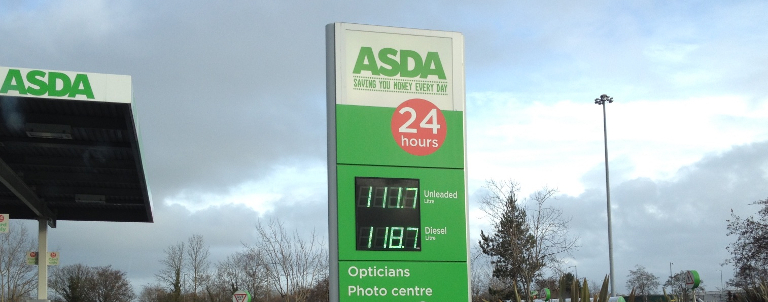
Supermarket giant ASDA cut the price of its fuel by 2 pence a litre last Thursday following the drop in wholesale prices, leaving other supermarkets to scramble to keep their prices competitive. The reduction will bring its price to a national cap of 111.7 pence per litre for unleaded. The cap will apply to all 305 of ASDA’s filling stations, including 10 in Northern Ireland.
ASDA leads the changes
The price of wholesale dropped to $48 a barrel last week, prompting the move by the supermarket chain. It is currently the only retailer that has a national price cap in place, which ensures no driver will pay more than the cap figure of 111.7 pence per litre at any filling station anywhere in the UK.
Dave Tyrer, Head of Petrol Trading at ASDA, said the move showed that ASDA was once again leading the market in terms of the price of fuel at the pumps and aimed to help millions of motorists around the country. The price cap applies to both unleaded and diesel and comes ahead of the busy summer period.
RAC fuel spokesman Simon Williams confirmed the move was excellent news for motorists. He added that it was particularly good to see a major supermarket reducing the cost of diesel so that it was in line with the cost of petrol. Currently, the wholesale price of both fuels is very similar.
Current trends
Of the four main supermarkets that offer fuel, this price change means that ASDA is currently the cheapest. Its price has fallen from 113.9 pence per litre in April to the new low of 111.7 pence per litre last week. Its nearest competitor is Morrisons, whose price was 112.2 pence per litre, while both Sainsbury’s and Tesco were selling unleaded at 112.7 pence per litre.
June 17th
Change (ppl)
June 20th
BP
118.5
1.5
117.4
Shell
118.1
1.5
117.2
Esso
117.3
1.5
116.3
Texaco
117.4
1.5
116.5
Gulf
117.9
1.5
117.5
ASDA
112.7
0.8
111.7
Sainsbury’s
113.8
1.1
112.7
Tesco
114.1
1.4
112.7
Morrisons
112.9
0.7
112.2
Source: PetrolPrices.com
The price gap between supermarkets and service stations remains considerable, especially in light of the drop in wholesale prices. Prices for unleaded at major service stations are on average 4 or 5 pence per litre more than at supermarkets.
This shows that currently, supermarkets offer great value for money for motorists and the added bonus of being able to fill up while shopping is attractive to many. Plus, you can also collect loyalty points with some of the supermarkets that can reduce your fuel and food bills even further.
Super unleaded trends
The picture remains different on the super unleaded pumps, with supermarkets ASDA and Morrisons currently not offering a version of this product. Both Sainsburys and Tesco do and their prices at this point were very similar, at 118.6 pence and 118.4 pence per litre respectively. As mentioned in last week’s article about super unleaded, there are now many places to buy it at the same price as, or cheaper than, unleaded.
Again, costs at service stations for super unleaded were higher than those at supermarkets which offer the product. Prices varied from 127.2 pence (Texaco) to 129.2 pence (BP) for motorists wanting to fill up with this fuel.
Positive trend
With the other supermarkets already saying they are following the lead set by ASDA and reducing their prices, this shows signs of a positive trend as we move into summer. Prices have been unchanged in recent weeks, despite the falling price of wholesale fuel. As we move into the busy summer period, it is good news that the supermarkets are lowering fuel prices to help motorists keep money in their pocket for other essentials. Supermarkets remain the go-to place for great prices on petrol and diesel.
What do you think about the recent price changes? Do you think we could be seeing sustained reductions in prices or is this a temporary fall before an increase? Let us know in the comments below.
Image credit: “Petrol prices” by morebyless is licensed under CC BY 2.0 / image manipulated to show pricing.
The UK’s first National Clean Air Day was on 15 June 2017. It came with some dire warnings about problems with pollution on our roads and the dangers to motorists and their passengers, as well as to children and cyclists.
According to research commissioned by the Global Action Plan (GAP) and the UK Health Alliance on Climate Change, drivers and their passengers are exposed to more pollution than pedestrians or cyclists. The research found that people in cars breathe in nine times as much pollution as those who are walking or cycling. However, a change of route can reduce this exposure by as much as 70%.
The report also warned parents that by driving children to school, they are increasing their exposure significantly compared to if they walked to school along the same route.
Pollution findings
The separate studies from GAP and the UK Health Alliance on Climate Change both found that children are more vulnerable to the effects of pollution due to one simple factor – their height. The risk to a child is 11% higher than to the average adult due to children’s lower height, because they are nearer the source of the pollution.
The studies looked at the problem of pollution, including air conditions inside and outside vehicles. The aim was to release them for the first National Clean Air Day and to help raise awareness of the dangerous levels of air pollution being experienced in parts of the country. The reports also hope to inspire people to push for change to improve the situation.
Finding solutions
One group of those questioned said that both the government and car manufacturers needed to do more to deal with the problem. But nearly two-thirds of the same group said they were willing to pay out from their own pockets to help deal with problem, with an average of around £2.50 a month being the figure they were willing to contribute. This would equate to £1 billion a year if a corresponding number of people in the general population were willing to contribute.
These two reports are among several additional studies being released with the aim of shocking people into action around the subject and to help find solutions. One from King’s College London discovered that the amount of pollution a person inhales while travelling inside a vehicle is significantly higher than if you were cycling the same route.
Today a “Pay as you Pollute” tracking technology was again highlighted in the media as the best way to manage the rising pollution problem, charging high polluters who drive around high risk zones such as schools. However, critics see it as a stealth tax on families and low income groups, who are most likely to drive higher polluting vehicles near high risk areas.
Mistaken assumptions
A poll of 2,000 adults found that 96% incorrectly thought they were inhaling less pollution as a driver or passenger in a vehicle than when they were walking or cycling. In the same poll, 43% said they thought that closing a car window made them safe from harmful emissions, even though harmful particles from emissions can be just as damaging inside a car as outside.
Face masks are another idea that people believe in, yet which seem to have little material benefit. Air quality scientists say that they have little effect at filtering out the microscopic particles that have such a huge effect on the heart. Heart-related problems account for around 72% of the UK’s 40,000 premature deaths from outdoor pollution, including strokes. The remaining 28% are from respiratory problems.
Can you limit the risk?
As part of National Clean Air Day, motorists are being asked to study their routes and to look at them from a pollution perspective. A new app has been launched covering London, Birmingham and Glasgow, to show which areas of the city are most polluted. It helps people avoid these areas, easing the problem and reducing the health risk.
As a driver, there are other ways you can limit risk. The first thing to do is ALWAYS switch on air con to circulate air inside the cabin of the car only. This cannot stop harmful fumes coming in, but it can reduce them by 20-30%. Keep the windows shut at all times while commuting and, if possible, limit journeys by car if other means of transport can be used instead.
What do you think about these results? Are you shocked that drivers and passengers are affected more by toxic fumes than cyclists and pedestrians? Will this be a wake up call for people to act? Let us know in the comments below.
The electric vehicle (EV) is finding real traction both in the UK and across the globe. However, a serious issue remains – the limited number of EV charging points. Is it possible that the humble street lamp could hold the answer?
The UK’s charging infrastructure is often citied as one of the biggest bottlenecks to mass electric vehicle adoption – it simply isn’t expansive or convenient enough for most EV drivers. Factor in differing socket types, reliability and availability and you have an issue that is in urgent need of addressing.
Figures show that electric cars past the two-million mark globally, with sales increasing by a massive 60% in 2016 alone thanks to new models and lower prices in showrooms. In the UK, plug-in car sales recently hit 100,000.
UK EVs are supported by a network of public charge points in more than 4,000 locations, according to vehicle-charging website zap-map.com. However, that’s not enough to keep up with expected demand over the coming years. Enter German company Ubitricity, which has come up with an ingenious solution to the problem – installing a socket that EV drivers can plug a bespoke charging cable into on the 7.5 million street lamps across the UK .
Put a socket on it
The process is simple enough – the local council pays the company to swap out a street lamp’s existing panel and retrofit it with a socket and cover. The process takes a mere 30 minutes before the street lamp is ready to be used. EV drivers then purchase the smart charging cable that connects their vehicle to the lamp post. The cable features technology that monitors and uploads all pertinent metering and billing information.
The cable costs £50 and can also be used on standard sockets, bypassing Ubitricity altogether if necessary. Subscribers should expect to pay roughly 15 pence per kilowatt hour and a 9 pence plug-in charge, plus a monthly fee for the service. The only concerns are the potential security issues, where someone could steal the cable when in use or simply remove it from the EV being charged and plug it into their own.
Despite such concerns, the technology has genuine appeal to councils. Installing a traditional public charging point is believed to cost around £6,000, while the lamp-based tech costs a mere £1,000. Better still, the council can get help covering installation costs by taking advantage of the £2.5 million on offer through the Office for Low Emissions Vehicles’ On-street Residential Chargepoint Scheme.
Dealing with pollution head-on
Perhaps most importantly, the street lamp technology is seen as a valid way to drive down pollution in cities. Peter Buckwell, Richmond Council Cabinet member for highways, commented in an interview with the International Business Times,
“Poor air quality is one of the biggest issues facing London. We need to do everything we can to cut vehicle emissions… I hope that as we continue to roll out more charging points, even more residents will start buying electric cars. They aren’t just good for the environment, they are also good for the pocket.”
Richmond isn’t alone; several London boroughs are already adopting the unique charging system. For instance, Hounslow Council has already installed 26 charge points in a trial and expects to have 75 charge points rolled out by the middle of 2019. Only time will tell how far the scheme eventually spreads across the UK, but with such a simple and cost effective solution, don’t be surprised to see the technology appear in a street lamp near you before too long.
Would you take the plunge and plug your EV into a street lamp? Or do you have concerns about the technology? Let us know your thoughts below.
The government is currently reviewing the results of its consultation on extending a new car’s need to have its first MOT from three years to four. For drivers’ wallets, it’s potentially good news, but many in the auto sector remain deeply concerned about the plan.
Representing the biggest change to the MOT for 50 years, the move would benefit 2.2 million drivers annually. They would no longer need to pay for the test in the third year of their vehicle ownership, thus saving themselves £109 million collectively per annum. The Department for Transport and Driver and Vehicle Standards Agency (DVSA) have stated that the change would see the UK’s MOT regulation being brought into line with other countries in Europe, such as France and Denmark.
Road safety at risk?
However, industry experts say that the change could wreak havoc on road safety. Research shows that around 17% of cars fail an MOT on their initial attempt, with technicians in 2016 identifying over 400,000 potentially fatal vehicle defects. These included 85,720 tyre-related failures, 47,138 brake failures and 24,628 suspension failures. By extending the period from three to four years, Euro Car Parts claims that 410,000 extra unsafe cars will be unleashed on our roads, including 28,573 extra unsafe tyres.
Critically, industry chiefs say that it’s thanks to the MOT deadline that drivers remain focused on their vehicle’s maintenance and upkeep, such as monitoring and replacing worn tyres. Indeed, research by TRL in 2011 revealed that motorists would fail to properly maintain their vehicles without the pressure of a looming MOT deadline.
Jobs under the hammer
Then there’s the impact the extension could have on the MOT sector itself. Some predict that Britain’s 22,000 garages, which carry out 29 million MOTs annually, would be hit hardest, driving down incomes and threatening jobs in the sector. Shaban Ali, founder of MOT and servicing app MyFutureMot.co.uk, told the Bristol Post,
“Whilst arguing that the move will save motorists £109m collectively, it can also be said that the industry is set to lose £1bn annually if the proposal goes forward. It’s no secret that the industry gets a large part of its revenue from repairs and not the MOT fees. The repairs industry has weathered many storms recently but this change could be the straw that breaks the camel’s back.”
Drivers beware
An industry that is set to lose so much might be expected to challenge the MOT move. However, drivers aren’t as keen on the move as might be anticipated either. According to an AA survey of 19,000 members, only 44% of motorists were in favour of the change, while 26% were set against it. The rest remained undecided.
The MOT itself came into existence in 1960, with the three-year check introduced in 1967. Some argue that this length of time means an overhaul of the test is long overdue, because cars are now more reliable and have better safety features. Perhaps the real question, though, is whether driver attitudes towards maintenance have changed for the better or worse over the years. Maybe it’s this area that the government’s review of the consultation should focus on next, before taking a final decision on the MOT change in 2018.
What do you think of the proposed change to the MOT? Is it a much needed reconfiguring of a dated, 50-year-old rule or a move that will put motorists’ lives in danger? Let us know your views below.
The latest Financial Ombudsman’s Annual Report shows that car finance loans have become the third most complained about matter. Following payday loans and PPI, car finance complaints have increased by a staggering 64% in the last year, leading experts to admit that this could be the next mis-selling scandal.
What are personal contract purchases?
A personal contract purchase (PCP) is a type of car loan offered by forecourt salesmen working on commission. It involves minimal credit checks in order to ensure people that can afford it. PCP loans often allow people to drive away in a new car despite paying a deposit as low as a few hundred pounds.
Loans are sometimes offered that are worth more than the individual’s salary and hire car agreements now account for 90% of car sales across the UK. Watchdogs are set to probe these ‘irresponsible’ loans, as there are concerns that salesmen aren’t using an affordability test to ensure that people can afford the loans.
Increasing complaints
The concerns are highlighted by the 64% increase in complaints to the Financial Ombudsman about such loans. The increase comes as figures show that the UK spent over £3.5 billion on car loan deals in March alone, an increase of 13% on the same period last year.
Complaints about hire purchase policies rose to 5,029 complaints in 2016-17, the majority of which were concerning car purchases. This is an increase from 3,072 in the previous year’s report, according to the FOS. And looking back two years, the increase is even higher, 73% from a figure of just 1,784.
Complaints about this type of finance were the third most complained about topic after payday loans and PPI. Payday loans received 10,529 complaints in the year, another large increase from 3,216 the previous year. Nearly 60% of the claims were upheld by the Ombudsman in favour of the individual.
Payday loan lenders have seen an increase in rules applying to their practices in recent years, including limits on how many times they can ‘roll over’ a loan and how much interest they can charge. These rules have aimed to stop spiralling debt.
In total, the Financial Ombudsman received 25,984 complaints in 2016-17, an increase from 13,713 on the previous period. Complaints were on a wide range of topics including catalogue shopping, credit reference agencies and guarantor and logbook loans (where another person or a vehicle is used as security).
Regulation inspection
The Financial Conduct Authority (FCA) has recently said that it plans to look into the high-cost credit sector, including overdrafts and high-cost products. Its measures have already placed a price cap on the payday loan sector, which came into force in January 2015 and will be reviewed this year.
The FCA next plans to look at high-cost products to see if they are being used correctly or if they are detrimental to the customer. Overdrafts in particular can have poor price transparency and charging levels, particularly un-arranged overdrafts.
As more people complain about car loans, there is little doubt that the FCA will expand its investigation to encompass this area. What it will find and how it will approach the matter will have a big impact on how people acquire car financing in the future.
We would like to know our readers’ thoughts on car finance loans, so please add your comments below.
The European Union has ambitious plans to take charge of road safety rules and make them uniform across the whole of Europe’s 28 countries. The rules cover speed limits, new technology and road safety measures, with the aim of protecting the most vulnerable road users (such as pedestrians and cyclists). They aim to halve road traffic fatalities by 2030 and halve the cost of accidents by €50 billion a year.
The plans were drawn up with the transport ministers of all 28 member states, including Chris Grayling, the Transport Minister for the UK Government, in Malta earlier this year, at the Valletta Declaration for Road Safety. (Download the plan here)
Last week, the EU endorsed the plans as its road safety strategy for the next 15 years. The move was hailed by road safety organisations as “an important step forward in protecting against needless lives lost on Europe’s roads,” according to a spokesperson for road safety charity Brake.
Key target to halve road-related deaths
The key target – to halve road-related fatalities by 2030 – is ambitious but achievable. There were 26,100 road-related deaths across the EU in 2015, costing €50 billion a year (increasing to €100 billion when serious accidents are included as well).
Pedestrians and cyclists are to be incorporated into the EU’s mobility plans, with promises to include more “dedicated infrastructure” for these groups, including segregated paths and lanes. Considering recent terrorist events, and how vulnerable cyclists and pedestrians are to the impact of vehicles being used as weapons, this is a logical step, which road safety campaigners will welcome.
The EU also plans to roll out a series of low speed limit zones across the EU, setting a new, standard 30 kph (20 mph) speed limit. Quite when and where the UK will roll out these designated zones is not known. As far as we know, it will be the first time the EU has dictated speed limit restrictions in the UK and is probably the beginning of EU speed limit harmonisation occurring in the future.
Safety technology as standard in all vehicles
One of the most interesting aspects of the declaration is that all 28 member countries have agreed on legislation where new safety technology must be fitted in all new vehicles across the EU. The move is similar to the Euro NCAP standards already in place for seat belts and crash testing.
It is not clear what the timetable is for this new technology, but the underlying objective is clearly focused on saving lives and reducing the chance of high-speed accidents.
The eCall system, for example, allows a car to transmit an “SOS” signal autonomously to the emergency services, cutting response times and saving lives more quickly. Intelligent Speed Assistance is a technology installed in cars that tells the driver when they have reached the speed limit of the road they are on. It also changes dynamically based on when the car moves into a different speed limit, automatically slowing the vehicle down.
Automated Emergency Braking Systems is the most topical system. Some vehicles (such as trucks) already have this technology and it saved lives in the recent terrorist attack in France. The truck used in the Nice terror attack applied a handbrake automatically that could not be overridden after the first major impact.
Interestingly, although the declaration mentioned mobile phone use as a leading cause of road accidents, it did not mention mobile blocking technology. This is perhaps because the major mobile handset and operating system providers are keen to self-regulate rather than allow the EU to impose rules on them.
Do you welcome the EU’s road safety strategy? Are you happy that the EU will determine speed limits, the use of safety technology in cars and road infrastructure decisions in the UK? Let us know in the comments below.
Earlier this week, several customers who filled their cars up with unleaded fuel at a BP garage on the East Lancashire Road in Liverpool claimed that their fuel tanks had been contaminated with water. All three drivers affected saw their cars break down less than a mile away from the forecourt.
Not only did this impact the drivers financially, as they could not go to work, it also hit them in the wallet with the cost of breakdown recovery and repair. One driver took their nearly new car to Vauxhall and was shocked to discover that fixing the car due to contaminated fuel was not covered by its new car warranty.
Not covered under warranty or car insurance
The £300 bill from Vauxhall to drain the fuel tank and replace the fuel lines was not covered by the driver’s car insurance either. Insurers regard this as being the fault of the driver, along the same lines as putting diesel into an unleaded vehicle. The Liverpool Echo reported that the garage has provided refunds, but this claim has not been confirmed by the affected drivers.
The garage itself has apologised for causing the issues but has not specifically explained why water was mixed in with the unleaded fuel reservoir . All other forms of fuel sold at the station were unaffected.
While this could be regarded as an isolated incident, a similar issue occurred at two fuel stations using the brand name Clean Energy on Merseyside in March earlier this year. Several drivers were affected and in one instance a BMW driver was unable to claim insurance for a repair bill totalling £1,400 (for draining the fuel tank and replacing the entire fuel system in the engine).
Contaminated fuel: trend or isolated incident?
One of the mechanics who repaired an affected car took a picture to illustrate what was in the fuel tank (see image) and posted it on Facebook. He was then inundated with comments from other drivers also affected by water-diluted petrol. This made us think at PetrolPrices – are we seeing a new trend here or is this isolated to Merseyside?
Liverpool City Council confirmed that Citizens Advice was dealing with six complaints in relation to contaminated fuel in that month alone, so there does appear to be something happening here. It is unclear whether mixing water with petrol is legal and whether there is any form of legal redress to get compensation back from any garages that do this, especially if it is not covered by warranty or insurance.
Can you protect against contaminated fuel?
Worryingly, there is no way to tell if the pump you are using is contaminated by water. The only way to guard against it is by checking out Facebook or local media sources to ensure that you are aware of stations that have been cited as having contaminated fuel locally and steering well clear of them.
If you are affected by contaminated fuel in your car, it seems that the only way to get financially compensated is to raise it with the local Citizens Advice Bureau and seek compensation from the garage you think has provided the contaminated fuel. They are not obligated to provide a refund but given the impact this could have on their sales, one would expect they would see reason and pay to keep their reputation intact.
Have you been affected by fuel being diluted with water? Is this a new form of scam or just an honest mistake by the garages in question? Are you happy that this is not covered under vehicle warranty or that you cannot claim on your insurance for it? Let us know in the comments below.
A recent survey by black cab taxi app mytaxi has found that London drivers are more reliant on sat navs than drivers anywhere else in the UK. The survey estimates that London drivers waste on average 62 hours a year blindly following sat nav instructions into traffic jams and black-spots, with these “zombie drivers” further exacerbating traffic congestion on the roads.
The mytaxi survey found that a massive 88% of drivers in London use sat navs all the time, versus 76% for the national average. Further to this, one in five Londoners say they cannot find their way home in London without a sat nav. Meanwhile, a whopping 65% confess they would not be able to cope without a sat nav in an unfamiliar location outside of London.
Ignoring road conditions
Most worryingly of all, 62% say that they pay no regard at all to road signs, famous landmarks or even temporary lights and road signs, such as diversion signals if a road is closed, when following the sat nav in the car. This zombification has led to drivers blindly driving into dead ends, going the long way if re-routed by the sat nav or getting stuck in unnecessary traffic congestion because a sat nav fails to choose the quickest route, wasting up to 100 hours a year per driver.
The survey also found that 39% of all sat nav routes fail to reach the exact destination, while only 13% of the routes selected by sat navs were the quickest to the destination. In a sly dig at Uber drivers and other sat nav-reliant minicab services, mytaxi General Manager, UK, Andy Jones, comments:
“Sat nav technology is undoubtedly a huge help to many people but it is certainly not flawless and the results can be both frustrating and comical, as evidenced by the huge number of misadventures we have recorded.”
“We are proud to say that all mytaxi drivers have spent three years studying for The Knowledge memorising over 25,000 streets and 20,000 landmarks. There really is no substitute to real local knowledge when it comes to navigating through traffic and finding the quickest routes to a destination.”
How to tackle being a “zombie driver”
The obvious way to tackle being a zombie driver is to switch the sat nav off and try to navigate using road signs and maps, especially on common routes that you undertake. There is no substitute for knowing the back routes personally, as this can enable you get around the jams at peak times.
Some drivers have sat nav on by default because they think it will find a faster route if there is traffic congestion on the current route. However, although sat navs such as Google Maps often proclaim there is a “faster route available,” this is not always correct. That’s because these sat navs don’t analyse the current congestion level on the alternative route at the same time – at best they predict it based on historic traffic levels at that day and time, so it’s not a true, real time comparison between routes.
Another way to tackle your zombie driver status is to use an app like Waze. Waze is a community of drivers who aim to help other drivers to avoid traffic jams in real time. Much of the data you see in Waze does appear in Google Maps, but you can’t replace the feeling of Waze and the sense of finding a new route for the community of other drivers out there.
Are you a “zombie driver” and do you agree that sat navs take you into traffic jams rather than help you avoid them? Do you think you are over reliant on your sat nav – would you be able to cope with road signs and maps? Let us know in the comments below.
Historically, premium fuels such as super unleaded have kept a respectable distance of at least 5 pence a litre away from unleaded. In some cases, the difference has been as much as 15 pence per litre.
Recent data from PetrolPrices.com indicates that some supermarket brands are now bucking this trend and offering super unleaded at only a few pence more than the cheapest unleaded stations in the area. Indeed, if you are smart about where you buy, you can now get super unleaded fuel “cheaper” than unleaded fuel in some parts of the UK.
For example, as of Monday this week, the cheapest super unleaded station in the UK is a Sainsbury’s station in Tamworth, recorded at 114.7 pence per litre. That’s 1.7 pence per litre cheaper than the national average price for unleaded, which stands at 116.4 pence per litre.
The news will delight premium fuel converts and those who drive high-performance vehicles that need fuels on a higher-octane rating to ensure peak performance and protect the engine against unnecessary wear and tear.
The charts below illustrate that over the last few months, Tesco and Sainsbury’s appear to be selling super unleaded at very competitive prices, close to the average price for unleaded from main petrol retailers. PetrolPrices.com believes this is a conscious tactic by the supermarkets to try to lure the most profitable customers into buying at the supermarkets.
Petrol retailer v supermarkets average prices April – May- June
Unleaded
April (p)
Change (p)
May (p)
Change (p)
June (p)
BP
120.4
1.6
118.8
1.5
118.5
Shell
120.1
1.6
118.5
1.5
118.1
Esso
119.3
1.7
117.6
1.5
117.3
Texaco
119.4
1.8
117.6
1.5
117.4
Gulf
119.7
1.5
118.2
1.5
117.9
ASDA
113.9
1.3
112.6
-0.1
112.7
Sainsburys
115.6
1.5
114.1
0.3
113.8
Tesco
115.4
1.1
114.3
0.2
114.1
Morrisons
114.5
1.7
112.8
-0.1
112.9
Super unleaded
April (p)
Change (p)
May (p)
Change (p)
June (p)
BP
132.1
1.5
130.6
0.1
130.5
Shell
130.7
1.8
128.9
0
128.9
Esso
131.2
1.4
129.8
0.3
129.5
Texaco
129.4
1.5
127.9
-0.4
128.3
Gulf
131.8
1.2
130.6
1.2
129.4
ASDA
N/A
0
N/A
0
N/A
Sainsburys
120.7
1.6
119.1
0
119.1
Tesco
120.6
1.2
119.4
0.3
119.1
Morrisons
N/A
0
N/A
0
N/A
A famous rule of buying psychology is that if someone buys from the same place more than three times, it becomes habit forming and generates loyalty. In this instance, it seems that the Tesco and Sainsbury’s are trying to not only create habits for premium fuel users to switch away from the main retailers, they are also trying to convert existing unleaded fuel users to “trade up” with very little change in cost (it works out at roughly £1-2 extra per fill up).
Benefits of premium fuels
Premium fuels are refined to be at a higher octane rating than standard fuels, which burn more in the engine, thus creating more power and improved fuel efficiency. They also contain additives that not only clean the engine and make it perform better, but also protect against wear and tear inside the engine itself.
It is a widely accepted practice that every month you should “treat your car” to a tank of premium fuel, as this is will improve the performance and long-term health of the car. It seems that this is now more cost effective than ever, given the recent price changes led by Tesco and Sainsbury’s.
How and where to find price anomalies
Using our fuel price comparison tool is, of course, the best way to find these price anomalies. They appear all over the UK. The best way to check is to try to price search between home and the workplace, or regular weekly trip locations. You should notice a marked difference in pricing between affluent areas with fewer stations and locations where there is more local competition, especially high concentrations of supermarkets clustered together.
To give you an example, in Guildford the cheapest unleaded price is at Sainsbury’s Burpham, at 115.9 pence per litre. Six miles away in Aldershot, Tesco is selling super unleaded at 117.9 pence per litre. That’s 2 pence per litre difference, equivalent to a £1 increase in cost for a vastly superior fuel if filling a standard 55-litre fuel tank.
Can you get super unleaded cheaper than unleaded?
As mentioned earlier, in some parts of the UK the cost of super unleaded is lower than the UK average for unleaded fuel. Thus, if you’re driving on a long journey, you can take advantage of the lower costs versus what you pay locally.
You can also use vouchers and/or gift cards when you purchase super unleaded to get it at a cheaper price than unleaded.
Both Tesco and Sainsbury’s provide money off fuel vouchers. You can receive these when you spend a certain amount of money in-store, or earn Clubcard points on fuel to get a discount that is sent in vouchers three months later. When you enter the store, it’s also worth visiting the customer service desk and asking if there are any fuel promotions running. For example, at Christmas, Morrison’s was offering 10 pence a litre discount on fuel if you spent £50 in store, so it’s well worth asking.
Have you found somewhere where the price of super unleaded is close to or cheaper than unleaded? Do you think petrol retailers try to confuse us with their pricing? Let us know in the comments below.
The Ifbattery is set to revolutionise charging times for Electric Vehicles, meaning that owning one could actually be practical for all the demographics, not just the handful that want to do the right thing.
Transportation for the masses is changing, Electric Vehicles (EV’s), Hybrids, BEV’s and PHEV’s are a serious part of many manufacturers plans for the future, but right now, they are flawed.
Battery prices, limited range and lengthy charge times are just three of the problems that manufacturers currently face, but technology developed by a team at Purdue University in the U.S. is about to change at least one of those; charge times for the battery could be reduced to the same length of time as it takes to fill up a regular tank.
Minutes not Hours
Plug-in vehicles currently account for around 0.10% of worldwide car sales, and whilst the likes of Tesla are pushing the technological boundaries, reducing costs and developing products that you’d actually want to own because it’s a great product, that figure is surely set to rise.
The first generation of plugins would see you being able to run your daily commute and back before needing to find a power-source to plug-in to, and once you’d found that source, you’d be there a while – an hour’s charge for ten miles wasn’t unheard of.
As with all technology, once it’s adopted, people start pushing development and improving the whole experience, in the case of electric vehicles, this has brought prices down, extended the driving range and to some extent, reduced charging times – the Tesla Supercharger station can give a 100% charge in just forty minutes.
IF-Battery
The fact remains that charging times for these vehicles means that a plan is still required if you’re looking to travel any distance – you can’t just hop out and fill up before continuing with your journey, you’ll need to think about where you’re stopping and for how long; a coffee? Lunch? Dinner … Overnight?
Welcome to the world of modern battery technology – the Ifbattery.
The Ifbattery is what’s known as a ‘flow’ battery, as with many great or revolutionary inventions, the idea behind it sounds quite simple; the battery uses fluid electrolytes to re-energise the spent battery fluid – you drain the spent fluid and replace with new.
It’s hoped that the existing petrol station infrastructure (tanks, pipes, pumps etc) could be used to store, remove and fill the batteries, meaning that a changeover to this new tech could be relatively simple and low-cost.
Click below to watch more on the technology.
As a Consumer
At the moment, this new technology isn’t going to improve matters directly, although with research teams working hard to improve the situation, you know that these developments are in the pipeline (excuse the pun!).
There will come a day when electric vehicles are able to compete on price, range and practicality with traditionally fossil-fuelled vehicles, but that day isn’t quite here yet. If you’re looking to switch fuels for your vehicle, you’re going to need to wait for another few years before this type of technology is widely available.
In the meantime, prices for electric vehicles (and the associated hybrids) are becoming more affordable, they are just beginning to compete with the regular cars, if you can live with the extended charge times, they could well be worth looking at as an alternative mode of transport.
Is electric power something you’d consider instead of fossil fuels? What would make your decision easier? Let us know in the comments section below.