
Fuel can typically be purchased on a Spot or Contracted basis.
Spot purchases are most affected by sudden price changes and supply disruption. Suppliers publish their prices daily for retailers to either accept or reject or price on the live market. Some retailers may have multiple supply options so can shop around.
Contract purchases can take different forms, but they will be linked to a global benchmarks. The main data provider is S&P Global Platts and so these contracts are often referred to as ‘Platts plus’ contracts. Platts publish a daily price and fuel distributers will add their agreed premium (delivery, profit etc) to this, to form a contracted price. This is a daily contracted price and most commonly takes affect two days after, where Mondays close if effective for deliveries on Wednesday.
Another common method is a ‘weekly lagged’ price where the closing prices for a week are averaged and then used to price the following weeks deliveries. So, the closing values from Monday to Friday week 1 are used to price deliveries in week 2.
Then there are less common 2-week lags, 3-week lags, monthly lagged, current week, current month, and more.
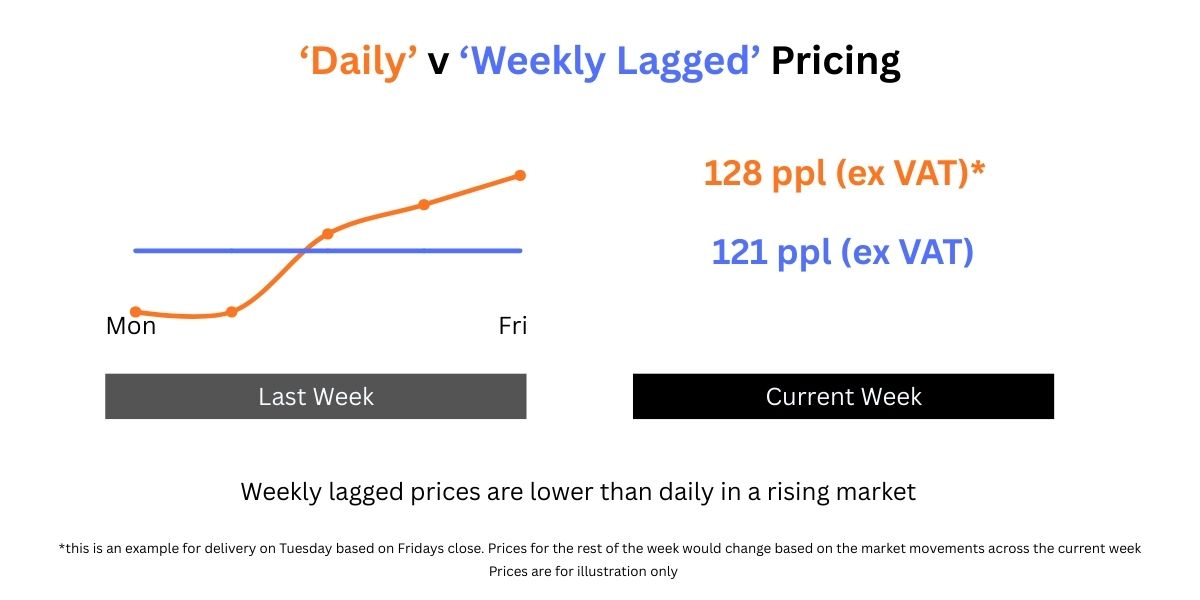
It’s up to the fuel supplier and the station operator to agree the pricing mechanism. In short a daily based price is better in a falling market and a weekly lagged (or 2 weekly lagged) is better in a rising market.
Retailers may even split how they purchase with different volumes on different pricing mechanisms in different areas. Having optionality on contracts can sometimes help retailers be more competitive.
Contracts will usually be volume based and so even if a retailer has a contract in place if demand spikes, they may need to purchase outside of their contract on a spot basis.
In a competitive environment having different contracts and purchasing patterns can ultimately help the consumer. However, in a rising market such as what we have seen it can lead to wider pricing spreads and margins creep up. As stations purchase on higher spot prices they have little to no option to increase prices and may even take a hit on margin to remain somewhat competitive. This reduces competition for stations on weekly lagged or longer deals allowing them to either hold prices or increase for additional margin.
But surely a leased site (from a major oil company) have no choice.
Hey Howard, it entirely depends on the site. For example, Shell and bp are the only major oil company who still own and operate some sites – some being the big word because the vast majority are independent business on which bp and Shell just supply the fuel. Esso, Texaco and Valero no longer own any petrol stations in the UK and are merely the supplying brand.
Why is there a price difference between petroleum stations of the same company eg: Asda in Stafford and Asda in Cannock 9 miles away?
A combination of ‘because they can’, and the degree of local competition. The latter usually forces the prices down, unless there is in effect a local cartel/informal agreement to keep the prices up.
Hi Andrew, thanks for your comments. It is very difficult to get site of a fuel stations individual cost prices – what we do know, is how some of them buy fuel. Some stations are priced by their supplier on the average day of wholesale fuel (plus suppliers margin) from the day before. If the wholesale price of fuel goes up 10ppl or more overnight (which has been happening) then your cost price has gone up over 10ppl or more. You can read a bit more about how fuel is bought and priced here: https://www.petrolprices.com/news/how-do-petrol-stations-purchase-fuel/
The real gripe we think, is that over 50% of the pence per litre is a tax, and if the UK Gov wanted to support motorists they’d review Fuel Duty and the VAT rate.
Good question! Probably one to ask Asda’s PR department but it can vary on competitors in the area. If An Asda in one location is competing with another supermarket that may change how they price if they’re up against a company owned Shell site.
I remember when Asda used to be cheaper than every other garage. Unfortunately the ISA brothers bought into Asda and took the onsite garages too. This made them the one of the biggest outlets as they added their other 200 plus sites to their portfolio. This is turn gives them the monopoly to dictate the higher prices.
It seems to be that my local garage has said that is due a delivery next week has already put up prices on unleaded by 7pence a litre.
Exactly – they put the price up on petrol they’ve already bought and paid for.