
Electric cars to be issued with a noise at low speeds to prevent accidents

Pedestrians who are elderly or young, visually impaired, deaf or use headphones while walking are at risk of being hit by electric and hybrid cars due to how quiet they are at low speeds. This is resulting in calls for them to be issued with noise generating technology that will alert pedestrians who may not otherwise notice them coming.

Although the EU is introducing rules which state that these cars must be fitted with low-speed alerting sounders, will it be too little too late with the Government’s push to get more of these environmentally friendly, but silent, vehicles on the UK’s roads?

Electric vehicles are ‘Silent Killers’

The biggest call for electric and hybrid cars to be issued with technology that creates a sound comes from road safety group SteerSafe who have branded these vehicles as ‘Silent Killers’ because vulnerable people cannot hear them approaching which puts them at risk of being hit.

This includes the elderly, the blind, children, the deaf, headphone wearers, and those who are preoccupied or unwary and unable to take in what is happening around them.

SteerSafe is headed up by founder Christopher Hanson-Abbott OBE who gained his OBE for services to safety in transport when he made the first reversing alarm for large vehicles 40 years ago. He has stated that he would like ministers to set an example to the rest of Europe by being the first country within this continent to make noise emitting technology on quiet cars compulsory.

Over in the United States, they are already ensuring that all new hybrid and electric cars make noise at low speeds to help to keep pedestrians safe.

Although the EU will be making it mandatory for car manufacturers to fit these devices to new cars from 2019, with all electric and hybrid cars already on the roads being required to have a sounder retrofitted by 2021, SteerSafe feel that this is not good enough as these ‘Silent Killers’ are already causing a risk on the roads.

British engineers have been working on creating a sounder for quiet vehicles for over five years, with most designs being speakers which are fixed to the car and work in the direction that it is travelling so that the noise doesn’t annoy those who are not in the vehicle’s path.

A variety of sounds have been tested, including the whine of an old electric motor, the rumble of a petrol or diesel engine, and computerised squawks, and the sound would be emitted when the vehicle was travelling at 19mph or slower when there is little or no noise from the wheels on the road

The rise of electric cars

Due to the Government investing hundreds of millions of pounds in trying to increase the number of environmentally friendly vehicles on the UK’s roads, and offering tax breaks to those who drive one, there was a 40% rise in registrations of these cars last year and 45,400 new cars sold on the road by the end of 2017.

It is also expected that these figures will rise due to the fact that no new petrol or diesel cars will be sold after 2040. In addition to this, leaked details of the Government’s ‘Road to Zero’ policy make it sound like any vehicle that can’t travel 50 miles on electric alone will also be banned from sale, and this includes all of the hybrid and plug-in hybrid vehicles that are currently on the market.

Although many people are in favour of driving a vehicle which does not damage the environment, it is vital that the issue of how they put vulnerable people at risk is taken seriously as the amount of accidents is simply rising with the number of these cars that are being driven.

Accidents caused by quiet cars

In research carried out by the charity, Guide Dogs for the Blind in 2015 they found that people are 40% more likely to be hit by a car that makes little or no sound in comparison to a petrol or diesel model and that there was a 54% increase in incidents with quiet cars between 2012 and 2013.

The National Highway Traffic Safety Administration also back this up with their statistic that 2,400 pedestrians are injured every year by quiet cars, and that issuing sounders would put a stop to this high number of incidences.

Guide Dogs manager James White has pointed out that they are totally in favour of increasing the number of eco-friendly cars on the roads, but that more has to be done in order to make them safer.
Since electric cars are so quiet at low speeds, the only thing to suggest is as a pedestrian is to become hyper-aware at road junctions and crossings. Look in all directions when crossing and of course, make sure that you abide by the road traffic regulations and cross when the road signs are green in colour.

Are you concerned about the risks caused by quiet electric and hybrid vehicles? What noise do you think would be the most effective at alerting pedestrians about the vehicle’s presence? Let us know in the comments below.
£99 authorisation charge shocks drivers at the pumps

A new form of charge has been noticed by customers at some petrol stations across the country when they try to fill up by paying directly at the pump instead of inside the store. Customers reported having a £99 authorisation charge taken from their accounts by Asda on top of the filling up cost itself.

A large sum

Jade from Yorkshire bought £5 worth of petrol from Asda, only to discover that £99 had also been removed from her account. This charge is a new authorisation charge that is being trialled at a few stations in the North of England. While the money was later refunded to her, she was £99 short for 2-3 days.

Asda are placing this problem on the shoulders of Mastercard/Visa as they say that it is now industry standard. However, Asda didn’t inform anyone that this would happen and have covertly released the charge at three stations first and are looking to roll it out nationwide.

The rules behind it

Mastercard/Visa recently introduced a new pre-authorisation charge on all pay at pump transactions to ensure that a person has enough in their account to be able to afford the fill-up. The pre-authorisation charge is ring-fenced by the bank, rather than Asda, and is held until you have finished filling up. After you have finished filling it should be released although in this situation it took a few days for the funds to return.

Visa released a statement about the pre-authorisation charge here:

“The way that pay-at-pump fuel payments are treated has been standardised across the industry to ensure security for individual cardholders, retailers and card issuers.

“When an individual chooses to pay at a pay-at-pump fuel dispenser, an initial amount is held against their account while they dispense their fuel to ensure that they have sufficient funds to pay for the cost of their fuel. This initial amount should be adjusted immediately after fuel is dispensed to reflect the actual cost of the fuel.

“Visa has been working closely with card issuing banks to ensure that consumers do not experience delays in the adjustment of the initially-held amount, however if consumers notice that initial amounts held against their accounts are not adjusted immediately, they should raise this with their card issuing bank in the first instance.”

What other companies are doing

While Asda is the only one currently running this scheme, other retailers are aware of the changes, but have not implemented it yet.

A spokesperson for Sainsbury’s said “We are aware Visa and Mastercard are rolling out an industry wide update for pay at pump machines. We are currently reviewing the update before any introduction at our petrol filling stations.”

BPme, the filling up app from BP, has a £100 pre-authorisation charge if you select full tank, otherwise it will pre-authorise the amount you select from within the app. This has been in place since they launched the app.

A Morrisons spokeswoman said: “At Morrisons Petrol Stations, the amount taken out of customers bank accounts should be the same as the amount they pay at the pump.”

Shell said that this wouldn’t affect customers when we asked, although their app terms and conditions state that “pre-authorisation happens with PayPal or your nominated financial institution (whichever is applicable) of the amount of money equal to the value of the offer…If the offer is rejected; cancelled by you or the site cashier; or automatically cancelled in the case of inactivity, the amount pre-authorised may be unavailable for use until the pre-authorisation has expired. Expiry times for pre-authorisation amounts can vary between financial institutions… You can dispense a maximum amount of fuel with a value equal to the pre-authorised amount of money and you will only be charged after the fuel has been dispensed.”

In a bid to stop people from buying petrol who don’t have the money, some banks have gone a step further to protect them. Basic bank account holders who don’t have overdrafts are struggling so Santander has blocked anyone with a basic debit card from using pay at the pump. Other banks such as Halifax and Lloyds have elected to block basic cardholders from using pumps that have not been updated to meet the new requirements. As not many forecourts have introduced the new £99 authorisation checks, this will no doubt affect a lot of people.

Can you get around this?

The simplest way is to avoid using pay at pump, while in some situations this may be impossible, there is often an alternative manned station in any part of the country.

However for some people pay at pump is the only option since Asda is usually the cheapest in an area and many of their sites are unmanned. There is nothing you can do to avoid the situation, but make sure that when you do fill up at a station that you have enough money in your account to cover the maximum amount it would cost you to fill up, which is £99.

While the amount ring fenced should be released straight after filling up and then the correct payment for fuel is taken, it can take between 2-5 working days for some banks to release the authorisation fee back to your account. Although we can understand why Visa/Mastercard are imposing this rule to ensure people can pay for what they fill up with, it is simply not acceptable that banks are holding onto authorisation funds and are not releasing it back the very same day.

PetrolPrices will keep monitoring the situation and report on further developments on this story as they emerge.

UPDATE Asda are withdrawing the trial until all banks can comply. An Asda spokesperson told MoneySavingExpert: “We always want to do the right thing for our customers, which is why we have made the decision to suspend Visa and Mastercard’s pre-authorisation transaction trial.

“The intention of Visa and MasterCard in this trial was to ensure customers had sufficient funds in their account to pay for their fuel, and the £99 would be immediately released back to customers by their bank.

“Whilst we have received very few complaints about this process until we can be given assurance that all banks are able to comply with the Visa and Mastercard rule change, we cannot continue to implement this change and risk harming our customers’ trust in us.”

Has this ever affected you? Would having a £99 charge affect you? Let us know in the comments below.

Rising oil prices lead to more pain at the pump

April was a varied month regarding the price of petrol and diesel, and experts are already predicting that May could see more changes ahead. The possible merger of Asda and Sainsbury’s supermarkets could play a part in price changes for May as the combined supermarket group would automatically become the largest petrol retailer by volume of fuel sold, so would also have an immense influence on the cost of fuel in Britain.

Average prices in April

The average price for unleaded in April rose from 119.8 pence per litre in March to 121.4 pence per litre in April. The rise in diesel was less significant, increasing from 122.6 pence per litre in March to 124.1 pence per litre in April. For unleaded drivers, the increase came at both ends of the month – the first week saw it creep up to 121p then again in the third week, by another 2p on the average price. Diesel drivers saw a steady growth throughout the month, increasing by 1p each week.

The reason for these increases was the price of Brent Crude oil, which saw steady growth during the month. On the 2nd of April, the price was $67.64 a barrel and rose to $68,65 on the 9th and again to $71.42 on the 16th. It saw another increase jumping to $74.01 on the 23rd but dropped back down by the end of the month, finishing on $73.12.

Following the trend

In the middle of the month, experts were already predicting that the price at the pump would increase, which it did for both petrol and diesel. They predicted around 3p a litre for both which proved to be an accurate assessment – both ended the month approximately 3p a litre higher than they began.

The price in the middle of the month for crude oil reached the highest figure since November 2014 when it jumped to $75.20 a barrel. It came at the end of a six-day rally where prices kept rising and saw an increase of more than 20% since prices initially dropped in February.

Finally, at the end of the month, the price fell a little despite supply concerns regarding the US imposing sanctions on Iran. It led to the price ending the month slightly lower than in the third week although prices at the pump continued to rise right to the end.

What caused the rise?

The cost of Brent Crude oil can be influenced by any number of factors around the world. In the middle of the month, there was a dramatic spike in the price that was connected to the ongoing crisis in Syria and the chemical weapons attack. It caused concerns that there would be a war between the West and Russia in Syria and the price of oil rose accordingly. This rise in oil price has a direct impact, but there is usually a delay of a few weeks between the oil price and the effect of this on the pump price.

Experts are also saying that the price of crude oil could continue to rise into May. April saw a slight drop in the price at the end of the month, but Reuters is predicting that the average price for the whole year will soon be above $67 a barrel. Reuters claims that strong compliance with OPEC-led product cuts and supply disruptions have been big factors in causing this price rise.

However, America may continue to disrupt global oil markets by ignoring OPEC and increasing oil production and supplies as part of their aggressive trade war threats they are currently undertaking with China and the EU.

The month of May will see US president, Donald Trump, decide on the deal with Iran which has been featured a lot in the news. It could even have an impact on the price we pay for fuel. Experts say that if the president pulls out of the deal and sanctions are re-imposed, the cost of oil could rise by $2-3 a barrel. Some are talking about a worst-case scenario of oil passing the $80 a barrel mark.

Closer to home – supermarket merge

Another big story this week that could affect our future fuel prices is the proposed merger between supermarket giants Asda and Sainsbury’s. The deal is still in the early stages, and the Competition and Markets Authority will look at the merger from many perspectives.

For UK drivers, one of the leading concerns is the lack of competition. Supermarkets usually top the list for the cheapest places to buy fuel, and the merger could see the new company have 600 forecourts across the UK. Currently, Asda has a price promise where they will always be the cheapest fuel station within three miles – but Sainsbury’s have no such guarantee.

So, will the merger see Sainsbury’s adopt this policy? Or will it see Asda abandon it? Retail experts say that the new merger company should have lower supply chain costs so, therefore, the price of everything from a litre of fuel to a carton of milk should go down. But, will this be the reality as the new company wants to maximise profits?

Other concerns will be around the fuels offered. Will both forecourts provide the same products or will they remain with their own branded fuels? Will the quality of products change? The deal is one that has a lot of questions that need to be answered before UK drivers can feel comfortable about it.

Did you notice your fuel bill increasing in April? And do you regularly use Asda or Sainsbury’s for your fuel and do you think the merger is going to mean cheaper fuel prices? Let us know in the comments

Breakthrough diesel technology promises to end the ‘demonisation of diesel’

Diesel fuel has been firmly in the crosshairs of the government and environmental campaigners for a number of years now, and December 2017 saw a record fall in sales for new diesel cars – down 31% from the previous December.

The reason why diesel, in particular, is being targeted is down to emissions; the combustion process produces Nitrogen Oxides (NOx), which include Nitrogen Dioxide, Nitrous Oxide and Nitric Oxide. Studies have shown that long-term exposure to some of these will significantly increase the risk of respiratory problems, and Particulate Matter (from diesel) has been shown to cause cancer.

Here in the UK, there were 11,940 premature deaths attributed to nitrogen oxide last year, and a further study put Oxford Street, London as the second highest level of nitrogen oxide pollution in Europe.

Test Bed Driving

Manufacturers have to prove their product emissions through the use of a test bed – an engine dynamometer or rolling road, which in theory, works well. Anyone in the automotive trade will tell you that these don’t simulate real-world driving conditions, and ‘driving’ a test vehicle in a cell that’s perfectly controlled (heat, humidity, load, speed, air pressure) doesn’t put the same demands on the engine or drivetrain.

This can lead to such situations that Volkswagen found themselves in back in 2015, although whether that was a deliberate abuse or genuine mistake, only Volkswagen know, but new European legislation was passed in 2017 that required new cars to be tested with RDE (Real Driving Emissions).

The Bosch Breakthrough

The regulation currently states that all new cars should emit no more than 168 milligrams of NOx per kilometre under urban, extra-urban and motorway driving, but that is set to be tightened further in 2020 – the target is 120 milligrams.

As one of the world’s best-known fuel-injection (FI) manufacturers, Bosch has developed a new FI system that could see the revival of diesel once again. In a recent statement, they say that 13 milligrams of NOx per kilometre is entirely possible, with no loss of economy and performance, and no increase in CO2 emissions.

They go on to say that even in the most extreme of conditions, they’re averaging just 40 milligrams per kilometre – still under a quarter of the current limit, regardless of weather, temperature, traffic or speed.

The system uses a combination of advanced fuel-injection technology, newly developed air management systems, and intelligent temperature management to make this possible, but Dr Volkmar Denner, Bosch CEO still believes there’s further development to be done with increasing reliability on artificial intelligence (AI).

Denner’s vision is to create an engine with virtually no impact on ambient air; no significant particulate or NOx emissions, for both unleaded and diesel engines.

Future Planning

We often see plans to reduce emissions, improve mpg, boost power, but they tend to be a statement of where a company wants to be heading rather than what they’ve been doing. In this case, the technology and components are available now, off-the-shelf, ready to be picked for a production run.

As to what this means to the sales price remains to be seen, but Bosch has said that it wouldn’t necessarily mean an increase to the price for a consumer, but as with any technology, it’s usually the end-user that pays for development.

So if you have diesel car that you know is high polluting, what can you do?

Waiting for the system to become commonplace isn’t really viable – despite what Denner says, manufacturers will have their production schedules in place for some time to come, so the reality is that we may not see the new wonder Bosch system fitted to a productionised car for at least a year, perhaps longer. Can we wait another year? Or does that mean all purchases are put on hold until it is on a production vehicle?

Nor do we know how viable it would be to retrofit this new technology, or even if it’s at all possible? There are over 12 million diesel cars registered in the UK, and while the newer diesels may be ‘clean’, it will take a number of years to replace all 12 million.

There’s very little you can do right now to change things, but you can at least ensure that your vehicle is working to the best of its abilities – making sure your particulate filter is clean is perhaps the biggest step, but the rest of it is regular, good practice; correctly inflated tyres, clean air filter, regular oil changes are just common sense and will help to keep your car running as it should.

It’s great to see that manufacturers are still pushing development of fossil-fuelled vehicles and that the death knell that appeared to be imminent might just have been postponed for now, but we’re still in the dark when it comes to plans. Of course, we could end up with further segregation for cars, but in all reality, unless the technology becomes widely adopted, and recognised by the government, this could be just a little too late.

With society knowing about the dangers of diesel, do you think that it’s possible that this could turn things around? Would you even look to swap from an unleaded vehicle to diesel if this became common practice?

Welsh Government to introduce 50 mph speed limits for cleaner air

In a bid to try to reduce dangerous air pollution, the Welsh Government has released plans to lower the speed limit of five different stretches of road to a maximum of 50mph, two of which are on the busy M4 motorway. This would be the first parts of any motorway in Britain with a fixed speed limit lower than 70 mph.

They hope that this move will reduce nitrogen dioxide levels on roads that currently exceed legal emissions limits and expect that lowering the speed limit will have almost immediate results on the amount of air pollution in these locations.

Clean Air Fund

The plans to reduce speed limits are part of the Welsh Government’s £20 million Clean Air Fund which seeks to lower the amount of air pollution in Wales and show the country as being a leader in innovative and effective clean air solutions.

This comes from the Welsh Environment Minister, Hannah Blythyn, who stated on the 24th April that one of her key priorities is to reduce air pollution and that she is confident that the proposals they have in place will help them to achieve this goal and create cleaner air for both local communities and the environment.

In a recent study by the World Health Organisation, Port Talbot in Wales came top as having the worst air pollution in the UK. However, air quality in Wales has improved overall compared to previous decades, and Blythyn is hopeful that by taking further action to reduce air pollution from all possible angles, the Government can lower the risks that both the public and the environment are currently facing.

The Welsh Government admitted that they failed to suggest suitable ideas for reducing air pollution in the past, and this is why it has been pushed into the spotlight now.

The fund will run until 2021 and will also help to support local authorities to comply with nitrogen dioxide limits, plus a website will be launched which allows people to look at the air quality levels in their area in real-time.

This website will also feature data on current and forecasted air pollution levels, plus historical information and related health advice too. In addition to this, schools will be able to access educational games, tools and materials which they can use to teach children about air pollution, the dangers that it can bring, and they can help to reduce it.

Clean Air Zones have also been proposed which will be areas of the road which are out of bounds for older, more polluting cars, or charges them for entering these zones. Ministers are currently looking into whether these zones should be made mandatory for local authorities or if they should be voluntary, whereas in England Birmingham, Derby, Leeds, Nottingham and Southampton authorities have all been told that the need Clean Air Zones in place by 2019.

Will reducing the speed limit work?

It is proposed that the sections of road which will have their speed limit reduced are the M4 between 41 and 42 Port Talbot, the M4 at Newport, the A494 at Deeside, the A483 at Wrexham, and the A470 between Upper Boat and Pontypridd. This change will take place in June this year.

The Welsh Government believe that by reducing the speed of traffic on these stretches of road they could cut dangerous emissions by up to 18%, but not everyone feels that this will be the case.

For example, RAC’s Head of Roads Policy, Nicholas Lyes, is sceptical about the new speed limits although he supports the Clean Air Zones which have been suggested. He believes that because these roads often experience traffic jams that lowering the speed limit to 50mph is unlikely to make a difference as although it could help with the flow of traffic, jams are still likely to occur and these are one of the causes of pollution.

This means that nitrogen dioxide levels wouldn’t necessarily fall, and Lyes suggests that the Welsh Government take a look at the capacity of these roads to get a clearer understanding of what could be done differently.

How might this affect you?

If you use one of these five stretches of road, then you are likely to see the change in speed limit to 50mph by the end of June. It may improve the flow of traffic if you are used to sitting in jams during your journey, but it will also mean that your trip will take longer to complete.

These new 50mph speed limits will be mandatory so you must stick to them like you would any other speed limit while you are travelling on one of these roads. Be aware that its likely that when these measures come in, they will be supported by a range of mobile and fixed camera placements to ensure that people are adhering to the new 50 mph speed limits.

In some cases, the cameras may be difficult to spot, as a new generation of HADECS cameras being rolled out on smart motorways are cleverly obscured in various ways to catch drivers out when they enter these new speed restricted zones.

Do you think that lowering the speed limit will have a big impact on air pollution in Wales? Do you use one of the roads that will be affected? Let us know in the comments below.

Watch out for John driving a Fiesta behind you! The UK’s most dangerous drivers revealed

  • Men named John are the most likely to cause accidents
  • Ford Fiesta is the car which is involved in the most road accidents
  • Law firm reported that the most common incident is being hit from the rear
  • Halifax is road accident capital of the UK

New research from law firm Your Legal Friend delves into the statistics of recent road accidents within England and Wales, highlighting the most dangerous drivers on our roads.The study was based on real accident data from their system based on 25,000 claims over the last year.

The research examined factors such as the vehicles, gender and age involved in road accidents, as well as the dates and times that the most and least accidents take place. The research revealed that 93% of accidents resulted in some form of injuries, with neck injuries (74%) as the most common trauma, followed by back injuries (59%).

While there is a common misconception that age is a detrimental factor when its comes to road accidents, the study also revealed that drivers are most likely to cause an accident are at the age of 30. However, it also revealed that drivers are more likely to be on the receiving end of the accident at the age of 32, making your early thirties the most dangerous time to be out on the road.

Wrong place, wrong time

While the climate and weather does sometimes play a large role in road conditions, April was reported as the safest month on the roads with only 7.25% of all accidents, while July was the most dangerous month, with 9% of all accidents happening this month.

  • Sundays are the least chaotic day of the week, with less accidents than any other day.
  • Fridays are peak time for accidents, as drivers rush home after the working week.
  • The most dangerous time to be on the road was 5-6pm. in the evening on any day.
  • The research also revealed that the highest proportion of road accidents took place in Halifax, followed by Liverpool, Coventry, Barking and St Albans.

Which vehicle models should you look out for?

Ford cars proved to be the most accident-prone car brand with one involved in 16% of all accidents, Ford Fiesta Zetec models are the most common cars to be involved in an accident.

The 10 vehicle models most likely to cause an accident are:

  1. Ford Fiesta
  2. Mercedes Benz Sprinter
  3. Ford – Focus
  4. Ford – KA
  5. Vauxhall – Corsa
  6. DAF Trucks – LF
  7. Volvo – FH
  8. DAF Trucks – CF
  9. Renault – Clio
  10. DAF – XF

The 10 vehicles most likely to fall victim to an accident are:

  1. Ford – Fiesta
  2. Ford – Focus
  3. Audi – A3
  4. Mercedes Benz – Sprinter
  5. Volkswagen – Golf
  6. Ford – Ka
  7. Renault – Clio
  8. Citroën – DS3
  9. Vauxhall – Corsa
  10. Vauxhall – Astra

While these statistics are not proportional to the number of cars it does show that lorries (DAF) are more likely to cause accidents. While this is obvious because of their size, surely we should be concerned at the number of trucks that are on the list that are causing accidents? Is there something that can be done in the haulage community to help prevent numerous accidents?

Philip Waters, a Solicitor from Your Legal Friend commented on the findings: “At one point or another, most people have experienced that heartbreaking moment of their first road accident. This study has revealed some rather interesting statistics, challenging a few common misconceptions about drivers in society today. These facts challenge stereotypes around women drivers and the elderly on the road, showing that men in their early thirties are the most likely to cause, and be involved in, road accidents. While no two drivers are the same, it would seem over-confidence on the road can be the most harmful trait for anyone, and that all drivers should ensure that safety is their first priority while out and about.”

So, whether you’re looking to see if you’re likely to cause an accident or which drivers to avoid on the roads, check out the interactive tool here, or read through a breakdown of the statistics in this graphic.

What do you think of these statistics based on real accident data? Are you a John and drive a Fiesta in Halifax? Have you been a victim of an accident on Friday night and agree with these results? Let us know in the comments.

Top 10 most expensive places to fill up in the UK

Price increases happen to everything we buy, but we tend to notice it more when it’s at the pump and maybe that’s because we visit them often. When we do, the price change is noticed in every drop that goes into the car and what we pay at the till.

But in some parts of the UK, prices are more expensive because of unique factors at play. We’re led to believe that rural areas get hit hardest – something about being less cost-efficient to transport it there and lack of competition, and while the figures do tend to bear that out, there are some discrepancies in certain towns and we wanted to look at this.

PetrolPrices has conducted an analysis of average fuel prices across thousands of places in the UK using the modal average, meaning recorded instances of real prices. When doing this we have also made sure that a location must have at least two petrol stations in the search for it to qualify, this is to ensure that remote, rural locations are not included. The tables below for Unleaded and Diesel illustrate those places which are most expensive in the UK based on real pricing this month so far.

Most expensive petrol by town from January 2018 to April 2018

*Average price calculated based on modal statistics

<div id="the-price-of-fuel"><!-- [et_pb_line_break_holder] --><div class="table-responsive"><!-- [et_pb_line_break_holder] --><table class="table table-bordered"><!-- [et_pb_line_break_holder] --><tbody><!-- [et_pb_line_break_holder] --><tr style="height: 42px;"><!-- [et_pb_line_break_holder] --><th>Town</th><!-- [et_pb_line_break_holder] --><th>County</th><!-- [et_pb_line_break_holder] --><th>Pence per litre (GBP)</th><!-- [et_pb_line_break_holder] --></tr><!-- [et_pb_line_break_holder] --><tr style="height: 22px;"><!-- [et_pb_line_break_holder] --><td>WOOLACOMBE</td><!-- [et_pb_line_break_holder] --><td>DEVON</td><!-- [et_pb_line_break_holder] --><td>139.9</td><!-- [et_pb_line_break_holder] --></tr><!-- [et_pb_line_break_holder] --><tr style="height: 22px;"><!-- [et_pb_line_break_holder] --><td>TIGHNABRUAICH</td><!-- [et_pb_line_break_holder] --><td>ARGYLL & BUTE</td><!-- [et_pb_line_break_holder] --><td>135.6</td><!-- [et_pb_line_break_holder] --></tr><!-- [et_pb_line_break_holder] --><tr style="height: 22px;"><!-- [et_pb_line_break_holder] --><td>MARKFIELD</td><!-- [et_pb_line_break_holder] --><td>LEICESTERSHIRE</td><!-- [et_pb_line_break_holder] --><td>134.7</td><!-- [et_pb_line_break_holder] --></tr><!-- [et_pb_line_break_holder] --><tr style="height: 22px;"><!-- [et_pb_line_break_holder] --><td>ACHARACLE</td><!-- [et_pb_line_break_holder] --><td>HIGHLAND</td><!-- [et_pb_line_break_holder] --><td>134.6</td><!-- [et_pb_line_break_holder] --></tr><!-- [et_pb_line_break_holder] --><tr style="height: 22px;"><!-- [et_pb_line_break_holder] --><td>ISLE OF BENBECULA</td><!-- [et_pb_line_break_holder] --><td>EILEAN SIAR</td><!-- [et_pb_line_break_holder] --><td>132.9</td><!-- [et_pb_line_break_holder] --></tr><!-- [et_pb_line_break_holder] --><tr style="height: 22px;"><!-- [et_pb_line_break_holder] --><td>GRETNA</td><!-- [et_pb_line_break_holder] --><td>DUMFRIES & GALLOWAY</td><!-- [et_pb_line_break_holder] --><td>132.8</td><!-- [et_pb_line_break_holder] --></tr><!-- [et_pb_line_break_holder] --><tr style="height: 22px;"><!-- [et_pb_line_break_holder] --><td>LYMM</td><!-- [et_pb_line_break_holder] --><td>CHESHIRE</td><!-- [et_pb_line_break_holder] --><td>132.6</td><!-- [et_pb_line_break_holder] --></tr><!-- [et_pb_line_break_holder] --><tr style="height: 22px;"><!-- [et_pb_line_break_holder] --><td>ISLE OF ARRAN</td><!-- [et_pb_line_break_holder] --><td>NORTH AYRSHIRE</td><!-- [et_pb_line_break_holder] --><td>132.0</td><!-- [et_pb_line_break_holder] --></tr><!-- [et_pb_line_break_holder] --><tr style="height: 22px;"><!-- [et_pb_line_break_holder] --><td>LOCKERBIE</td><!-- [et_pb_line_break_holder] --><td>DUMFRIES & GALLOWAY</td><!-- [et_pb_line_break_holder] --><td>131.9</td><!-- [et_pb_line_break_holder] --></tr><!-- [et_pb_line_break_holder] --><tr style="height: 22px;"><!-- [et_pb_line_break_holder] --><td>FRESHWATER</td><!-- [et_pb_line_break_holder] --><td>ISLE OF WIGHT</td><!-- [et_pb_line_break_holder] --><td>131.9</td><!-- [et_pb_line_break_holder] --></tr><!-- [et_pb_line_break_holder] --></tbody><!-- [et_pb_line_break_holder] --></table><!-- [et_pb_line_break_holder] --></div><!-- [et_pb_line_break_holder] --></div>

Most expensive diesel by town from January 2018 to April 2018

*Average price calculated based on modal statistics

<div id="the-price-of-fuel"><!-- [et_pb_line_break_holder] --><div class="table-responsive"><!-- [et_pb_line_break_holder] --><table class="table table-bordered"><!-- [et_pb_line_break_holder] --><tbody><!-- [et_pb_line_break_holder] --><tr><!-- [et_pb_line_break_holder] --><th>Town</th><!-- [et_pb_line_break_holder] --><th>County</th><!-- [et_pb_line_break_holder] --><th>Pence per litre (GBP)</th><!-- [et_pb_line_break_holder] --></tr><!-- [et_pb_line_break_holder] --><tr><!-- [et_pb_line_break_holder] --><td>MARKFIELD</td><!-- [et_pb_line_break_holder] --><td>LEICESTERSHIRE</td><!-- [et_pb_line_break_holder] --><td>139.7</td><!-- [et_pb_line_break_holder] --></tr><!-- [et_pb_line_break_holder] --><tr><!-- [et_pb_line_break_holder] --><td>ACHARACLE</td><!-- [et_pb_line_break_holder] --><td>HIGHLAND</td><!-- [et_pb_line_break_holder] --><td>139.6</td><!-- [et_pb_line_break_holder] --></tr><!-- [et_pb_line_break_holder] --><tr><!-- [et_pb_line_break_holder] --><td>TIGHNABRUAICH</td><!-- [et_pb_line_break_holder] --><td>ARGYLL & BUTE</td><!-- [et_pb_line_break_holder] --><td>137.9</td><!-- [et_pb_line_break_holder] --></tr><!-- [et_pb_line_break_holder] --><tr><!-- [et_pb_line_break_holder] --><td>WOOLACOMBE</td><!-- [et_pb_line_break_holder] --><td>DEVON</td><!-- [et_pb_line_break_holder] --><td>136.6</td><!-- [et_pb_line_break_holder] --></tr><!-- [et_pb_line_break_holder] --><tr><!-- [et_pb_line_break_holder] --><td>ISLE OF BENBECULA</td><!-- [et_pb_line_break_holder] --><td>EILEAN SIAR</td><!-- [et_pb_line_break_holder] --><td>135.9</td><!-- [et_pb_line_break_holder] --></tr><!-- [et_pb_line_break_holder] --><tr><!-- [et_pb_line_break_holder] --><td>FRESHWATER</td><!-- [et_pb_line_break_holder] --><td>ISLE OF WIGHT</td><!-- [et_pb_line_break_holder] --><td>133.9</td><!-- [et_pb_line_break_holder] --></tr><!-- [et_pb_line_break_holder] --><tr><!-- [et_pb_line_break_holder] --><td>ISLE OF UNST</td><!-- [et_pb_line_break_holder] --><td>SHETLAND ISLANDS</td><!-- [et_pb_line_break_holder] --><td>133.7</td><!-- [et_pb_line_break_holder] --></tr><!-- [et_pb_line_break_holder] --><tr><!-- [et_pb_line_break_holder] --><td>GRETNA</td><!-- [et_pb_line_break_holder] --><td>DUMFRIES & GALLOWAY</td><!-- [et_pb_line_break_holder] --><td>132.9</td><!-- [et_pb_line_break_holder] --></tr><!-- [et_pb_line_break_holder] --><tr><!-- [et_pb_line_break_holder] --><td>LYMM</td><!-- [et_pb_line_break_holder] --><td>CHESHIRE</td><!-- [et_pb_line_break_holder] --><td>132.7</td><!-- [et_pb_line_break_holder] --></tr><!-- [et_pb_line_break_holder] --><tr><!-- [et_pb_line_break_holder] --><td>WILLINGTON</td><!-- [et_pb_line_break_holder] --><td>DERBYSHIRE</td><!-- [et_pb_line_break_holder] --><td>132.6</td><!-- [et_pb_line_break_holder] --></tr><!-- [et_pb_line_break_holder] --></tbody><!-- [et_pb_line_break_holder] --></table><!-- [et_pb_line_break_holder] --></div><!-- [et_pb_line_break_holder] --></div>

These averages are based on modal statistics from the recorded prices. The modal average defines the most frequent price to appear within the data range.

Who are the worst and why

Woolacombe in Devon is the most expensive place for Unleaded in the UK and 4th most expensive for Diesel. Woolacombe has very few service stations, no supermarket competition and is remote relative to the nearest town Barnstaple, which is 15 miles away. The two stations located there take advantage of this isolation, and this is one example of high prices due to being in a remote holiday location, such as Freshwater on the Isle of Wight and the Isle of Man.

Markfield in Leicestershire has topped the poll for the most expensive place for Diesel in the UK for some time and is 3rd most expensive for Unleaded. The reason for this it has a junction of the M1 there connecting to the A50, so the four stations there have their prices artificially high to try to take advantage of drivers coming off or going onto the M1, where higher prices are expected at motorway services. Gretna, Lockerbie, Willington and Lymm are all similar in that they are all places which exist close to major roads, often where motorways intersect with A roads.

Motorway service station prices are very high because drivers are stuck in a captive market, stations push up their prices, their argument is the costs are higher, which is something the government wants to investigate with a official inquiry.

While being in a beautiful part of the UK, Acharacle is a remote place in the Highlands and regularly is in the top most expensive places for fuel. Tighnabruaich, Isle of Benbecula, Isle of Arran and Isle of Unst all fall in to the same category of fuel prices being high and in the top 10 due to the remoteness of their locations. That said locals in the Shetland and Orkney Islands do receive a subsidy which means that they can claim back a discount on fuel costs of up to 20% provided by the local council.

How to locate the cheapest fuel

We’ve listed the most expensive places to buy fuel, but if you live in those areas, there’s no escaping the fact that you’re paying higher prices, and travelling around the area to find the cheapest fuel is more important than ever, where competition is healthier, and therefore prices are lower.

As a general rule of thumb always look to see where the supermarkets are. ASDA and Morrisons are consistently in the top 100 cheapest locations in the UK. Sainsburys and Tesco also have low prices in the South as well. Where there are many petrol stations close together, this usually makes prices lower too. If you live an affluent area, drive to a less affluent area, generally, prices are a few pence a litre lower.

Moreover, if you haven’t already yet done so, use the PetrolPrices service – it will tell you exactly where to find the cheapest fuel in your area or nearby. You should also ensure that your car is working to the best of its abilities – tyre pressures can influence your MPG more than you realise. Around 90% of energy loss through rolling-resistance is down to the repeated changes in shape as the tyre rolls. Therefore, a correctly inflated tyre has a much lower rolling resistance. Remove anything that causes drag on the car and keep the windows closed and if possible air con down to a minimum.

Keeping fuel usage at a minimum is the best way of not giving the government nigh on 80% in tax, but what methods do you use to do that?

What do you think of these prices? Have you paid more than 137.0p per litre? Or is that the extreme that few of us never experience?  Let us know in the comments below.

50% of UK drivers think speeding is acceptable claims new 2018 survey

A new study from insurer Direct Line found that half of UK drivers think that speeding is acceptable and the majority of those spoken to admitted to speeding.  The survey spoke to 2,000 motorists and found that 50% of them saw nothing wrong in speeding.  It begs the question, does the UK have a problem with speeding and are we choosing to ignore it as a nation?

Surprising results

The Direct Line survey also showed that 78% of drivers admitted to speeding at some point, with 5% saying that they break the law every time that they get behind the wheel.  Some of the most common ‘acceptable’ speeding offences include doing 79mph in a 70mph zone, 56mph in a 50mph zone and 26mph in a 20mph zone.

The impressions of what is ‘okay’ regarding speeding is conveyed in the stats for people with speeding fines.  The survey found that nearly two-fifths of the drivers said they had a speeding conviction and the most common of these were for doing 37mph in a 30mph zone and 61mph in a 50mph area.

When asked why they had broken the speed limit, just over half of the survey group (51%) said that it was because they were unaware of how fast they were travelling.  Another third (34%) said that they were purposefully speeding because the roads were empty. And 19% said the reason was that they were running late, 14% said they were caught out in an area they thought didn’t have speed cameras.

A growing problem

Speeding is apparently a growing problem around the UK.  According to the latest stats released towards the end of last year, a total of 1.97 million fixed penalty notices were issued in 2016, a rise of 25,000 on the previous year and a massive 107,000 on the 2014 figure.

It means that one in three UK motorists are being fined every year, mostly due to the rising number of automated speed cameras around the UK. The figures also include the people who opt to do speed awareness courses rather than accept fines and points on their license.  Of the total number, nearly half of those picked the course route rather than paying a fine.

Speeding hotspots

There are also regional differences around speeding fines with hotspots being highlighted around the UK.  Research from UK Carline in January this year looked at speeding offences based on police force areas as well as top speeds that drivers were caught doing.

It found that West Yorkshire had the highest number of speeding tickets issued in 2017 at 142,000 followed by Surrey at 62,000 and West Mercia at a similar figure.  The City of London constabulary distributes the lowest number of speeding tickets at just over 3,100, but this may be more due to the nature of the capital’s roads and traffic than anything else.

West Yorkshire also hold the record for the highest speed with a driver caught doing 160mph on the motorway – the driver was 90mph above the speed limit.  Drivers were recorded at 150mph in Surrey and Kent as well as just below this in Lincolnshire and Dundee.

Perhaps even more frightening was some of the recorded speeds in 30mph zones.  The highest was in Dundee at 106mph followed by West Yorkshire at 102mph and Dorset at 96mph.  It shows that being in residential areas does seem to deter some drivers from exceeding the speed

Why we speed

The disregard for the rules around speeding is an interesting one.  We all know that going too fast increases the chance of an accident and can lead to injury or even death.  But other factors encourage us to put aside these concerns and press down on the accelerator.

Some of the reasons that people give for speeding shows the pressure of life sometimes gets the better of us.  A survey by Aviva last year showed that everything from running late for work to being pressured by aggressive drivers behind us results in us speeding.  Distractions such as music or children can also mean we don’t realise we are breaking the law.

Another strong reason for speeding is that we believe we are safe, competent drivers.  A Safe Driving Survey from 2016 found that 8 out of 10 motorists thought they were safe drivers.  The Thames Valley Police said that 95% of all road crashes are due to human error.  So, do we believe we are safer on the road and better drivers than we are?

Other reasons for speeding

As cars become more and more technology orientated and more is done for us without thinking about it, there is a danger that we naturally become too dependent on tech.  It can result in being reliant on safety features, warning lights and little beeps to tell us when something is wrong.  It is referred to as behavioural adaptation. It means we are adapting to letting the car do more thinking for us and failing to monitor ourselves as much – hence speeding without realising.

The final point from the psychology side is known as the Ripple Effect.  You are at a traffic light, and just before it turns green, someone behind hits the horn.  You feel cross and pull away at high speed to get away from them.  Their behaviour has had a ripple effect on your own and caused you to speed.

Speed limits for a reason

We all know that speed limits can be frustrating and speed cameras a menace.  But it is easy to forget that they are often there to protect us and others around us.  For example, 20-30mph limits are usually in residential areas, around schools and hospitals where a slower speed could result in saving someone’s life if there is an accident.

Motorways may seem to be a ‘safer’ place to speed because there are fewer fatalities and accidents than normal roads, but this relies on our skill as drivers which may not be as universal as we believe.  And the higher the speed, the higher the risk of severe injury or death if there is an incident.  In 2016, there were 229 deaths on the roads involving a speeding vehicle and another 1,549 people seriously injured, motorway accidents formed less than 20% of that figure, but had a much higher fatality rate compared to normal road accidents.

Smart motorways are the latest weapon aimed at catching out drivers who speed, what many drivers don’t realise is that smart motorway cameras are on all the time and not just during times when there are speed limits on the boards above lanes. While it may seem like they have been created to catch drivers out who speed, its actually to prevent accidents from happening by actively encouraging drivers to lower average speed and managing congestion more effectively during busy times.

Do you agree that we have a problem with speeding in the UK or are the speed limits too slow? Do you think further measures such as smart motorways are the right way to go or is average speed cameras a better approach? Let us know in the comments below.

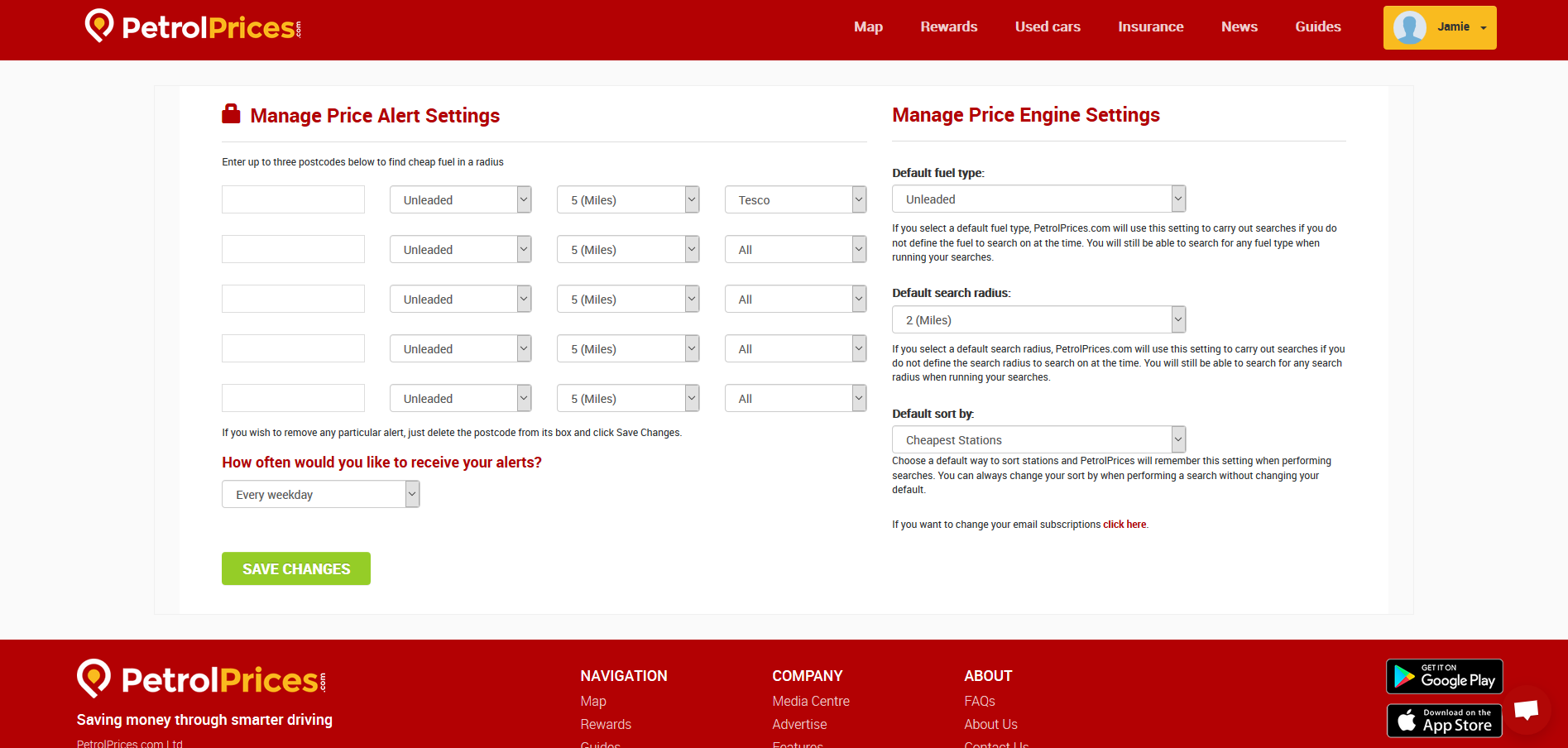
Feature update: Brand filtering in Price Alerts

Last week, we announced our new website. Hopefully, this has improved the overall experience of using our site. However, this is about our latest Plus feature, brand filtering in your price alerts.

For those of you who have an existing price alert, filtering by distance and by fuel type is already possible. With a Plus membership, you can now filter your alerts to only show certain brands.

This is game-changing for those who have a preferred station to fill up at, whether you’re a fan of the super-cheap supermarkets or you’re a traditionalist who stays loyal to the original retailers.

To add a price alert by brand, head to the alerts section of the member’s area and select the option you would like from the drop-down.

If you’d like to start filtering your price alerts by brand, you’ll need to be a Plus member, which is just £2 per month (or less than a cup of coffee!).

If you’re already part of the Plus membership, just head to the alerts section of the member area using this dropdown.

Once you’re in the alerts section, you’ll see all your existing price alerts. However, you’ll notice the additional drop-down box listed under ‘Brand’. Clicking on this will open up a list of all the brands we have price data for.

screenshot of account

For example, if you’d like to show only Tesco stations, merely click the Tesco station listing, remember, you’ll need to click save changes. If you don’t, your price alert won’t update.

If you ever want to suggest a new feature, head to the contact page and click “suggest a feature”.

Number of diesel cars on UK roads at record levels

Despite the Government’s relentless efforts to dissuade people from driving diesel cars, new statistics from the Department for Transport have shown that their attempts have failed miserably as there are now more diesel cars on the road than ever before.

The data shows that a record number of diesel cars were registered at the end of 2017 with a total of 12.4 million of them being driven on UK roads, which is 308,000 more than in 2016. This suggests that people are not scared by the forthcoming vehicle excise and MOT changes, the toxicity charges in London and are just not ready to give their diesel cars up because the benefits of keeping one outweighs the incentives to switch to lower emitting petrol, hybrid or electric cars.

A record number of diesel cars

The statistics show that 2 out of every 5 of the 31.2 million cars that are on the UK’s roads are diesel cars, which is up 0.5% on the previous year despite there being a 16% drop in new registrations.

This is certainly not a stat that the Government were hoping for as they have been desperately trying to reduce the number of diesel vehicles on the roads over the last 12 months by encouraging people to opt for hybrid or electric models instead.

However, just 45,400 new electric cars were on the road in the last quarter of 2017 which means that the UK roads are home to 272 diesels for every one electric vehicle, which is barely an increase on the number recorded the previous year.

Petrol ownership has also been decreasing, with numbers falling since 2004. The end of 2017 saw 0.3% less petrol cars on the roads than there were at the end of 2016, with 59% of the total number of cars being driven running on petrol.

Why the Government’s plan backfired

For months the Government have been implementing plans to encourage people to buy cleaner cars, such as the new Vehicle Excise Duty making low carbon dioxide producing vehicles more expensive to tax, and surcharges being introduced for driving and parking high polluting cars in Central London.

With so much effort being put into eliminating diesel cars by the Government it may be surprising that there are actually more diesels on the roads now than ever before, but there a number of potential reasons for why this has happened.

Jack Cousens, Head of Roads Policy for the AA, stated that changes made to Vehicle Excise Duty by the Government were counter-intuitive as they have just ended up forcing higher tax bills onto those who would have preferred to buy a cleaner car. Instead, people are keeping hold of their older, more polluting cars which is the complete opposite of what the Government was aiming for.

Another possible deterrent for motorists is that they want to avoid the surcharges that they would face if they bought a new model, so they would prefer to stick with the vehicle that they currently drive.

Steve Gooding, director of the RAC Foundation, summed the situation up well by saying that the Government cannot eliminate diesel cars as quickly as they wanted to due to the fact that they are entrenched in our society, and that it will take years to significantly decrease the number of diesel vehicles on the UK’s roads.

What happens next?

It is argued by some motoring experts that the slump in new diesel car buying is only the beginning of the downward trend in diesel car use and that a small increase in diesel car use before the decline is logical, given the fact that more drivers are keeping hold of existing cars rather than trading up to a new one.

The Government are expected to launch a raft of new measures soon with their national Cleaner Air Initiative, which is likely to contain more limits and taxes on the use of older, high polluting vehicles to get them out of major cities. The measures implemented will start to have an effect and it will fall in 2018. Evidence of this is Jaguar Land Rover’s recent decision to lay off 1,000 staff, which they say is because of the fall in demand for new diesel cars.

Do you currently own a diesel car that you are keen to keep hold of and if so why are keeping it? Are you considering trading in your diesel car for a hybrid or electric alternative? Let us know in the comments below.