French police request details of 246,000 UK drivers in five months

French police request details of 246,000 UK drivers in five months

January 1st 1973 saw changes within the UK, that nearly 50 years later still have ramifications; we became part of the European Economic Community. Strangely, a year after we voted ‘Leave’, the UK government were still signing up for schemes that tied us to Europe, in the form of the updated Mutual Legal Assistance scheme.

Essentially, the scheme (updated in 2017) allows foreign authorities to access driver records to pursue them for any motoring misdeeds while abroad. In total, 18 countries signed the new agreement, including France, Germany, Spain, Malta, Finland and Poland. While it covers a number of offences, the majority relates to speeding.

Mutual Legal Assistance

Forgetting the complexities, or rights and wrongs of Brexit, the system was designed to apply a more uniform structure to motoring, and the adherence of regulations throughout the European Union; whether you’re driving in Poland, or motoring through France, you still need to be mindful of the speed limits or any motoring laws that you may be breaking.

It just seems that some countries are a little more proactive when it comes to pursuing the offender.

Between February ’19 – June ’19, Finland requested the details of ownership just three times, Luxembourg were a little more proactive at 1,222 requests, Germany applied their usual Germanic efficiency with nearly 23,000 requests, but compared to France, their efforts were amateurish: 246,138 requests were made in the five-month period.

Driving in France

The high number can really only be attributed to two things – the French cameras are often unseen, or only seen at the very last minute, and the fact that their tolerances are much tighter. In the UK, we’re generally advised that the speed cameras are set at 10+2 – that’s 10% plus 2mph (which isn’t always the case), whereas in France, the trigger is set at just five percent over the limit.

In the UK, the cameras must be visible, for a distance enough to allow the driver to react, whereas in France (and a number of European countries), the camera can be set away from the road, hidden on a bridge or parked in such a manner that once you’ve noticed it, you’re too late.

Similarly, the Dutch are renowned for their ingenuity, one of their favourite hiding spots for example, is a wheelie bin by the side of the road, on bin day. You simply have no option but to comply with the limit if you don’t want to get a ticket. (And yet the Netherlands requested information just 96 times).

What will leaving Europe mean?

Currently, no one really knows whether or not the reciprocal arrangement will be active once we leave Europe, although it’s thought that as with many other motoring laws and legislation, it’s likely that it will remain in place, potentially as part of a strategy to minimise the ‘hardness’ of a hard Brexit.

But as we reported back in September 2017, despite it being called a reciprocal agreement, it isn’t very reciprocal; foreign drivers caught speeding in the UK can use a legal loophole to escape punishment, in the form of the agreement itself.

The (Euro-centric) agreement states that registered owner is responsible for all fines levied, but in the UK, it must be found that the driver is responsible, which means that a vast swathe of drivers are going unpunished, as no proof of the driver is available. Allied to that, is the fact that the UK police need to issue their NIP (Notice of Intended Prosecution) within 14-days, whereas in parts of Europe, the police can take up to a year for the same.

Personally, aside from the seemingly one-way interaction, I feel that this type of legislation can be a good thing – it gives drivers the chance to make the decision about their behaviour, their driving habits and what the possible outcomes could be. It actually encompasses the whole spirit of fairness, of doing the right thing, and allowing motorists a level playing field throughout Europe.

Despite being EU legislation, the sense of it is entirely British; you can’t get any more British than our inherent sense of fair play, and this legislation provides just that.

Have you ever been caught for a motoring offence abroad? What was the outcome? Do you feel that Brexit will mean less red tape? Let us know in the comments.
Right-wing thinktank wants to stop the freeze on fuel duty to cut air pollution

Right-wing thinktank wants to stop the freeze on fuel duty to cut air pollution

Bright Blue; “A deep intellectual gene pool for the Conservative Party’s future”.

Emission Impossible, a ‘jaunty’ take on the classic TV programme, or later film series, in which the good guys wrestle the bad guys, before self-destructing. Clearly, in this case, the ‘bad guys’ are car owners, and the good = Conservative politicians. The plot encompasses all topics that register ten on the ‘devious politician’ scale; Brexit, stealth tax, cash cows, anti-pollution, emissions and car ownership.

Sadly, this isn’t the latest plot for a new blockbuster, but yet another ridiculous political report, dressed up with environmental concerns and expense for the motorist, only this time, it’s the turn of the right-wingers.

Meeting all legal requirements

Buried within the 130-pages is the statement that “The UK currently meets all its legal requirements on air pollutants, except for hourly and annual limits on NO2”, you also find that their graphs show a very real decline in kilotonnes of emissions, since 1970 to present-day – NOx, for example, has gone from around 8,900 kilotonnes since 1970, to approximately 1,800 kilotonnes today.

This isn’t a marginal decline, or a ‘trend’, this is a steady decline, consistent and proven, with a blip in the early 90s that lasted for a few years.

And yet despite their evidence to the contrary, Bright Blue is recommending a number of proposals, all aimed at the private and commercial motorist, that will make vehicle ownership even more expensive than it is already, and encourage a number of potentially nefarious activities to boot.

The car is the answer

In 2016, cars attributed 16.5% of the UK’s total NOx emissions, LGVs and HGVs accounted for 15.5%, buses and coaches made up 1.7% and motorcycles and scooters accounted for just 0.1% – a total of 33.8% of the total NOx.

That leaves a whopping 66.2% to account for; aviation weighed in at 21.5%, railways were 3.9% and shipping … 40.8% – more than the total road transport combined. And yet, once again, it’s the motorist that’s paying the price.

And what a price that will be.

Some “Bright” ideas

In amongst the proposals set-out by Bright Blue, there are a number of them that should be of concern to us all, although if you’re a diesel motorist (on the back of the recommendations of the government of the time), you may want to stop reading now.

Diesel Duty

Along with abolishing the fuel duty freeze (in place since 2010), Bright Blue say that diesel motorists should have an extra tax added to their fuel – a ‘Diesel Duty’.

Diesel Excise Duty

Not content with adding extra tax to diesel fuel, it’s also recommended that diesel motorists have their own ‘Diesel Excise Duty’ instead of the regular VED that we currently pay.

Profiteering councils

All councils should be allowed to profit from their charges for the pollution charging schemes they introduce, and we’ve all seen how their profiteering works when it comes to parking charges.

Public reporting

Under the new proposals, members of the public will be tasked with reporting vehicles that spend time idling unnecessarily. This isn’t a terrible idea, aside from the fact that they’ll be rewarded with a share of the spoils – a percentage of any fines levied for the offence.

Speed limit reduction

Lastly (although there are more proposals in the document), a recommendation for all urban areas to have the speed limits changed from 30mph to 20mph. Again, we’ve reported on this numerous times, and quite frankly, it’s a ridiculous notion that doesn’t work, unless working in conjunction with a number of other measures, and even then, it only works under very strict criteria.

Air pollution

Once again, no one denies that air pollution needs work, but we’re cleaner than we ever have been, and it’s a continuous downward slope. Further, evidence suggests that vehicles are cleaner than ever, with most modern diesels polluting less particulate matter than the equivalent petrol-engined counterpart. None of these proposals look to incentivise giving up the car, and it’s solely reliant on penalising the motorist for revenue.

They even state that councils should be able to profit from it. This isn’t stealth tax; this is purely about revenue generation for greed.

Why can’t the commercial entities such as aviation or shipping be held accountable? The simple fact is that as a nation, we’re reliant on our car; public transportation is often ineffectual or expensive (usually both), we’ve built a society of out of town retail parks, entertainment and leisure facilities. Thanks to punitive taxes leaving businesses struggling or going to the wall, full-time employment can often mean an hour’s commute each way to get to work.

Yes, if you manage to live your life without a vehicle, if you cycle or walk everywhere, and have no need for a car, that’s great news, but you’re in the minority. So while that lifestyle may work for you, that doesn’t necessarily mean that works for everyone.

What do you think to the proposals? Is this just another money-making scheme? Or do you see a real benefit from it? Let us know in the comments.

No deal Brexit unlikely to lead to fuel shortages

No deal Brexit unlikely to lead to fuel shortages

Here at PetrolPrices, we can often be controversial, we have been known to “stir the pot” but today in this article we want to debunk some of the myths that are floating around about fuel shortages. You may have heard on the radio, in the news or even our very own Kitty Bates speaking on BBC Wales about it, and we just wanted to share that message with you.

It is worth noting that this is just us using facts and common sense to piece together the puzzle and come to a conclusion that we hope can help to dispel some of Project Fear!

Operation Yellowhammer

Over the weekend, it is thought that a former minister leaked a document entitled “Operation Yellowhammer” to the press, which covered a lot of scenarios, some more worrying than others in the event of a no-deal Brexit.

Some media outlets are disputing this and saying it is a realistic expectation of what could happen with a no-deal Brexit, however Michael Gove, whether you agree with him or not, claimed the paper to be out of date, something that was later dispelled by the government and shown that it was written on the 1st August.

Mr Gove, speaking to the BBC, said “It’s certainly the case that there will be bumps in the road, some element of disruption in the event of no-deal.

“But the document that has appeared in the Sunday Times was an attempt, in the past, to work out what the very, very worst situation would be so that we could take steps to mitigate that. And we have taken steps.”

What does Operation Yellowhammer say about fuel?

In this we want to specifically focus on fuel, being PetrolPrices.com. The document leaked to the Sunday Times states two issues that could be a potential problem for the UK. The first is traffic disruption due to checks at the border which could limit supply to London and the South East.

The second issue is due to the zero per cent petrol import tariffs reducing competitiveness in the market, something that is shown by the industry. “The concern is that this is a unilateral decision by the government and overnight we go from being on a level playing field with European competitors to being totally uncompetitive,” one source said. “It will have a major impact on domestic petroleum manufacturers.”

Back in March, the government announced that on 87% of imports the import tariff would be set to 0% to ensure that everyone could still afford fuel which is now something multiple government sources are investigating as a risk to GDP. This is down to the uncompetitive prices UK imports would have in comparison with the rest of the EU market.

However, all of this still doesn’t mean fuel shortages, at least not long term. With the whole situation regarding Brexit, there will a time of uncertainty and this has been known for a long time and should be expected.

Piecing it all together

If we break down where the UK gets our oil from the vast majority comes from non-EU namely Russia and OPEC. Only 8% of all UK fuel is from EU countries, so if we can’t get it from the EU, it would not be long before another area upped the supply. Similarly, if fuel is less competitive to sell into Europe, then there could be potential for it to be sold in the UK.

Alongside that UK oil consumption has been decreasing year on year since 2013, as electric vehicles and hybrids come into play and as cars become more and more fuel-efficient. In reality, it’s probably not going to be long before that extra 8% we currently get from the EU is no longer needed as people convert to Alternatively Fueled Vehicles (AFVs).

While yes, there may be some inflated prices for a month or so, or perhaps some delays, we really think that a lot of the fear surrounding this is just the last chance to hype up Project Fear before the 31st of October.

Jason Lloyd, Managing Director of PetrolPrices.com says “The impact of a no deal Brexit on fuel supply across the UK is likely to be temporary as retailers adjust and source supplies from different sources. According to the Office for National Statistics, the UK imports about 9% of its petroleum from Sweden and the Netherlands, all other imports into the UK come from Russia or OPEC countries. ”

“Should petroleum from any country get stuck at the UK border, I would expect the 7 UK refineries and North Sea pipelines to increase the supply of petroleum from non-EU sources to offset the loss, but that would cause a few weeks temporary disruption.”

Do you think there will be fuel shortages nationwide? What do you think will happen on the 31st? Let us know below

Supermarket Sweep! Morrisons, Tesco, Sainsbury’s offer fuel promotions up to 10 ppl this weekend

Supermarket Sweep! Morrisons, Tesco, Sainsbury’s offer fuel promotions up to 10 ppl this weekend

Morrisons is today announcing a 5p-a-litre off the cost of fuel to help make diesel and unleaded more affordable.

Morrisons is making the cuts to help summer motorists in the run-up to the August Bank Holiday and the return of the school run.

Ashley Myers, Head of Fuel for Morrisons, said: “With the bank holiday and kids returning to school soon, this deal will help motorists save when they fill up.”

The deal will be available to customers who spend £40 in Morrisons stores (not Morrisons.com) until 25th August. Customers will receive a voucher that will allow them to pay the lower price until 1st September. (Terms and conditions apply)

Sainsbury’s customers can save 10p per litre on fuel when they spend £60 or more on groceries at a Sainsbury’s supermarket or online between Thursday 22nd and Tuesday 27th August 2019 (exclusions and terms and conditions apply).

Qualifying customers will receive a coupon at the checkout or when they receive their online groceries order and will have 14 days to redeem the offer at one of 306 Sainsbury’s forecourts (not valid at Pay@Pump). The discount can be used to fill up on unleaded petrol, super unleaded petrol, diesel or LPG up to a maximum of 100 litres.

As usual, customers will also be able to collect Nectar points every time they fill-up, with one point awarded for every litre purchased.

David Pegg, Fuel Buying Manager at Sainsbury’s, said: “To celebrate the August Bank Holiday weekend we’re offering customers 10p per litre off fuel when they spend £60 or more on groceries at a Sainsbury’s supermarket or online. Whatever customers have planned for the long weekend, we hope this offer will put money back in their pockets and help them enjoy the summer.”

T+C’s here: https://help.sainsburys.co.uk/help/terms-and-conditions/fuel-tcs

Tesco is a similar 10ppl offer, and more terms can be found here: https://www.tesco.com/groceries/en-GB/zone/Fuel-Promo

As always, motorists can use the new PetrolPrices.com app to find the best forecourts near them, download here

Four out of five airports have increased drop-off charges, are you feeling the sting?

Four out of five airports have increased drop-off charges, are you feeling the sting?

Just in time for the holiday season, comes research by a major motoring organisation that says, this year, four out of five airports in the United Kingdom have increased the fees for drivers dropping off and collecting passengers.

Travellers and those making the trip to wave them off, or welcome them back, are in an uproar to find themselves stung by expensive so-called ‘kiss and fly’ charges, with many taking to social media to complain. We look at the airports raking in the parking profits and what you can do to avoid paying more than you must.

Charged up

The investigation by the RAC found eight out of 10 (82%) of the UK’s 22 busiest airports introduced or raised their fees this year, with London Stansted Airport the most expensive for both drop-off and pick-up costs.

The automotive company based their study on 22 airports that serve over 1million passengers each year.

They looked at fees charged to motorists who leave their vehicles in what is most often known as a ‘short stay’ car park to drop off passengers either outside or as close to the front of the terminal as possible, or meet someone at the arrivals gate.

Gathering their information this month, the RAC scoured the airport websites’ recommended parking tariffs for motorists to use for passenger collection.

Just as you may be when you find out the cost, the required fee is often in tiers. What you’re charged may depend on how long you’re at the airport. For instance, you might need to pay a set price for the initial charge—the first 10 minutes, say—with the next 20 minutes costing a different price.

The biggest price-hike culprit—London Stansted Airport—will charge you £4 for a 10-minute drop-off (a 50p increase from last year) and £8 for a 30-minute pick-up (up £2.50 since 2018).

A ‘goodbye’ tax?

Only recently PetrolPrices covered the news that Heathrow Airport would soon be the world’s first airport to use an Ultra Low Emission Zone (ULEZ) so it’s little surprise to hear that the rise in drop-off and pick-up parking charges is being attributed to pollution.

A spokesman for The Airport Operators Association said:

‘Airports that operate drop-off charges directly outside the terminal do so for a number of reasons, including to manage congestion and to limit the environmental impacts of kiss and fly journeys.’

What seems crazy is that despite aviation also being a huge contributor to environmental pollution, some airports are now charging more for drop-off and pick-up fees than for the price of some flights

Simon Williams, Media Relations Manager at RAC, said:

‘Many airports charge drivers to drop off and pick up to keep the terminal entrances clear of traffic and to discourage long stays in car parks.

‘Some might also see this as a way to encourage other forms of transport to the airport, but nevertheless, these fees are still unwelcome, especially when you consider how little time most people actually spend at the airport.

‘In reality, many travellers simply either do not have easy public transport access to get to the airport and even if they do, they can’t always depend on it getting them to the airport in good time.’

Off to a flying start

While it’s expensive to drop off passengers right outside the terminal, you can still help your loved ones while avoiding steep charges.

You can also do things to avoid stress and keep your time at the airport as short as possible, such as reading the parking information on the airport’s website to find out the fees, payment options, and stay times. Some airports may even offer lower rates for pre-booking your parking online.

Many airports offer a cheap or free alternative such as car parks further from the terminal, either within walking distance or requiring a shuttle bus connection.

Some airports may also offer free pick-up and/or drop-off for a limited time.

Consider saying your goodbyes to your passengers before you get to the airport to keep the farewell time short.

Ask your friends or relatives to call you once they’ve got their luggage and passed through passport control so you can park at the best time. Remember, though—use a hands-free device!

Check out nearby free parking places in case of a delay with your friends or relatives’ flight so you can wait for the plane to land before heading to the terminal. If you’re picking somebody up, make sure you keep track of the plane’s landing time.

Are you flying overseas this summer? Did you agree to drive somebody to or from the airport? What airport will you use and will an increase in parking prices change your plans? Share your thoughts in the comments.

One in four motorists liable fined under ULEZ

One in four motorists liable fined under ULEZ

Since the introduction of the new Ultra-Low Emission Zone on April 8th, Transport for London has raked in around £26m in levies and penalty charges. That’s approximately £198,473 each day.

We shouldn’t forget that the figure is on top of the regular congestion charge (£250m raised 2016/17), and the fact that just 28 employees of Transport for London earned just under £7m between them for the year 2016/17, according to the TfL Annual Report & Statement.

At nearly £900,000 / day in revenue, you’d have thought that TfL would be a little more forgiving when it comes to enforcing their strict 7-day doubling of the penalty fine for missing a ULEZ payment; the £12.50 charge automatically raises to £80 after the deadline of payment is missed (within a day or two of the infringement), which doubles to £160 if the penalty charge isn’t paid within seven days.

ULEZ charges

The ultra-low emission zone charge is payable 365 days of the year, 24-hours a day, and the charge doesn’t cover anything more than for the day – arrive at 23.59hrs and leave at 00.01, you’ll pay twice.

Around one in four motorists that are liable for the charge have been fined so far, with many complaining of lack of clear signage or a misunderstanding of the whole situation; how to pay, where they pay, what area it covers – 130,000 motorists have been hit with a fine since April.

Which also leads to an issue over non-authority websites offering to take payments for the charge, and charging a further £7.49 for the pleasure – the total fee, including ‘processing fees’ comes to £19.99. It seems as though it isn’t just Transport for London that want their fat slice of the pie.

Taking advantage

Of course there is the argument that London has some of the best public transport networks available, certainly within the UK, so in theory, there’s little need for personal transportation if you’re going about your daily business within the city.

And yet, 28% of Londoners live in poverty, that’s six percentage points above the national average, and if you look at inner London, that figures rises to 32%. For many Londoners, owning a car is an essential lifestyle necessity, not a luxury.

In a recent study by Deutsche Bank, London was ranked as having the most expensive public transport in the world, which leaves millions of Londoners relying on their own car for transportation, and yet they’re being penalised for the privilege. It would seem that there are very few options, other than to walk everywhere.

Maximising profits

Ask yourself, if car insurance wasn’t a legal requirement, would it still be so expensive? You can guarantee that the market would change significantly, as competing providers made deals and offered more for the money, all in a bid to win your business.

It’s the same for the ultra-low emission zones – if you positively need to enter the zone, you have to pay the price, and while some may say that £12.50 per day is a small price to pay, I’d argue that it’s a family meal for some, and with no viable alternative transport, families are going without.

Also, we shouldn’t forget that the Congestion Charge (when first introduced) was such a horrifying idea that even Westminster Council, with the backing of Kensington and Chelsea borough council tried to block it. Now, we happily await for the next charge to come along, and accept it with nothing more than a minor grumble. It’s also worth pointing out that the charge has more than doubled since the introduction.

Air pollution

Air pollution is a very real thing, no one (least of all, me) is denying that. But it seems as though Transport for London want their cake and to eat it too; the world’s most expensive public transport, and charging you to enter the city in certain vehicles.

As we reported last week, electric buses account for just 2.6% of the TfL fleet, so they’re not exactly leading by example, and the issue isn’t about changing private vehicle usage, it’s more about incentivising rather than penalising.

You want polluting cars to stop entering the city? Give them discounted public transport. Stop looking at the bottom line of the bank balance, and start thinking about genuine ways to improve transport networks that benefit more than the few.

Use some of that £900,000 per day revenue to subsidise the networks, to offer something viable, that isn’t going to take food out of the mouths of the poorest in our society. Give them the option to give up their car, not force them further into poverty.

MPs propose to ban all hands-free devices in cars

MPs propose to ban all hands-free devices in cars

Someone using a mobile phone behind the wheel is four more times more likely to crash yet statistics show mobile phone use being a factor in collisions has actually risen every year since 2017. MPs warn that the current regulations make it seem like hands-free driving is safe, whereas they say it has the same risk as actually holding the phone.

Now, MPs from a cross-party group are calling for all hands-free use to be banned and for the current legislation to be reviewed, taking into account new technologies and it being socially acceptable in some circles to decrease use and increase the social stigma around it to try and deter more people.

What’s the case?

Ever since the increase in technology and the percentage of the population that own a mobile phone (94% in 2017, up from 82% in 2005) has also risen drastically.

Alongside that 25% of motorists admit to making a call or texting behind the wheel, with that rising to 39% when doing so while the engine is idling. The annual RAC report on motoring showed no decline from 2017 to 2018, even though a stricter penalty of £200 and six points was introduced.

For someone in their first two years of driving, this would mean an immediate licence removal and they would have to retake their test.

Toughen up

The penalty for using a phone was doubled back in March 2017 but Road Traffic Officer (RTO) numbers have decreased leading to fewer people going to the High Court over such matters. In the cross-party government report, the RAC cited a study that said in the years before 10 years to 2017, the number of full-time road traffic officers in England and Wales fell by almost a third from 3,766 to 2,643. The number of offences for using a hand-held mobile phone while driving that resulted in a Fixed Penalty Notice (FPN), driver retraining or court action fell by over 30% between 2016 and 2017 and has been falling steadily for the past six years—by more than two thirds since 2011.

In order for a law to be effective, it must be enforced and the above stats show it isn’t at the minute. The previous minister for Road Safety, MP Michael Ellis requested a review into RTOs and how technology may be able to increase their effectiveness.

Near our offices in Aldershot, we have what has been affectionately nicknamed “vulture cameras” along the A3 which can detect eating, mobile phone use and the driver and passenger not wearing seat belts behind the wheel. These could potentially be used across the country to automatically detect such offences.

Industry implications

But what would an outright ban on hands-free use behind the wheel mean for mobile workers such as mobile repair technicians, taxi drivers and others who rely on their cars as their job.

The BBC spoke to Kelvin Hardy who repairs, inspects and maintains incinerators across the country. He said “I use a hands-free phone with voice recognition and I have to have one. I could get a call out to a job and then get another call telling me I’m not needed. Being able to take that call can save a wasted journey. I’m not a big business, it’s only me involved. If you have a secretary taking calls it might be fine, but I don’t have that. [If the ban happened] I’d have to stop every hour on the motorway.”

“For me it’s all about responsibility. You don’t have to take a call. I don’t pick up calls if I’m surrounded by lorries or there’s heavy rain. It’s about not being distracted. I see some horrendous driving on the roads that no one seems to bother about.”

This also comes into play with in-car entertainment systems. Where is the line drawn here as some could argue this is a form of handsfree and therefore should be banned, effectively rendering millions of cars illegal. Does this then also mean all other distractions should be banned? Noisy children, arguing over directions with the passenger, music of any kind, other noises, in fact, could we not ban roads near historical monuments in order to prevent driver distraction?

This does open a can of worms on distracted driving. We as a society have a decreased attention span and are becoming more and more distracted. Could this be the start of an automation switch into cars that are intelligent and reduce the risk of human accident? Or could this be the start of an anti-mobile revolution where people start going back to smaller more basic phones?

Facebook’s user base has declined 15 million since 2017, and people are turning against the ever-connected world. But how far will this go?

What do you think of this ban? Would it affect your work? How far will the distracted driving go? Let us know below

Privately owned cars should be BANNED by 2030 says pro-Corbyn think tank

Privately owned cars should be BANNED by 2030 says pro-Corbyn think tank

Politics; “the art of looking for trouble, finding it everywhere, diagnosing it incorrectly and applying the wrong remedies” – Groucho Marx.

Here at PetrolPrices, we try and stay clear of politics, but very occasionally we need to dare to tread that path, to have a say, to inform you, and to take a stand. From a personal point of view, I’m very apolitical, certainly in a professional capacity, but occasionally, I read something that I feel should be discussed.

With talk such as “ownership models”, “the relentless subjugation of the public realm to the exigencies of the private motor car”, “rapid de-carbonisation” and “isolate and atomise society” being used to describe owning a car, I for one feel that there are some pretty powerful words being used, all with the intent of further demonising the ‘motor car’, you could even perhaps call it propaganda, for that is really what it is.

But they’ve saved the most powerful sentence until last – “inside armoured shells that protect those inside by endangering everyone else”.

Away with all cars

Would you be overly surprised if I told you that this came from a radical left-wing pro-Corbyn supporting think tank? That the white paper (unashamedly called ‘Away with All Cars’) has been written in conjunction with Greenpeace UK and a group called ‘Common Wealth’.

Before you accuse me of being a climate-change denier, you should understand that the group want to ban all cars; fossil-fuelled, EVs, PHEVs … ALL privately owned vehicles. The reasons given are ‘emissions’ and ‘air pollution’. But it begs the questions; do we all just accept being herded on to mass transit solutions? Like some form of communist state?

If this was a regular government ‘think’ tank, we’d be calling it nonsense, passing it off as some sort of buffoonery, and complaining that it’s the motorist being punished again, but it isn’t, the whole tone of the white paper, its sponsors and their values are driven by the radical left-wing; they’re sharing their political values, it isn’t about the motor car, it’s about a political ideology.

The impact of road pollution

No one is denying, including myself that road pollution is a massive killer. The statistics are very clear, according to COMEAP, road pollution leads to between 28,000-36,000 premature deaths a year. London is one of the worst cities in the world for deaths caused by road pollution.

The Mayor of London is trying to discourage drivers from bringing in high polluting vehicles and encouraging lower emission petrol and diesels that meet tough EU standards, EV or hybrid cars into the new ULEZ zone. This is a sensible and pragmatic approach. But this think tank just wants to ban vehicle ownership outright, is there is something bigger at play beyond zero carbon emissions?

The banning of cars

We’ve become used to being the scapegoat for all things climate related, it seems that the answer to any questions relating to air pollution end with ‘make the (private) motorist pay’. Just last year, the Government came under attack for their policy with the ministerial cars – from the 84 vehicles run by the Government Car Service, there are just six electric cars and one hydrogen fuel powered vehicle in the fleet.

The Prime Minister’s runaround is a supercharged 5.0 litre V8 Jaguar, and that’s followed around by a fleet of Land Rovers. None of those shout ‘economical’ as they drive past. Isn’t it time that our ‘leaders’ started doing just that, and lead by example?

Currently, electric buses in London account for just 2.6% of Transport for London’s fleet, and Sadiq Khan has been accused of misleading the public with some of his claims; “London will soon have the largest double-decker electric bus fleet in Europe” is a prime example.

Technically, what he said wasn’t wrong, but the reality of the situation is that Dublin is the only other city in Western Europe that uses double-decker buses in significant numbers.

Car-free days

Plans are already in place for the first car-free day to be held in London, and the transport research manager for the Centre for London has already stated that we need to think about ‘locking in car-free lifestyles for good’.

When all’s said and done, the reality of banning privately owned cars, or banning them from London permanently is quite frankly, ridiculous. While it could be argued that there are many other great cities in the UK, it’s London that’s the hub of the country, and with no reliable means of cheap transportation available to those that are less fortunate, the city will grind to a halt.

We’re already seeing on a smaller scale, that when a city makes life difficult for a motorist, they vote with their wheels and park, shop or eat out of town. It’s unlikely that London will ever become a ghost town, but financial losses only need to be small for someone to take issue.

And that’s why the ‘Away with All Cars’ white paper is a non-event, with nothing more substantial behind it than pushing a weak political agenda. With that said, similar to what we see with certain other world leaders, quite often the rhetoric isn’t designed to convert new people, rather than reinforce the message to the already converted, you could even say, to radicalise them.

What do you think to the plans to ban all private owned cars by 2030? Is it as ridiculous as it sounds? Or should we sit up and take notice? Let us know in the comments.
Speed limit technology to be implemented in all new cars by 2022

Speed limit technology to be implemented in all new cars by 2022

Speed limiters will be made compulsory fitted to all new vehicles in 2022 under proposals put forward by the European Union and this will be copied by the UK Government, as confirmed by the Department of Transport. The official purpose of the speed limiters is that it will reduce road deaths by 20%, however drivers can still override the stated speed limit if they need to in case of an emergency manoeuvre.

This is the first step towards the gradual full automation of all vehicles. Driver safety and the reduction in road deaths is being used as the justifiable reason to impose it, but this is only the beginning of a set of rules that will eventually lead to all vehicles driving themselves.

The driving Nanny

New European legislation is to come in to force for 2022, in which all new cars will be fitted with ‘Intelligent Speed Assistance’; a system that automatically restricts power when it recognises, you’re speeding, thereby slowing the vehicle down to the limit.

This isn’t really about the kind of unobtrusive technology being used to monitor our daily movements though, we’re now talking about technology that interacts with our surroundings to physically prevent us from taking part in any ‘wrongdoing’.

And in this case, ‘wrongdoing’ isn’t robbing a bank, flashing an innocent bystander or physically harming someone, wrongdoing is all about the evils of speed, for no matter what the reasoning, you’re the Devil Incarnate should you allow your speedometer to creep above the permissible limit; this is speed enforcement en masse.

And it gets worse.

Given the fact that it uses a combination of GPS-tracking black box technology, sign-reading cameras, and connectivity, it’s entirely possible for the system to tag your time, location, and speed to send off a detailed report about your nefarious activities, all ready for prosecution. And while that sounds extreme, think of this: with Intelligent Speed Assistance, revenue from convicting speeders will be down, and relying on safety cameras alone to make the difference just won’t cut it.

No obvious reduction in deaths per year

These new proposals are down to the fact that for the last decade, fatalities and casualties from road accidents have remained pretty constant – around the 1,700 per year mark. And yet the number of cars has increased by around 2m in the last decade, and so while the numbers are similar, the percentages are smaller – a fact not mentioned by the government.

Further still, much of the in-action with road safety comes down to budget cuts and a drop in the long-term spending; there’s no road safety expertise at local council level, and no long-term strategies in place to reduce accident numbers.

With an estimated price of £2,000 added to each new car (for the incorporation of the system), it’s the motorist (once again) that’s been tasked with footing the bill.

Safest roads in Europe

And yet still there’s another question. Is this really about road safety? Are our roads dangerous enough to warrant the actual physical interference of the government in our daily driving activities?
According to a new European Commission study, Britain has the safest roads of any European country, so while we’re a country (apparently) full of speeders and hooligans, we’re doing OK.

Of course, it’s easy to blame this at the feet of the Eurocrats, and thank all things holy that Brexit is happening, but despite it being a European Commission approved legislative act, we’re set to follow the legislation with or without Brexit. This is most definitely happening.

I’m not against measures that work to reduce inappropriate speeding, I don’t see my local ring-road as my own personal racetrack, and as an automotive engineer, I’d argue that ‘speeding’ in one car could be a completely different experience to breaking the law in another. And what does this mean for high performance cars, sold by all the main automotive brands? Does that mean that a shiny top of range Bugati Veyron can only pootle along at 70 MPH in the UK? It seems almost laughable, but this is the imminent reality we all face.

But what I do object to, is the physical interaction, taking control away from the motorist, and wresting it in the hands of a government think tank that tells us they know best. It’s allowing the government to take drastic measures to force us to comply with the lowest standard of driving permissible, while I’ve spent a lifetime improving, learning and demonstrating courteous & respectful driving, albeit with the occasional burst of speed. What is point of Advanced Driving Courses anymore if this happens?

More accidents not less?

Finally, we’ve already learnt that reducing the speed limits to 20mph has the opposite effect; accident statistics rise, and it’s proven to be down to lack of concentration or complacency for the lower speed. What happens when the driver must concentrate less because the car will automatically monitor & adjust the speed? We could actually see more accidents because the drivers think, ‘the car has this under control’ and increases in accidents caused by driver distraction could skyrocket.

What do you think to the new speed limiters? Will they be a good thing for road safety? Or is this a step closer to being forcibly stopped from controlling our vehicles? Let us know in the comments below please.

Retailer of the month: Co-op Fuel

Retailer of the month: Co-op Fuel

Interview with Eddie Jenkinson, National Fuels Manager, Co-Op Fuel

When did you start selling petrol? “In the 1990’s”
How many forecourts does the Co-op have? “147 Co-op own brand plus 60 that have a Co-op shop but may sell a different brand of fuel”
On average, how many litres of fuel went through Co-op owned sites last year? “Around 650 million litres”
What was the last site you opened? “We last opened Chester Handbridge on the 19th July”

Petrol Forecourts as a ‘Community Hub’

“We are delighted to have had the opportunity to make a significant investment in our Kirk Hallam site. The work to enhance the petrol filling station forecourt and food store will allow us to better serve the needs of the local community. The conclusion of this investment in the community is a great way to mark the 175th anniversary year of the Co-op!”

Eddie, added: “Petrol stations are often seen as a “community hub” supplying local residents with groceries and services alongside fuel and food to go offers, coffee and other refreshments for visitors passing through the area. We are also ensuring that EV capability is built into all new forecourt developments in readiness for the expected growth in EV car ownership. Handbridge and Kirk Hallam are the latest in a series of significant makeovers for our forecourt sites – in the last two years around 10% of our forecourt Estate has been renewed and received major investment to better serve the community.”

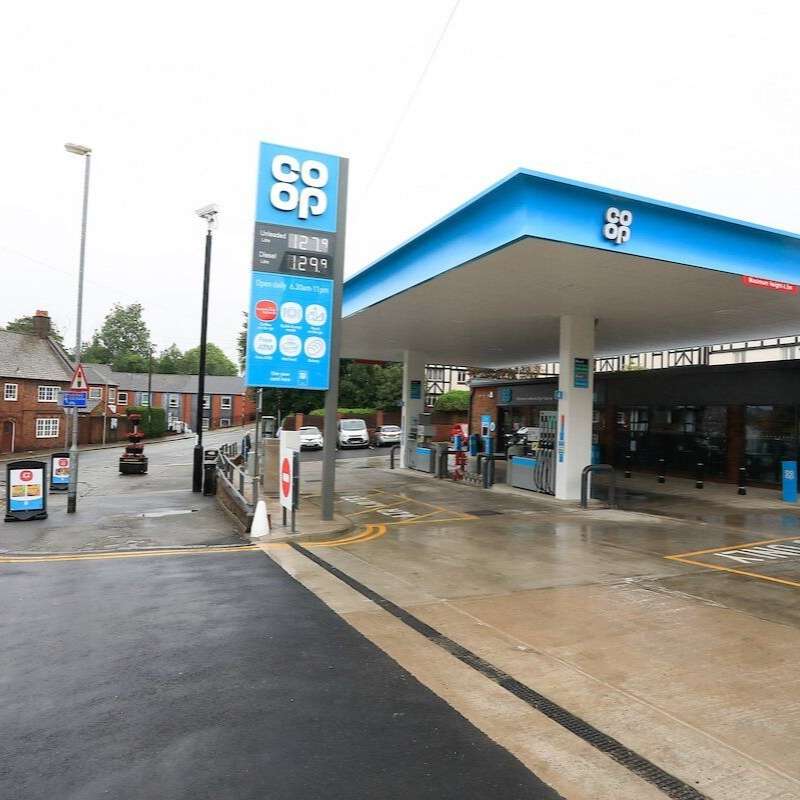
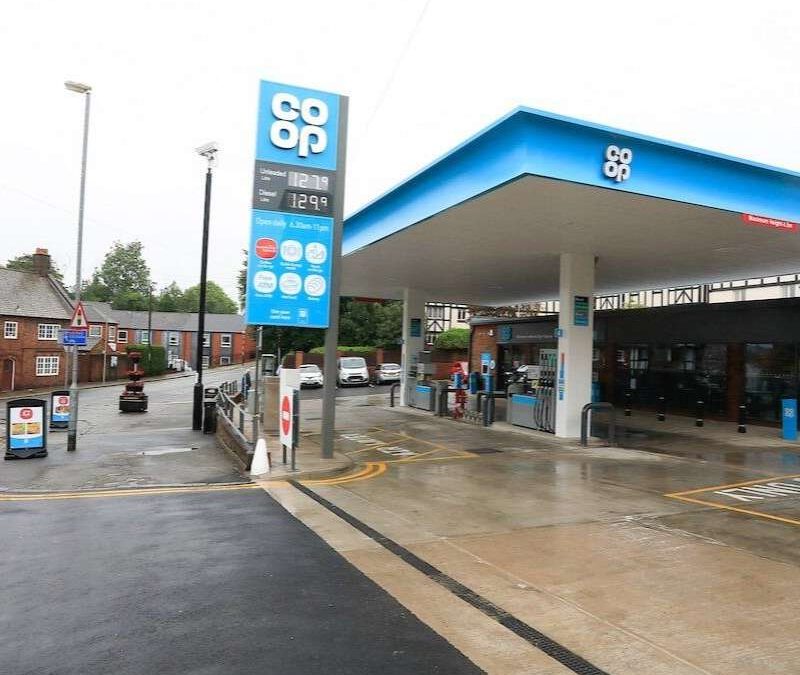
Co-Op Fuel Chester Handbridge

The latest addition to the Co-op forecourt roster is Handbridge Service Station in Chester. Previously an Esso and owned privately, it’s now become part of the wider group.

After opening on the 19th July to a great reception, the multi-million-pound redevelopment has a changed layout to improve traffic flow and an overhaul of the infrastructure.

As part of the international push for saving the environment, the new site runs on 100% renewable energy and offers compostable carrier bags instead of single-use plastic. The compostable bags double up as a caddy liner for your food waste collections and are certified for home-composting.