Most local authorities still operate diesel vehicles: Is your local council hypocritical?

Most local authorities still operate diesel vehicles: Is your local council hypocritical?

To meet international targets for carbon dioxide (CO2) emissions, in 2001, the government encouraged us to switch to diesel cars, even introducing new tax rates as an incentive, but after experts found diesel emissions contained particulates that cause health problems and premature death, politicians began to criticise drivers of ‘dirty’ diesel cars.

Despite their talk on the dangers of diesel, local authority leaders aren’t leading by example and switching to vehicles powered by alternative ‘greener’ fuel sources, highlighted by new research showing that almost 92% of council vehicles have diesel engines.

One rule for one and one rule for another

Under the Freedom of Information Act 2000, Auto Express reached out to the local authorities in England, Wales, Scotland, and Northern Ireland and found that, of the 320 that responded, 91.6% of all the vehicles run on diesel with 62 council fleets consisting only of diesel vehicles.

While fleets vary across the UK, the average fleet has 208 vehicles—vehicles such as dustbin lorries, gritters, and minibuses.

Local authorities admit that replacing their fleets’ diesel vehicles with electric alternatives isn’t an option most of the time, which shows how much the UK relies on diesel. With seven out of the 12 responding councils revealing 98.6% of their fleet is diesel-powered, the Northern Ireland councils depend most on the fuel. Scottish councils are least dependent on it, having the highest proportion of electric vehicles (EVs) in their fleet, but even nine out of 10 of their vehicles are diesel.

An increasing number of councils plan to either outright ban diesel drivers from entering certain areas or charge them a fee for the privilege.

In November, we told you how Bristol City Council plans to ban private diesel cars from its city centre, yet 369 (81.5%) of the council’s own 453 vehicles are diesel, and councillors say they intend to buy a further 64 diesel vans.

And 89% of the 4,844-strong fleet operated by London councils use diesel, including at least 724 (15%) pre-Euro 6 diesel vehicles. Yet, drivers of vehicles with the same non-compliant diesel engines must pay £12.50 to enter the city’s Ultra-Low Emission Zone (ULEZ).

Is an electric council fleet just a pipe dream?

Responding to the analysis by Auto Express, the Local Government Association (LGA)—the national membership body for local authorities across England and Wales—said ‘councils are eager to switch to EVs or low-emission alternatives where possible,’ but ‘the vast majority’ of the specialist vehicles councils use don’t have workable electric alternatives because ‘they don’t exist’.

A Spokesperson for the Convention of Scottish Local Authorities (COSLA) said the figures ‘show a shift away’ from the picture of a traditional diesel fleet and, because of this, there’s a progression towards ‘decarbonising Local Authorities’ fleets.’

COSLA said this shift is likely to span several years but that local government is ‘committed to working towards that goal with Transport Scotland and our public sector partners.’

A spokesperson for Bristol City Council who says the council ‘has a legal duty to improve our air quality,’ said the council hasn’t yet established full details of the city’s Clean Air Zone (CAZ) plan, but that, once the final scheme is in place, it’ll influence how the council uses its fleet, adding, ‘the aim is to reduce air pollution and establish Bristol as a carbon-neutral city.’

Councils that depend on diesel still run a high proportion of EVs compared to the proportion of EVs in the UK as a whole. Together, councils own 1,835 EVs—2.75% of their collective fleets—while the 94,000 EVs registered in the UK make up just 0.25% of vehicles. Of councils with larger fleets (over 20 vehicles), North Somerset has the highest EV proportion, with 36% of its 95 vehicles being pure electric. Of the councils that responded, their fleet included just 306 hybrids and 118 Plug-in Hybrid Electric Vehicles (PHEVs).

The dirty dozen

Across the UK, 12 local authorities stand out because of the number of diesel vehicles in their municipal fleets. These are Aberdeen, Dundee, Glasgow, Edinburgh, Newcastle, Leeds. Manchester, Sheffield, Oxford, Bristol, Bath & North East Somerset, and London. We’ve covered the plans to improve air quality in London and Bristol, but what can you expect from these other major cities?

Aberdeen, Edinburgh, and Dundee both have Low Emission zones (LEZ) under consultation, with Dundee’s introduction planned by the end of 2020 and Glasgow city centre LEZ will ban non-Euro 4 petrol cars and non-Euro 6 diesel vehicles from 2023.

Leeds, Sheffield, and Bath plan to charge drivers of more-polluting HGVs, buses, and taxis to enter the CAZ, with Leeds charging £12.50-£50, Sheffield £10-£50, and Bath £9-£100.

An emission standard-based CAZ for HGVs, buses, taxis, and vans is under consideration in Manchester and Newcastle and, while Oxford is under development, the council could ban non-EVs from parking in the city centre and upgrade its bus fleet to Euro 6.

The demonisation of diesel meant that, in 2017, CO2 emissions rose for the first time in 14 years because of drivers choosing petrol cars over diesel, causing a massive drop in diesel sales. What’s ironic is, tests show that most modern Euro-6 diesel engines are less polluting than many petrol vehicles. Let’s hope the government doesn’t make another u-turn once we’re all driving battery-powered cars.

Are the proposed ‘clean air’ measures workable and fair for everybody? Is your local authority listed? How are they performing? Share your opinions in the comments.

Distracted drivers targeted by AI “Interior Monitoring System” arriving in 2022

Distracted drivers targeted by AI “Interior Monitoring System” arriving in 2022

I’ve worked in automotive engineering for 30 years, with everything from a race-tuned Reliant Robin engine (to be used as a fire pump) through to Formula 1, and everything in-between – WRC, WEC, IndyCar, BTCC, WTCC and low-volume manufacturing, to name a few.

I grew up with sci-fi vehicles like the Johnny Cab, or watching the original Top Gear with William Woollard and Chris Goffey, in which we were presented ‘The Car of the Future’, usually in the guise of something with wings, or semi-autonomous capacity. Today, we are living that sci-fi reality.

It’s easy to decry this technology as the ‘Nanny State’ governing us and our driving, and to a degree, that’s exactly what it is. But, and it’s a big but, it’s these smaller steps of semi-autonomy, Artificial Intelligence, and governance, that are leading the charge to science-fiction, becoming science-fact.

woman using smart phone in the car

Artificial Intelligence

Gone are the days of perfecting the manual gearchange, double declutching, balancing power against grip, or even just reverse parking into a tight spot; modern cars can take care of all of that, and so much more.

Driving was once an art, possibly flamboyant, definitely something that you never finished learning or perfecting, but with the PlayStation generation, it’s just a tool, a method of transportation, where your inputs need to be bare minimum, with maximum efficiency. Is that such a bad thing?

Of course, much of the innovation comes from the need for safety, but it could be argued that  it’s a vicious circle: As cars become easier to drive, with less thought needed, driving standards fall because drivers don’t need to be as aware, or switched on.

Whatever the reasoning, a new way of driving is upon us, and it’s making the most of modern and innovative technologies such as Artificial Intelligence.

Bosch Interior Monitoring System

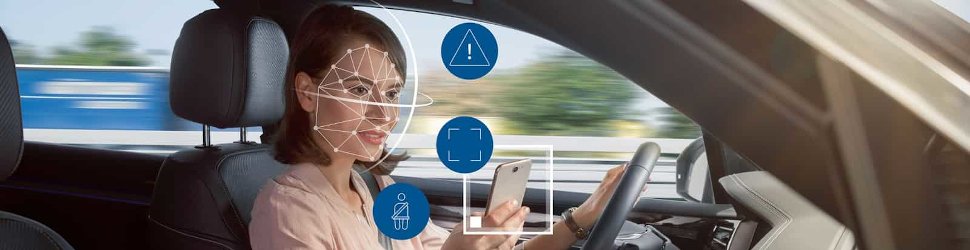
The latest news in safety and monitoring, comes from the German brand, Bosch GmbH. They are pioneering a system that uses a combination of cameras and Artificial Intelligence to monitor the occupants of a vehicle.

The system is capable of actively adjusting numerous safety systems (seat-belts being a prime example) to best contain or minimise injury; cameras mounted in the steering wheel, rear-view mirror and roof, will monitor eye movement, blink rate, and seating position to best determine whether the driver is distracted, or even if the passengers are sitting in an awkward position (as is the way with most children).

It can then take the appropriate action, be that adjust seat-belts, slowing the car, or just sounding a warning signal.

1 in 10

Past research tells us that around one in ten accidents are caused by distracted or tired driving, the European Commission estimates that systems such as the Bosch IMS could help save 25,000 lives by 2038.

That’s no small number, but you’d have to ask yourself whether in 2038, a system such as this will still be relevant? Surely, full autonomy will be commonplace, with human decisions at an absolute bare minimum?

With that said, this type of technology will be used in production vehicles from 2022, along with the speed monitoring systems and numerous other AI-based innovations, all to make our motoring lives safer. While I dislike the fact that these systems seem to be removing the skilful element of driving, I appreciate that these are necessary if we’re to make the switch to full autonomy in the future.

However, we’ve all seen the photographs of Tesla drivers seemingly asleep at the wheel, letting the Autopilot system do all the work. While that behaviour is (currently) illegal, and Tesla have built-in some safeguards (such as having your hands on the steering wheel), surely that’s the obvious misuse of these systems that we’d expect?

This is part of the problem that we referred to earlier – as cars become easier to drive, with less input needed, driving standards will fall, and we could see a spike in collisions and accidents as a result. American police have already had to use the Tesla’s Autopilot to bring a car safely to a stop (with the Tesla system recognising that the car in front was slowing to stop and it followed), but reliance on safety is still down to the one thing that can’t be changed; human behaviour.

Truthfully, there’s no easy answer, and the gap between traditional drivers and the PlayStation generation is getting wider – think of your elderly mother continuing to struggle with sending a text, and how frustrating that is to someone where it’s second nature. These modern generation vehicles will soon become similar.

Is technology a good thing? Is there an issue of slowing down the introduction of tech to allow drivers to keep up? Or should we just push for as much autonomy as possible? Let us know in the comments.

Image credit: Bosch

AA slam supermarkets for excessively high shop spend limits to get fuel discounts

AA slam supermarkets for excessively high shop spend limits to get fuel discounts

It’s hard to believe, and perhaps it gets lost with the differences between forecourts, but November saw petrol and diesel prices drop for the fourth consecutive month, by an average of £0.005 per litre.

However, motoring experts say that fuel is still overpriced, and the AA say that supermarkets aren’t helping the situation with their ‘deals’; spend £60 in-store and get 10p off a litre of fuel. It’s thought that only around 1/3 of motorists regularly spend this amount when grocery shopping.

3 petrol pumps

Fuel price drop

Fuel price analysts say that fuel is still overpriced, and considering that supermarkets have the margins to lower forecourt costs by up to £0.05 per litre, they should be doing more to help drive the prices down, and given that wholesale costs are low, they should be doing this.

The Fuel Watch report carried out by the RAC, says that prices for last month fell by £0.0048 for petrol, and £0.0044 for diesel in the same period, making the average price per litre drop from £1.26.41 to £1.25.93 (unleaded) and £1.30.27 to £1.29.83 (diesel).

This means that the average cost to fill a 55-litre tank is £69.26 (unleaded) and £71.41 (diesel), which is almost a couple of pounds less than the prices being paid in the summer. Since the beginning of August, fuel prices have dropped by around £0.03.31 for unleaded and £0.02.21 for diesel.

Petrol Prices

Of course, we at PetrolPrices could argue that downloading our app could potentially save you more than that anyway (with potential savings of over £220 per year), but in a survey carried out by the AA, consumers want to see more action being done to regulate prices, including forced time periods for following the wholesale cost; so that a forecourt had to reduce the price within a certain timescale.

The AA surveyed nearly 18,000 members, 73% agreed that the Government should set a maximum timescale for retailers to pass on savings, and 86% agreed that they thought supermarkets had the cheapest fuel.

With that said, supermarkets have come in for some heavy criticism, thanks mainly to the spend & save deals linked to fuel. Just 34% of the respondents to the survey said they would regularly spend £60 or more on groceries, and for those aged between 18-24, that figure fell to just one in ten.

When these schemes were first introduced, the ‘spend’ figure had variables – spend £20 for 2p per litre saving, £30 for a three pence saving, but these have gone by the wayside as supermarkets look to maximise their revenue, and in-store spending. 58% of the survey said that they thought supermarket vouchers were an underhand way of getting consumers to spend more.

One supermarket retailer did come out of it well though – ASDA had the cheapest fuel at the end of November, with retailers such as Sainsburys and Morrisons charging nearly two pence extra for diesel. It was also reported that significant savings at the pump (rather than through a voucher) only really happens when ASDA triggers a fuel price war.

Lesson learned?

Overall, consumers think that supermarkets have the cheapest fuel, and statistics do bear that out – averagely, supermarket fuel is £0.04.70 cheaper per litre than at other, regular forecourts, so clearly they’re doing something right, but is it enough?

It’s easy to say ‘vote with your feet’, but for some, that just isn’t practical; my nearest ASDA for example is seven miles away, an easy twenty-five minute journey each way, so I’d be faced with almost an hour’s driving for a small saving.

But … if you’re combining it with a trip for groceries also, then that could work for you, it certainly influences my shopping choice, and I can’t be alone. What would happen if people did start voting with their feet and using supermarkets in such a manner? You can easily see the likes of Tesco, Sainsburys and Morrisons having to compete, because they’d be losing both forecourt and retail revenue.

For some people, fussing over a penny or two saved at the forecourt is just an annoyance, but for others, it can be the difference between staying in the black, or hitting the red, and it shouldn’t be that way. Did you know that there are now more foodbanks than branches of the clown themed fast food restaurant?

Should supermarkets be doing more to help those on the breadline? Do you think that their ‘spend & save’ voucher is a good idea? Or just an underhand way of generating revenue? Let us know in the comments.

UK drivers getting lazy! Demand for automatic vehicles doubles in last five years

UK drivers getting lazy! Demand for automatic vehicles doubles in last five years

A report by the AA shows that those of us searching for cars with automatic gearboxes has almost doubled in the past five years, going from 9.9% in 2014 to 18.6% this year.

In their recent survey of 20,000 motorists, the motoring organisation found most people prefer automatics—with well over half claiming they’re easier to drive—but could there be another reason for the increased interest in automatics?

car gears

A shift away from manual?

Used vehicle selling site, AA Cars, said they’ve added more automatic vehicles to their advertised vehicle stock over the last five years and, of the models listed, the number of cars with automatic gearboxes increased from 23.4% in 2014 to 32.1% in 2019.

But it has been the last two years where the largest increase in searches for automatic cars has happened, according to the AA’s figures.

AA Cars looked at where in the UK is selling the most automatic cars and revealed the top 10 towns and cities with both the highest and lowest proportion of automatic cars for sale.

The highest proportion of automatic cars for sale was in Chelmsford, Essex, where 61.4% of second-hand cars for sale have automatic gearboxes. London came second, with automatic cars accounting for 53.6% of available secondhand cars, followed by York, where 42% of cars for sale have automatic gearboxes. The eight other towns and cities with the highest percentage of automatics for sale are Leeds (42%), Bury (39.5%), Luton (39.5%), Lincoln (39.4%), Sheffield (38.7%), Bradford (36.8%), and Doncaster (35.4%).

In the 10 towns and cities with the lowest proportion of automatic cars for sale, Liverpool has the fewest, with automatics making up just 15.5% of the stock, followed by Paisley at 15.6%, and Edinburgh’s used automatics accounting for 17.5% of the market. Making up the rest are Stirling (17.6%), Glasgow (19.8%), Newcastle-upon-Tyne (19.8%), Rotherham (22.2%), Nottingham (22.6%), Wakefield (22.6%), and Preston (22.8%).

Also in the AA Populus poll, 57% of drivers said automatics are easier to drive than manual cars, which meant they found them more desirable and only 9% of motorists said they were harder to drive than a manual vehicle.

Despite the figures highlighting that most people find automatics easier to drive, 32% of motorists say they don’t enjoy driving automatics as much as cars with a manual gearbox, while 20% of the survey respondents said they get equal amounts of enjoyment whether they’re driving automatics or manuals.

By popular demand

Are cars with automatic transmissions more popular because we don’t want the hassle of changing gear ourselves? Well, maybe, but AA Cars said there’s a good chance it’s because more of us are searching online for used pure electric vehicles (EVs) and hybrid vehicles. Most EVs don’t contain gearboxes and hybrid vehicles most often use an automatic-style gear-change.

James Fairclough, CEO of AA Cars, said:

‘Automatic vehicles are being manufactured in greater numbers, but it is pleasing to see that drivers are responding positively to this added supply with even more of them actively searching for these cars.

‘The increasing interest in electric cars is partly behind these figures, as the vast majority on sale are automatic and they are growing in popularity in the used car market.’

Clutch pedal use can get uncomfortable—more so in areas with heavy traffic—and can cause aching leg muscles because your left foot never gets a rest. Mr Fairclough said it was ‘no surprise to see that congested London is one of the best-stocked areas for automatic cars as they require much less effort to drive when someone is stuck in stop-start traffic.’

‘Every driver has different preferences for what they want from their car, so we would always urge people to take a car for a test drive before committing to a purchase. This can be an important step in determining if the car is in good condition, but will also help drivers decide if an automatic or manual is best for them, added Fairclough.

Shiftless and lazy?

Driving an automatic is a different driving experience than driving a vehicle with a manual gearbox, but is it lazy driving? What about power-assisted steering or other technological advances that make modern driving not only easier, but safer?

The AA’s survey results proved what we already knew; that many of us find it easier to drive automatics. Without the gear stick and clutch pedal, you can better focus more on other aspects of driving, like vehicle position, speed, and the road ahead. You also won’t suffer any embarrassment from stalling the engine, making hill starts and traffic lights easier, too.

Automatic cars aren’t without their downsides, though. In September, we told you about the hidden faults affecting some of the most popular cars, including the Ford B-Max (2012-2017), and the problems with its PowerShift automatic transmission that affected 25% of owners. Automatics also cost around £1,000 more than their manual equivalents, although the price difference decreases on used models.

Drivers who only hold an automatic licence often pay much higher car insurance premiums than those with a full licence and, if you pass your driving test in an automatic, you’re only legally allowed to drive an automatic vehicle, while if you pass your test in a manual car, you can drive both manual and automatic vehicles.

The government is looking into bringing the ban on the sale of new petrol and diesel cars forward to 2035 and, with EVs and hybrids growing ever more popular and advanced, it’s thought manual cars could disappear from UK roads within 10 years—something I remember my driving instructor predicting. I guess she was right. One thing’s for sure, driverless cars won’t have gears.

Do you drive a vehicle with an automatic or manual transmission? Have you driven both types? Which do you prefer? Tell us in the comments.

Travelling over Christmas? Here are the top ten rip-off service stations revealed

Travelling over Christmas? Here are the top ten rip-off service stations revealed

The motorway service station has been around since Watford Gap opened in 1959. Back then, it was all fine dining and table-side service – what we’d call a ‘destination event’ today, but sixty years later, it seems that the prices are still aimed fine dining, but without the experience, or table-side service, or decent food.

A cheese sandwich, refrigerated sausage roll, ready salted crisps, Wine Gums, Dairy Milk chocolate, Coke and water – typically around £6.90 from the average supermarket, but if you’re shopping at a motorway service station, expect to pay a little more. OK, maybe more than that, and that. In fact, those seven items could cost you over £16.

We’re fully aware that motorway services tend to make the most of their pricing and captive audience, but an average of 14% more expensive for fuel, and a whopping 135% costlier than a supermarket for snacks? That’s quite a markup.

UK service station

Completely justified

Of course, if you ask one of the service station operators, those prices are completely justifiable. A spokesman for Roadchef, which operates 30 different services on 21 sites, cornering 24% of the market share and generates revenue of around £115m per year, said:

“Motorway services are complex businesses and, unlike many high street operations, are required to be open 365 days a year, 24 hours a day. We also maintain around 10-40 acres of land around our sites, as well as access roads, lighting, extensive parking areas and in some instances, water treatment works. It means that our overheads are significantly higher than the majority of supermarkets and convenience stores.”

“Our own research suggests we are competitively priced against other service areas on these products and we strive to offer customers a range of choice in all areas, including fresh, high-quality sandwiches and snacks which are prepared in our own on-site kitchens in most cases.”

It’s worth noting that the Heart of Scotland services (M8 between Edinburgh and Glasgow) would charge just £9.31 for the same items.

The top ten rip-offs

Surprisingly, there doesn’t seem to be much of a North/South divide, with just £0.51 covering the top ten, covering regions from the North East and the West Midlands, through to London, Wales and the South East.

  1. Durham Services A1(M) – £16.21
  2. Lancaster (Forton) M6 – £16.17
  3. Woolley Edge M1 – £16.17
  4. Hilton Park M6 – £16.16
  5. Leigh Delamere M4 – £16.16
  6. Beaconsfield Services M40 – £16.01
  7. Bothwell Services M74 – £15.96
  8. Magor Services M4 – £15.81
  9. Birchanger Green M11 – £15.75
  10. Reading Services M4 – £15.70

Bottled water seems to be the favourite for inflated prices, with some service stations charging as much as 420% extra over a typical £0.44 price from the supermarket, with the Beaconsfield services charging £2.29 for just half a litre. All services offer free water refills though.

Government clampdown

For some years, government ministers have been promising to clampdown on the price inflation, but to date, nothing has been done, and there’s no plans to do anything. Clare Egan, head of Motor Product at Admiral Insurance (that commissioned the mystery shopper research) admits that most drivers expect to pay a levy for the convenience of the motorway service station, but that the prices at some service areas are nothing short of “highway robbery”.

“Grabbing the essentials from home or at least a supermarket before setting off could result in some big savings on the overall cost of your journey. Given the availability of free water refills at all of the service stations and the push to be plastic-free, motorists don’t need to spend anything on bottled water, let alone a forking out as much as 420 per cent more than in a supermarket.”

“Many of us will be making cross-country trips with our families over the coming weeks, and it will be tempting to stop en route for a snack or petrol. By planning ahead, you could avoid the hyper inflated service station costs, save some money for Christmas and help the environment at the same time.”

A reasonable cost

In the world of marketing and commerce, there’s a saying that goes along the lines of “If you’re not paying for the product, you are the product” – think along the lines of Facebook, Google, Twitter et al … it’s your data that’s of value to the company.

Clearly, when a company is offering a service (such as the motorway service areas), you expect to pay a premium for the convenience, but at what point does that ‘premium’ become blatant profiteering? While the operators claim to be ‘competitively priced’ with other providers, that doesn’t really say much, aside from the fact that they’re nearly all charging too much, and it’s unlikely to end anytime soon.

Do you use service stations? Are you happy paying the extra for the convenience? Or is it just a case of a bathroom break and nothing else? Let us know in the comments.

Image credit: © Copyright Mark Anderson and licensed for reuse under this Creative Commons Licence.

Study says a fiver’s worth of charge in an electric car takes you twice as far as £5 spent on petrol or diesel

Study says a fiver’s worth of charge in an electric car takes you twice as far as £5 spent on petrol or diesel

A new study says that £5 worth of fuel—be it petrol, diesel, or electricity—goes almost twice as far in electric vehicles (EVs) than it does in petrol and diesel vehicles and, if you buy a bus or train ticket for £5, your mileage distance will only be a fifth of that travelled by an EV.

After finding that one in five drivers thinks EVs are more expensive to run than other types of vehicles, the car-buying platform, carwow did some research to work out the cost-per-mile of an average EV. They say EV drivers get around 40-50 more miles out of their cars than petrol and diesel owners.

Audi MPG

Going the distance

The study, that used both regional electricity prices and regional petrol and diesel prices and calculated the car journeys based on normal driving conditions took the Volkswagen e-Golf and worked out the cost (per kilowatt-hour) of charging its batteries, calculated how far the car would travel before it needed recharging, and found it would travel about 102 miles.

They then compared the figures of the e-Golf against comparable petrol and diesel Golf models, taking into account their mpg statistics. They found £5.00 would take the diesel Golf 56.5 miles, while with the same cost of unleaded, the petrol model would travel 49.6 miles.

The carwow study then compared public transport distances, costing £5 (converted from euros for Dublin), out of 10 major cities and found that the fare would take you 20 miles via train and just 12.6 miles travelling by bus.

From London, £5 would take an EV as far as Worcester or Bristol, while a diesel car would only get to Oxford or Winchester, and a petrol car would only get to Basingstoke, Milton Keynes, or Bedford. Spend around £5 on a bus or train ticket and you won’t get far from the M25.

Miles apart

Matthew Watson, Editorial Director at carwow, said:

‘Some people might be surprised to see that you can travel pretty much double the distance in an electric car than you can with diesel or petrol, but you can’t argue with the data.’

The company, who hopes their research helps prospective buyers ‘adopt the new technology rather than write it off in favour of traditional choices’, said people need more education about electric cars, their ‘benefits and their feasibility’.

Mr Watson said the choice to move to an alternative fuelled vehicle ‘will be a personal one, depending on where you live and how much local investment there has been to infrastructure as the roll-out has not been even,’ though he said progress is happening fast.

Earlier research by motoring review website Parkers supports carwow’s findings. In an October article, they looked at the top 10 best-selling, most efficient electric, petrol, and diesel cars, comparing how far a pound of fuel would take each car. Calculating the distance in miles per pound (mpp), they reported that, for the same fuel cost, the EVs could travel around three times further than the petrol or diesel models.

Keith Adams, Editor of Parkers, said:

‘We created miles per pound as a way of demystifying the running costs of electric vehicles because above and beyond their range, and how long they take to charge, there is little uniformity in how carmakers express just how much energy these cars use.’

In Parker’s research, the first edition Kia e-Niro and the Renault Zoe 65kW, went the furthest, with each travelling a remarkable 33.1 mpp of electricity with Tesla’s Model 3 coming in at third place with 32.3mpp.

In comparison, Parkers found the most economical version of the Ford Fiesta—the top-selling car in the United Kingdom—was around four times as expensive to run than the EVs, with only 9.3mpp.

‘Taking fuelling costs into account, monthly costs for internal combustion engine cars and electric vehicles are much closer than the gap in list price might suggest. ‘While it’s easy to be put off at the price of an electric car when you look at it from a monthly costs perspective the prospect is all the more attractive.’

In charge

Vehicle running costs aren’t the only thing you need to consider when trying to decide whether a car is affordable for you. EVs are more expensive to buy than their petrol or diesel equivalents. After the £3,500 plug-in grant, the e-Golf costs £27,575, while the entry-level petrol model costs £23,340, and the diesel costs £25,585.

Electric vehicles often cost more to insure, not only because they’re more expensive, but because insurance companies have little experience insuring them yet, as the government continues to place tighter restrictions on petrol and diesel cars, EVs will become more common and so, cheaper to buy, reducing their insurance costs.

And, if you own a pure EV, you’re exempt from paying car tax (from next year there won’t be any company car tax on EVs, either) and, if you drive your car in London, you won’t need to pay Ultra Low Emissions Zone (ULEZ) or the Congestion charge.

Forty-nine per cent of people don’t know the UK has more charging stations than petrol stations, which may explain why 35% of EV drivers say they worry about their vehicle running out of power, not being able to charge it, and getting stranded. A recent study from Lex AutoLease found many drivers are afraid to switch to EVs because of ‘range anxiety’.

Yet, further investment is on the way if we can believe our politicians. In the lead up to the election, the Conservatives pledged an extra £500m to boost the UK EV infrastructure, to make sure there’s a ChargePoint within 30 miles of each home in England and Wales. And, as part of their ‘Electric Car Revolution’, Labour promised a £3.6billion rollout of EV charging networks across the UK, with interest-free loans to help drivers buy EVs.

Are EVs expensive to own? What are your concerns about owning a plug-in car? Do you own an EV? What’s your experience of their running costs?

Petrol stations are the latest places to dish out pricey parking tickets

Petrol stations are the latest places to dish out pricey parking tickets

Parking one’s car can be a nightmare and an often expensive one, too. Whether you’re using a train station car park or you’re parking your car at home, work, at a retail park, or a hospital, you not only face wasting minutes of your life trying to find a space, but the chance of a steep fee, the risk of a parking ticket from poor signage—or other ridiculous reasons—or not getting your change back from the parking machine. It’s a lucrative business, for sure.

Now, private parking firms are issuing steep fines to motorists who stay too long at petrol stations, with both BP and Shell garages getting parking companies to fit CCTV cameras at the forecourt entrances and exits, to catch and charge motorists who overstay their welcome. This means drivers who are spending good money filling up on fuel and using on-site facilities are getting hit with £100 fines.

It won’t wash!

Common law requires that businesses make their time restrictions signs unambiguous, but motorists say it’s easy to miss them on busy forecourts or junctions—even more so after dark—and most motorists aren’t aware that time limits now apply at more and more petrol stations across the country.

Earlier in the year, a motorist using the Shell forecourt in Kilburn received a £100 demand from Euro Car Parks for staying longer than their 20-minute limit and, last week, a driver got a £100 demand after she exceeded the maximum stay at a Shell garage near me. In both cases, the delays arose from queuing for the on-site car washes.

Time limits are a problem at BP petrol stations, too. A recent recipient of one of these demands used the BP garage on Mitcham Road in Croydon, south London. After paying for his fuel, the driver recalled queuing behind around six vehicles to use the car wash but later received a letter threatening debt recovery agents when he didn’t pay a £100 parking charge demand by MET Parking Services from him staying past the permitted 30 minutes limit.

The parking company sent his wife, the vehicle’s registered keeper, earlier correspondence, reporting the car stayed on the site for 47 minutes, demanding payment and offering to reduce the charge to £60 if paid within 14 days. The letter sat unopened until much later, so he paid the £100 in fear of debt collectors arriving at their house. He says he didn’t see any signs advising drivers of a time limit.

Last year at the same forecourt, a motorist noticing a queue for the petrol pump, used the on-site Marks & Spencer’s ‘Simply Food’ shop, resulting in another queue. After vacuuming his vehicle and waiting for the car wash, he’d been on-site 42 minutes and received the same £100 demand. After a difficult appeal, the motorist received a refund but said BP wasn’t interested, even after he told them they penalise their customers for using BP’s services.

Fair game

Staff from The Guardian newspaper visited the Croydon petrol station and spotted a sign warning motorists about the 30-minute rule, but said it would be easy to miss, more so when heading southbound. After approaching five drivers, they found two of them didn’t know about the time limit, despite having just driven past the sign. After speaking to BP staff, who said the number of similar complaints was a problem, one cashier thought BP was installing cameras at all the 1,200 forecourts in the country because people used the area just for parking.

A spokesman for MET Parking Services said of the BP garage:

‘The 30-minute maximum is clearly signposted throughout the site. We would encourage any motorist who believes they were issued with a charge notice incorrectly to appeal using our BPA [British Parking Association] audited appeals process. Motorists have the right to appeal to the independent appeals service, Popla [Parking on Private Land appeals], which is a free and easy to use service.’

Shell, who operate over 1,000 fuel stations, says they introduced the parking restrictions at sites with limited space to ‘make it fairer for everyone’ and the customers staying longer to use a car wash should put their vehicle details into the car wash or shop console to avoid receiving any charges.

Barrie Segal, a parking ticket expert and owner of AppealNow.com, said:

‘The fact that so many motorists have been caught out suggests that these requirements are not being complied with. It beggars belief that BP and Shell effectively penalise their customers for buying their petrol and goods in their forecourt shops. It behoves BP and Shell to ensure that their customers are not penalised. Drivers who feel that they have been unfairly fined should appeal explaining the reasons why the fine is unfair. They should also complain to BP and Shell.’

Fine print

There have been improvements in parking, though. Back in 2017, we told you how parking operators could track down driver details to pursue fines. Yet The Parking (Code of Practice) Act 2019 introduced a single code of practice and a single appeals process—to cap the level of penalties companies can charge—and the Driver and Vehicle Licensing Agency (DVLA) can no longer sell motorists’ details to companies who don’t follow the rules.

If you’re ever sent a parking charge demand, remember, no matter what their letters say, only local authorities can issue fines to motorists, not private parking companies. Instead, these firms can seek to reclaim so-called ‘damages’ from you.

If you receive a letter saying you owe them money, you can send the parking company what you would have paid to park in the local area, but state that your payment is a ‘full and final settlement’ and get a receipt.

The other way is to tell the company you think their demand is unfair and that you won’t pay. The parking firm then must decide whether they’re prepared to take you to court to prove their ‘loss’. If they do, you must defend the action. If you don’t turn up to court, you lose by default. Although parking firms sometimes take motorists to court, they often don’t.

Popla—an independent appeals service for Parking Charge Notices issued on private land—will appeal tickets issued by BPA members and overturns about 52% of charges and MoneySavingExpert has a section dedicated to parking ticket issues with useful template letters.

What’s your opinion on the £100 overstaying charge? Do companies design the restriction signs to make a profit by catching people unawares? Is a time limit necessary to prevent motorists using the site as a car park? Share your opinion in the comments.

Image(s) copyright:  (BP) © Copyright Lewis Clarke and licensed for reuse under this Creative Commons Licence. (Shell) © Copyright David Smith and licensed for reuse under this Creative Commons Licence.

Car tax evasion rates have tripled since the paper disc was withdrawn

Car tax evasion rates have tripled since the paper disc was withdrawn

Road vehicle taxation has been around since … well, road vehicles. The UK’s first road tax schemes for ‘light locomotives’ were introduced in 1896, and then under the Motor Car Act 1903, all road vehicles were taxed at 20 shillings per year.

No doubt that motorists of the day were slightly less aggrieved at paying a fee to actually help build roads and infrastructure, rather than shoring up failing local authorities, or feeding a greedy government.

Car tax evasion

Vehicle Excise Duty (VED) is the correct name for what we all know, and call, car tax. It’s been through a few minor shake-ups over the years, and more recently been tweaked to suit the increasing desire to incentivise cleaner transport, but essentially it amounts to the same thing; along with fuel duty, it’s just another way of eeking out a little more money from the motorist.

When the decision was made to drop the physical paper disc to save money (with estimates putting the savings at an expected £10m per annum), car tax evasion levels were around 0.6%, today, that level is around 1.6%, or approximately 634,000 vehicles. Or to put it another way, around £94m lost.

That figure is down slightly from the peak in 2017 – 1.9%, but it’s still very significant.

Financial burden?

Clearly the loss of the paper ‘tax disc’ has had an impact, but figures released by the Department for Transport don’t give any clear picture as to why; we know that around 40% of the unlicensed vehicles were over ten years old (around 51% in 2017), and that approximately 11% of the vehicles have been unlicensed for a over a year, so it’s more than a momentary lapse of judgement or memory.

Could this be ‘Austerity Britain’ hitting home? Or just a simple criminal element maximising the lack of enforcement procedures and resource?

Police numbers have fallen by 14% since 2010, that’s over twenty thousand less officers within the service, and of course that has an impact on catching persistent offenders for any crime, least of all car tax evasion.

Solutions

In our previous VED article, we talked about scrapping the normal VED charge and opting for a pay-as-you-drive style charge – a small incremental extra on top of the regular fuel price would mean that those using the roads would pay more, equally so for ‘dirty’ gas-guzzlers, and of course, there would be no costs associated for collection or enforcement. Quite a simple solution to what seems to being made into a difficult problem.

Perhaps the danger of that would be that those on or below the poverty line would simply shift from risking driving without road tax, to driving without insurance instead; the dilemma of only being able to afford one or the other.

Technically speaking, driving without road tax will automatically invalidate any insurance policy in place anyway, so there’s no difference in the eyes of the law, but there would of course be a saving on the insurance premium.

ANPR

With the increase of ‘safety’ cameras seemingly being used to replace good old fashioned human resource, you’d have to wonder just how hard it would be to convert them to be ANPR (Automatic Number Plate Recognition) capable – automatically detecting those cars driving without road tax, and issuing a fixed penalty notice or at least, triggering a warning for investigation.

Of course, as with any other systems or solutions, there will be instances that are incorrect (like heading to a pre-booked MOT for example), but surely, including some sort of notification system (for the driver to the DVLA) isn’t beyond the realms of possibility?

While it’s easy to think that for whatever solution, the criminally minded will have an answer, but this is about making the whole system easier. Perhaps with an increase in revenue, and fewer costs, the price could be subsidised for those that genuinely can’t afford to run a car, but practical reality dictates that they must.

Time and technology changes everything – from having to write out a cheque, send it through the post and wait for the disc to arrive, to simpler payments at the post office and instant delivery of the tax disc, through to direct debits and no disc. Yes the system is easier than before, and with opening up the process to monthly direct payments it’s more affordable, but we’re a long way short of being optimised, and it’s time for a revamp of the whole system.

Should the government scrap the VED and just place an increment on fuel duty? Do you have a solution as to how we can stop persistent evaders? Let us know in the comments.

Potholes & parking: two key strategies to win you over

Potholes & parking: two key strategies to win you over

As motorists, we get used to the ‘bust & boom’ nature of owning a car; hit with taxes, hit with taxes, and hit with taxes, with some light relief of “actually, you car driving people deserve a break”. Of course, the cycle usually follows a strict pattern – the timing of a general election.

Some candidates are telling us that they ‘vow to end rip-off NHS parking charges’, while others promise to end the blight that is potholes and poor roads. One in particular is mixing it up and offering to tackle both problems. To a degree.

But is it all pie in the sky thinking? A cheap trick to woo us?

Pothole repairs

The Asphalt Industry Alliance (AIA), whose members are primarily responsible for filling in potholes, states that £9.79bn is needed over the next ten years to bring our roads up to scratch, and that typically, UK drivers need to spend around £4bn every year on getting their car fixed due to damage caused by potholes.

The problem is so bad, that 56% of motorists have said that their car has been damaged at least once, and 28% of drivers have had an accident or near miss because of a pothole, a further 15% have had a tyre blowout after being damaged by a pothole.

Clearly, a strategy for fixing potholes is much needed, but the very obvious question needing to be asked is where would the money come from? Further taxation? We already pay tax on top of tax in the form of fuel duty, and then of course we have VED and numerous other stealth taxes.

With £2bn of money being promised as part of the Government national infrastructure strategy, there may just be enough to scratch the surface (but not fix it).

For a simple representation of the problem, which is said to amount to a 33km depth hole, Confused.com has put together a simple animation of what that means, along with a handy guide on how to claim for pothole damage to your car.

NHS parking charges

Both of the primary candidates have promised to tackle excessive NHS parking charges, albeit in slightly different forms – one is offering a complete abolition of car parking charges, the other wants to offer free parking for certain groups – terminally ill, frequent visitors to the outpatients dept., NHS nightshift workers and the disabled ‘blue badge’ holders (169 NHS trusts charge blue badge holders for parking).

Depending on the source used, we know that patients, visitors and staff coughed up around £272m for car parking in NHS facilities in 2018, with £86m of that being paid by the NHS staff and workers, and £950,000 being made up of fines for parking offences.

While it’s acknowledged that the NHS trusts are responsible for setting their own parking fees, the issue is somewhat clouded by the fact that not all of the trusts receive all (or any) of the money. More often, the trust uses a third-party operator to run the parking, and of course costs very between operators, and for once, it doesn’t seem to follow the North / South divide.

Manchester’s University NHS foundation trust topped the bill for revenue generated – just over £6m being distributed almost equally between public and staff, and the University Hospitals Coventry & Warwickshire claimed second spot, with just under £6m – £5,992,849 (just £2m for the staff).

Some politicians are calling it a “tax on sickness”.

Cheap vote winners

Being a motorist during a run up to an election is about the only time that we can feel valued, or at least considered, rather than the devil incarnate for having the audacity to use a private vehicle (even more so if it’s fuelled by unleaded or diesel).

But these promises made to us are nothing short of cheap tactics to win a vote, and anyone that bases their decision purely on the points raised will be in for bitter disappointment when the votes are counted and the next incumbent sits. That’s not to say that it’s all fantasy, but just that I for one won’t be holding my breath.

It’s all very well promising untold fortunes for the benefit of the motorist, but the simple reality is that many local authorities are on the verge of financial collapse, and any ‘spare’ money has long been accounted for. Any extra monies promised will either leave a deficit somewhere else, or have to be raised from further taxation, and as it’s for the motorists benefit, you can be sure that it will be the motorist paying for it.

What are your thoughts on NHS parking charges? How should the government (whoever that may be) fund these extra initiatives? Would you pay an extra tax for better roads? Let us know in the comments.

New cars to have breathalysers and speed limiters by 2022 following new EU rule

New cars to have breathalysers and speed limiters by 2022 following new EU rule

A new EU regulation says that all new cars must have integrated breathalysers and speed-limiters by 2022. Existing models sold after 2024 must also have this updated safety technology. The British Government has confirmed the standards will apply in the United Kingdom, despite Brexit.

The landmark ruling, which the European Transport Safety Council (ETSC) say may cut traffic collisions by 30% and save 25,000 lives across Europe over the next 15 years, received provisional approval in March but the European officials passed it early last week.

Tried and tested

In-car breathalysers are common in Australia and the United States, where they’re known more often as ‘alcohol interlock devices’, or ‘alcolocks’. Fitted onto the dashboard, the breathalyser needs a clean breath sample before the car’s engine will start. If the driver doesn’t pass the test, they must wait a certain amount of time before they can re-test. In-built chips can let the police know when a driver fails a test or if someone has tampered with the machine.

Some systems need the motorist to give repeat readings at random intervals, preventing drunk-drivers from getting a sober person to start the engine and/or drinking once the vehicle has started.

In a deliberate move, the EU won’t yet discuss the practicalities of how the breathalysers will work but, after doing my research into a common ignition interlock used in the US, I imagine it’ll work with a camera to check that the driver is the person taking the test whereby the camera takes an automatic snapshot of the motorist whenever they give their required sample.

Aside from breathalysers, the recent approval includes several new mandatory safety features including ‘Intelligent Speed Assistance’ (ISA) software, which stops drivers from going above speed limits, slowing speeding vehicles, and another feature that detects when you’re falling asleep, drifting over lanes, or losing concentration.

The speed-limiter software uses GPS data and speed limits from local traffic cameras, displaying the limits on your car’s dashboard.

If you go above the limit, the system reduces your car’s speed and, although you can override the system by pressing harder on the accelerator, if you continue to speed your car will sound an alert, like a seatbelt alarm.

The ETSC has suggested motorists should be able to deactivate ISA software. While speed-limiting equipment seems like something from ‘1984’, it could also help reduce road casualties, so shouldn’t we take advantage of all technological safety developments?

Drive like your life depends on it

People met the ruling, that the European Parliament says will save ‘thousands of lives’ and help motorists avoid speeding tickets, with a mixed response.

The road safety charity Brake describes the new regulation as the ‘biggest leap forward for road safety this century’ and Joshua Harris, Director of Campaigns at Brake, said:

Drink-driving and speeding are a scourge on our roads and the cause of devastating crashes every day.

Mr Harris added it was ‘fantastic to hear that alcohol interlock compatibility and speed-limiting technology will soon be mandatory.’

Despite our government agreeing to mirror EU road safety rules, it’s up to them to decide on how we use in-car breathalysers.

Neil Greig, Director of Policy and Research at IAM RoadSmart, says it’s unlikely the vast majority of the law-abiding public will ever use them to start their car, which may mean the only people who must use breathalysers to start their engines are motorists convicted of drink-driving, returning to the road after a driving ban.

Edmund King, President of the AA, said that ISA can help motorists from always checking their speedometers because even when people are religious about sticking to the speed limit, they still face the threat of ‘smartphone zombies and other unwary road users stepping out in front of them or drunk or distracted drivers crashing into them.’

King said, while technology plays a part, motorists shouldn’t only rely on computers and cameras to drive their cars for them and, until vehicles come with complete self-driving capabilities, people must keep their eyes on the road and their hands on the wheel.

He said: ‘Features such as lane-keep assistance, autonomous emergency braking, and driver-drowsiness warning systems have the potential to have a very positive effect on the number of accidents.’

The AA says something must exist to stop drink-drivers from buying or driving vehicles without fitted breathalysers.

Save your breath

Whichever of the new safety features we discuss, let’s not forget, we the consumer pay the extra to cover the cost of the advanced technology and its maintenance.

Regarding the breathalysers, many unanswered questions remain such as, how the machines cope with false readings from people using cough medicine or mouthwash, and whether drivers need to produce a 0% alcohol reading.

Will the machine register the readings of motorists with poor lung health? Will the regulation extend to motorcyclists, cyclists? Could the technology fail, leaving people stranded, unable to start their vehicles? Will we soon see an in-car system to test for drugs?

Will the safety features help police fight other crimes by reducing their traffic offences workload or will the government reduce officer numbers still further?

Brits might agree with making those convicted of drink-driving use an in-car breathalyser, but for every driver? Should we now presume guilt in all motorists?

There’s nothing wrong with enjoying a drink in moderation, but we’re the ones responsible for our actions, so, if you intend to drink, make sure you don’t drive over the legal alcohol limit. Arrange a designated driver or use a taxi or a ride-share service (like Uber).

If you space out your drinks or alternate between alcoholic and soft drinks, you give your liver a better chance of breaking down the alcohol in your system, preventing high blood alcohol levels.

So, will in-car breathalysers turn our ‘nation of drinkers’ into one of pedestrians? At least it would reduce harmful emissions

What’s your view on mandatory breathalysers and speed limiters? Are they a good thing? Share your opinions in the comments.