Update on ULEZ expansion in London

Update on ULEZ expansion in London

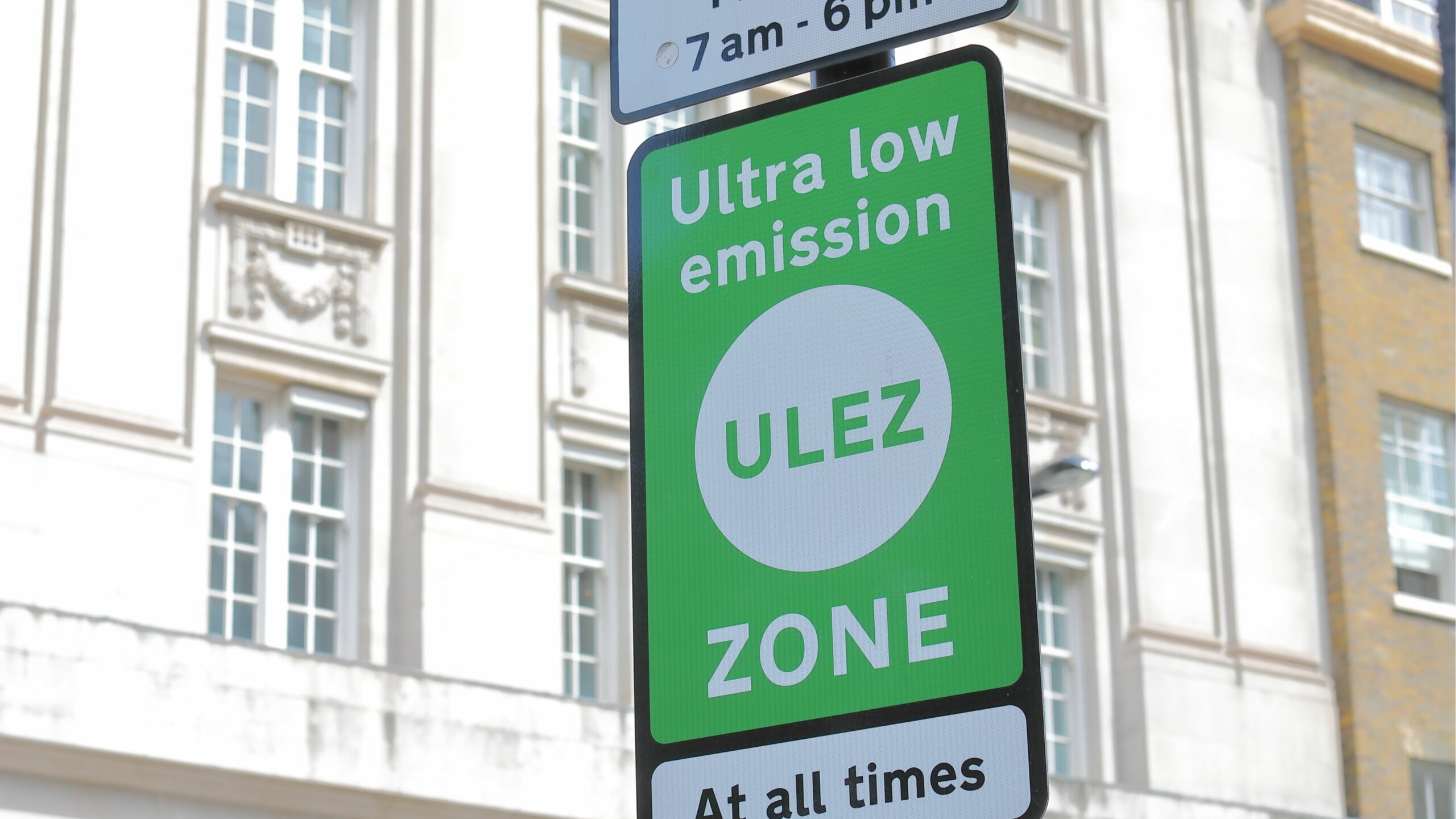
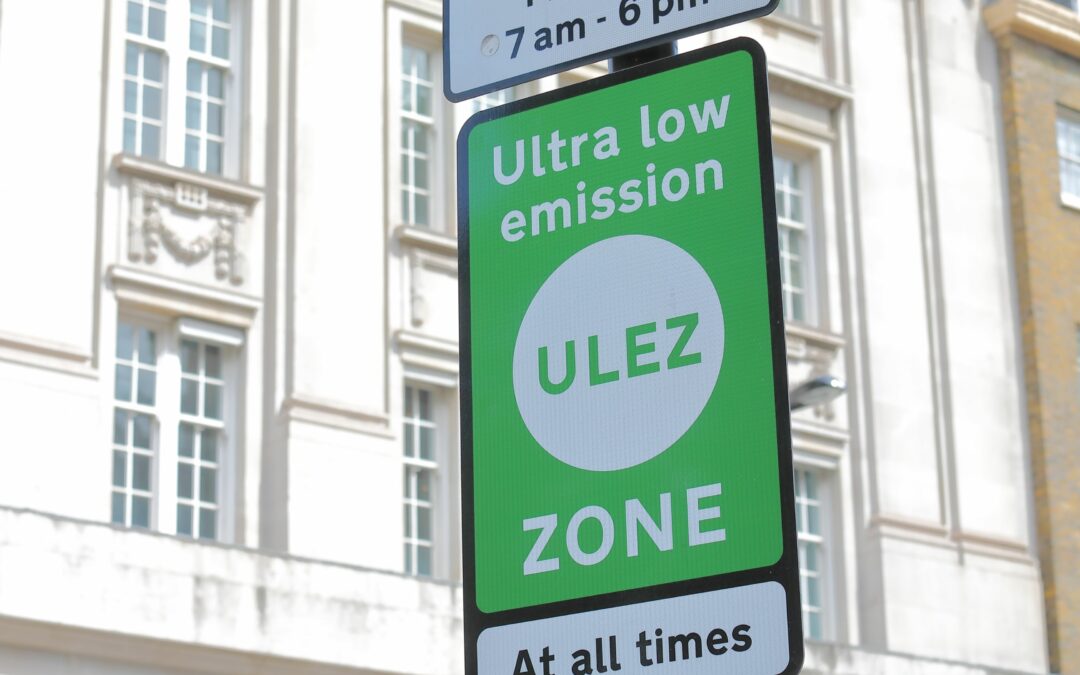
Two weeks ago we talked about The Battle over ULEZ expansion in London since then things have progressed again.

In late July, London’s High Court dismissed appeals made by the five Conservative boroughs. In making his ruling, Mr Justice Swift said he was satisfied that expanding the scheme was within the mayor’s powers and that enough information was given for people to provide “informed responses” to the public consultation process. Sadiq Khan described the judgment as a “landmark decision” and said he would press ahead with the expansion on August 29th as planned.

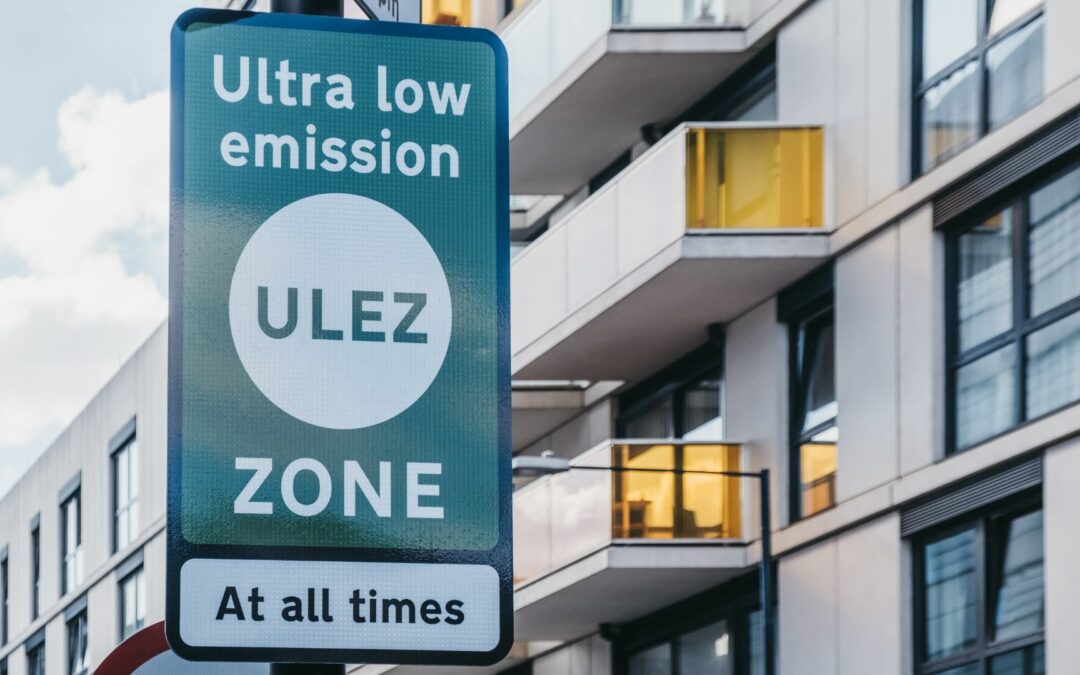
Initially, the ULEZ covered the same central area as the Congestion Zone before widening to the North and South Circular roads in 2021. In November 2022, a further expansion to cover all London boroughs was confirmed, and this is due to start on 29th August 2023.

The London mayor had come under intense political pressure from within his own party to rethink the enlargement and provide more support. On August 3rd, he announced that he would expand the established £2,000 ULEZ grant to all Londoners with non-compliant vehicles.

The decision was widely seen as a move to reduce the political fallout over the extension after the Tory by-election win in Uxbridge. The scheme will be available to any household with a non-compliant car or motorcycle, and is expected to cost £50m.

As of July 23rd, some 10,562 applications had been made to the scrappage scheme, with some £38.5m allocated to date. With the £50m addition to the scheme now being made, around £120m is still available.

Does the Ulez expansion effect you? Let us know in the comments. 

Plan ahead for summer drives

Plan ahead for summer drives

Sponsored content.

There’s a lot to love about summer; the long warm days spent visiting friends and family, the day trips to the beach or country parks and the good old UK Staycation. What isn’t always so great is the hectic journey to get to these divine locations.

We’ve all been there at some point or another, stuck in a traffic jam in sweltering heat and often with the sight of some poor soul pulled up on the hard shoulder with vehicle trouble.

As tempting as it can be just to jump in the car and set off on your summer adventure, it’s important to know what preparations you should make ahead of setting off on your journey.

It’s equally as important to know what you should do if you become the person stranded on the hard shoulder of a busy motorway or even on a country lane.

Start Rescue has provided us with a useful checklist on what to do in the event of a breakdown, as well as pre-journey checks that you can carry out to help prevent breaking down in the first place.

Pre-journey checks

Most breakdowns are avoidable. 17% of all breakdowns Start Rescue attended in 2022 were due to tyre issues.

With a trend of increased reported breakdowns during the busy months of July and August these pre-journey checks can help you…

  •  Check your fuel: Sounds simple, but check you have enough fuel. If you are driving an electric vehicle, ensure you have enough charge to either complete your journey or are able to plan where you can top up.
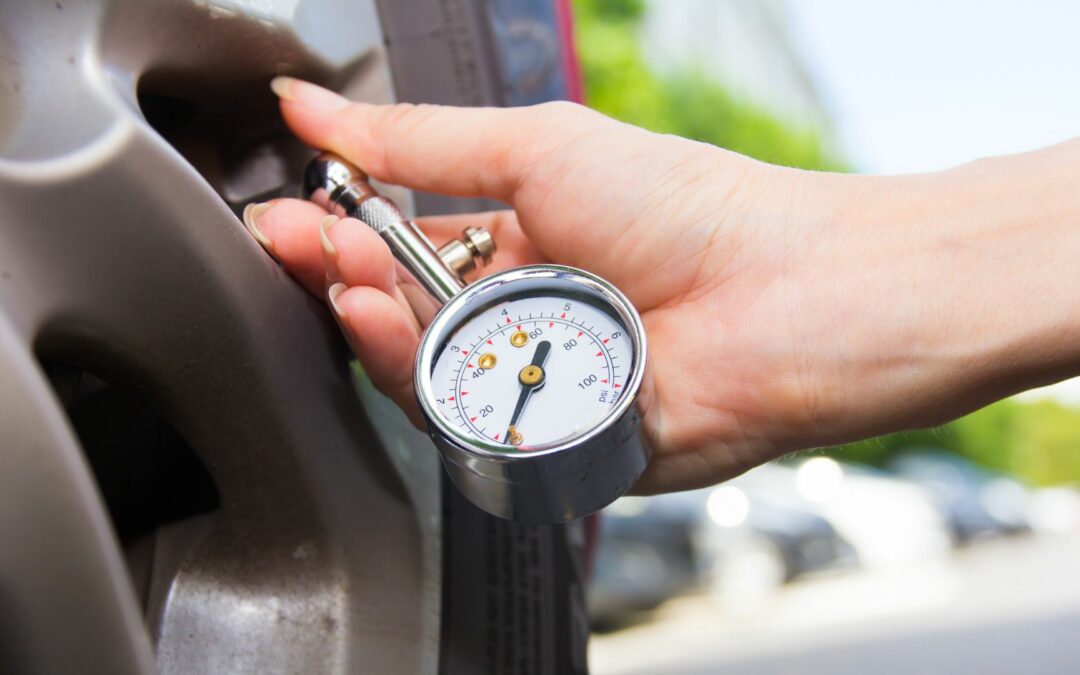
  • Check your tyres: Check your tyres are pressured to the manufacturer’s guidelines. It’s also important to ensure your tyres have at least 3mm of tread. Look out for bald patches or any tyre wall damage such as cuts, bulges or nails that could have punctured the tyre wall.
  • Check your oil: The oil in your vehicle helps to ensure that the engine runs smoothly, acting as a lubricant and helps to avoid it from overheating. Therefore, it’s important to ensure that you have the correct oil levels.
  • Check your coolant level: Ensure you have the right coolant levels to avoid your vehicle overheating, especially in heavy traffic.
  • Check your screenwash: Bugs and dirt on the windscreen can impair your vision so ensure the windscreen washer tank is topped up. Also check your windscreen wiper blades are in good condition.
  • Pack useful items: It’s ideal to have drinks, snacks, a blanket and USB phone charger or portable power bank to hand, should you experience a breakdown.

If you are unsure about coolant levels, oil, tyres etc, check your vehicle’s manual for guidance, or contact a local trusted garage for a quick vehicle check over, as checking the above will take no more than 10 minutes.

Summer Drives: Check your tyres: Check your tyres are pressured to the manufacturer's guidelines.

What to do in the event of a breakdown

  • Stay calm!
  • Get your vehicle to a safe place: If you are on a motorway, if it is safe to do so, see if you can make it to the next exit. If you can’t, pull up on to the hard shoulder and stop as far to the left as you can, with the wheels turned to the left.
  • Warn others you have broken down: Turn on your hazard lights and, if its dark or foggy, turn on your sidelights too. As long as you are not on a motorway, you can use a warning triangle if you have one, placing it at least 45m behind your vehicle.
  • If safe, leave your vehicle: Exit your vehicle using the left-hand doors and move as far away as you can, behind a safety barrier if there is one. On dual carriage ways and motorways, look to move up the embankment away from the fast-moving traffic. Always stand in a position which is behind your vehicle, not in front or to the side in case your vehicle is hit by another.
  • Broken down in a live lane? If you are unfortunate enough to break down in a live lane, immediately turn on your hazard lights. If you can’t get over to the left-hand lane, stay in the car, leave your seat belt on and call 999.
  • Call for roadside assistance.

As Lee Puffett, Managing Director at Start Rescue commented:

 “Simple vehicle checks could prevent a breakdown and help make sure you get to your destination safely. However, should you find yourself unfortunate enough to have an issue with your vehicle, through our invaluable network of local recovery operators, we’re on hand 24/7 to assist stranded motorists. So be sure to check your tyres, screenwash and oil, but if you don’t know how to, take your vehicle to a trusted garage to perform a quick check, as it will take minutes and could save you a great deal in time and money further into your journey. Please don’t run the risk and then ruin your day out or holiday. Most of all, have an enjoyable summer, with the peace of mind that Start Rescue is here to help!”

The Battle over ULEZ expansion in London

The Battle over ULEZ expansion in London

Boris Johnson decided to introduce the Ultra Low Emission Zone (ULEZ) when he was Mayor of London. It came into effect in April 2019, when Sadiq Khan became Mayor. A £12.50 daily charge applies for driving in the Ultra Low Emission Zone if a  vehicle doesn’t meet specific emission standards; broadly speaking, most diesel vehicles registered before September 2015 and petrol vehicles registered before January 2006.

Initially, the ULEZ covered the same central area as the Congestion Zone before widening to the North and South Circular roads in 2021. In November 2022, a further expansion to cover all London boroughs was confirmed, and this is due to start on 29th August 2023.

The Mayor’s office said it was needed to tackle air pollution, congestion and the climate emergency. Other cities in the UK, Bath, Bristol, Birmingham, Bradford, Glasgow, Portsmouth, Sheffield, Newcastle and Gateshead, have introduced clean air zones. Others will soon follow.

Low-emission zones have been introduced to clean up the air, aiming to make people healthier and reduce the burden on the NHS brought about by air pollution. For the London ULEZ expansion, £110m has been set aside for a scrappage scheme for people on low incomes or disability benefits, some small businesses and London-based charities. Eligible drivers can get up to £2,000 for scrapping a car. The amount of money on offer differs for vans and motorbikes.

Initially, the ULEZ covered the same central area as the Congestion Zone before widening to the North and South Circular roads in 2021. In November 2022, a further expansion to cover all London boroughs was confirmed, and this is due to start on 29th August 2023.

Serious concerns regarding the financial impact of ULEZ expansion have been raised by some residents, businesses and politicians. Some people affected say the scrappage scheme won’t help them. The cost of second-hand ULEZ-compliant cars has also risen. ULEZ expansion was a significant local issue during the Uxbridge and Ruislip by-election.

Five Conservative-led councils – Bexley, Bromley, Harrow, Hillingdon and Surrey – have launched legal action over the expanded scheme. In April 2023, they were granted permission to challenge the legality of how the ULEZ plans developed in a judicial review; the review is ongoing. Many local authorities affected by the expansion do not believe their transport systems or residents are ready for the expansion. The Mayor has defended the plan, arguing it is necessary to help prevent health conditions related to air pollution and even excess deaths. Preparations such as installing cameras have continued.

The number of older polluting vehicles that have entered the current Ulez has fallen dramatically, with 97% now meeting the cleaner standards. Within that area, it is estimated that NOx emissions have fallen by 26% since 2019. Air quality has improved, but all Londoners still live in areas exceeding World Health Organization guidelines for both pollutants.

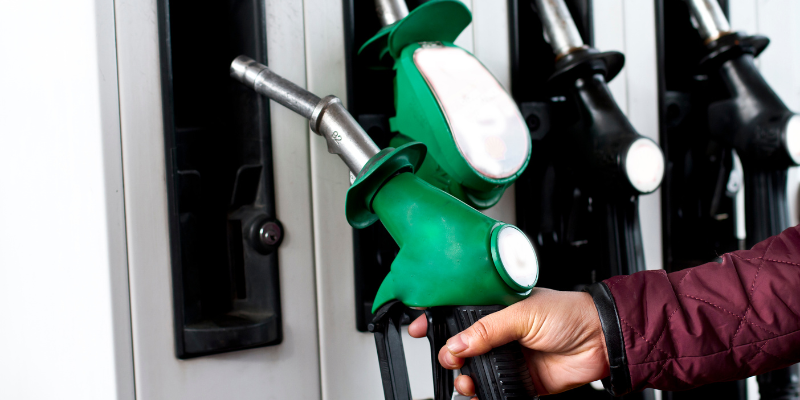
Diesel and unleaded prices are charging quickly currently, and competition is helping to drive down prices and ensure that UK drivers are being charged a fair price for their fuel. If you see a price that has changed, please consider updating it on the PetrolPrices app to help other motorists save on their fuel costs.

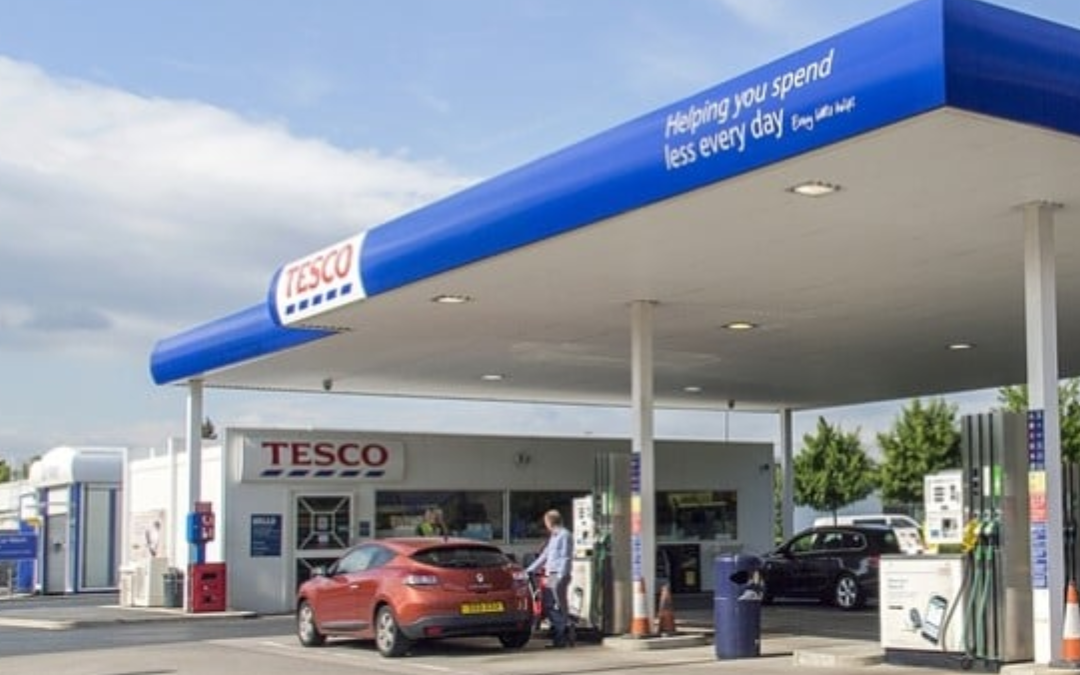
Tesco Lead the way in Unleaded and Diesel price parity

Tesco Lead the way in Unleaded and Diesel price parity

Back in May, we reported that one in 10 petrol stations were selling diesel at or below the price of unleaded petrol. At the time, wholesale diesel prices were four to five pence a litre lower than petrol, but in most cases, diesel drivers were being charged more.

This week we have seen that one in three petrol stations are now selling diesel at or below the price of unleaded petrol and in the case of Tesco forecourts this number is one in two.

The supermarkets have come under increased pressure from the government and motoring groups since the release of the Competition and Markets Authority report on fuel prices published at the start of the month.

Since the start of June, diesel retail prices have dropped 1.4ppl nationally, while wholesale prices have increased over 6ppl. Over the same period, unleaded prices have remained broadly unchanged at a retail and wholesale level. This squeezes the retailers’ margins and starts to correct the additional cost they have been putting on motorists.

Grant Shapps, Secretary of State for Energy Security and Net Zero, has spoken with fuel retailer bosses this week and has demanded “an immediate end to overcharging.” The government has also told fuel retailers they “must hand over their price data.” At the moment, there aren’t any details about how or when the new scheme will be implemented.

Despite Tesco having lower diesel prices when compared to unleaded petrol in many locations, they don’t have the lowest diesel prices overall. Asda and Morrison’s are offering the lowest prices on both diesel and petrol across the UK.

Both petrol and diesel prices have remained steady at the pumps over the past two weeks as the price reduction has stalled since the start of the year. Prices are, on average, just 0.50ppl lower than one week ago.

Wholesale prices have increased slightly since the beginning of the month, which may lead to prices creeping higher at the pumps in the near future.

Diesel is once again trading high than unleaded on the wholesale market. This could lead to diesel retail prices once again increasing over petrol.

Will the increase in government intervention mean retailers are less likely to increase prices, or will we start seeing the supermarkets lead the way with incremental increases? Let us know your thoughts in the comments. 

Despite Tesco having lower diesel prices when compared to unleaded petrol in many locations, they don't have the lowest diesel prices overall.
How Asda have changed their pricing strategy

How Asda have changed their pricing strategy

On Monday, 3rd July, the Competition and Markets Authority (CMA) published its road fuel market study.

The report focused on the supply chain and found “problems in relation to three aspects of the retail market.”

Asda, which was historically the market leader in terms of low pricing, was found to have decided to achieve higher margins in 2022. This was brought about by reducing prices “more slowly than would previously have been the case.”

Morrisons is also named as historically having a more aggressive pricing approach.

Tesco and Sainsbury’s were found to have “largely passive pricing policies,” whereby they set prices based on local competitors rather than cost movements. This meant that Asda did not drop their prices, and neither did Tesco or Sainsbury’s.

This change resulted in the headline figure of motorists paying 6 pence per litre more for unleaded petrol, or a combined £900m. Diesel prices were hit even harder, with an average of more than 13ppl from January to May 2023.

According to the CMA report, supermarket margins increased from 4.6ppl in 2019 to 10.8ppl in 2022. At the same time, large non-supermarket margins rose from 6.8ppl to 10.3ppl during the same period.

Asda’s Pricing Strategy

We at PetrolPrices, wanted to look further into Asda’s pricing strategies and what has happened to the retail fuel market.

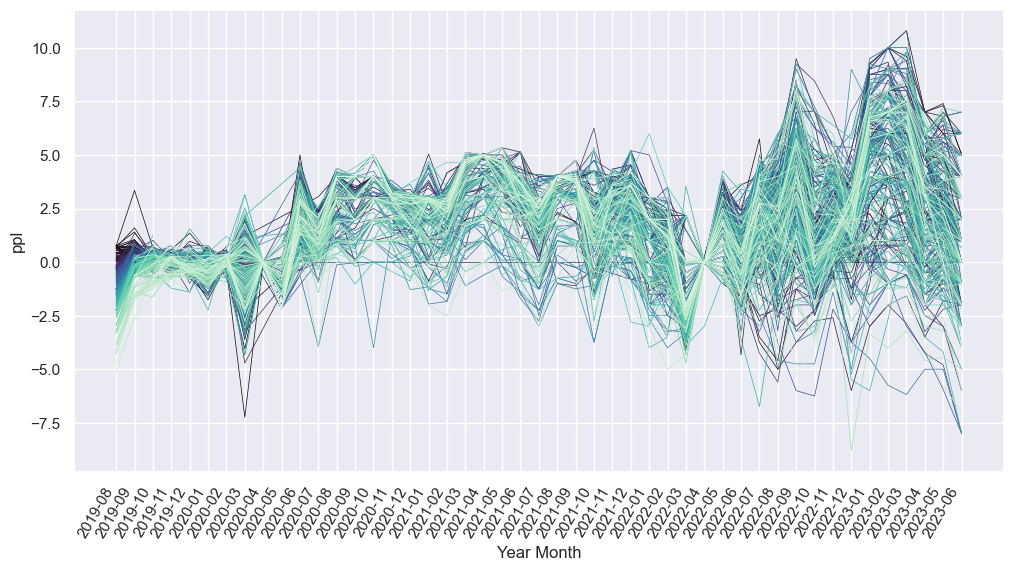
The CMA found that as prices fell, retailers did not pass the drop on to motorists and looked to increase their margins. However, this was at a national level. We looked at how Asda was pricing against other Asda sites. This comparison used Asda Bolton as a benchmark and compared all other Asda prices against it.

By comparing Asda sites against each other, you are removing global pricing factors, such as exchange rates, crude prices, wholesale diesel and unleaded prices. Local outages or transport issues may explain why a site in one area may become more expensive.

Diesel v Unleaded Map

This chart shows that between August 2019 and May 2020, Asda priced relatively consistently across the UK, which means that no matter which Asda you visited, you would pay the same or comparable price. In April 2020, this was particularly true, where prices were nearly all identical.

From June 2020 to April 2022, prices spread more widely across the Asda sites. Note that this isn’t showing an increase in price but an increase in price against our benchmark, Asda Bolton, which became one of the cheaper Asda’s during this time.

April 2022 is again an interesting point on this timeline. Prices were nearly exclusively 158.7ppl and then 160.7ppl during this time.

From May 2022 onwards, there appears to be a shift in pricing strategy with a much wider spread of prices across the Asda sites. There is more than a 15ppl spread across Asda locations from May 2022. This isn’t because of global pricing factors or exchange rates.

Asda has changed its strategy; from a relatively consistent national pricing structure to significant variations across the country. And remember, the CMA found that Tesco and Sainsbury’s were passive during this period, meaning they used Asda as a guide to price their sites. Any change in pricing strategy or margin increase that was seen on Asda forecourts, was also seen across all the supermarkets, and in the other retailers.

The market has not performed as it should. Supermarkets have 44% of the road fuel market (2021). The CMA’s report notes that other retailers, including Tesco and Sainsbury’s, did not respond promptly to cost movements and/or try to win market share. The report suggested, “Asda and Morrisons have been able to keep their market share broadly stable across this period.” Asda increased prices due to a lack of price competition from others.

The proposed solution from the CMA is for more market transparency. We agree this is a good thing. But it is no silver bullet. And will it stop this type of thing from happening again? It is being branded as a new idea for the UK, but one that is available in Germany and Australia. Still, fuel comparison platforms such as PetrolPrices are already available in the UK.

To read more about fuel price data in the UK you can do so here, at our Latest Fuel Price Data analysis page. 

Does this go far enough? Let us know your thoughts in the comments.

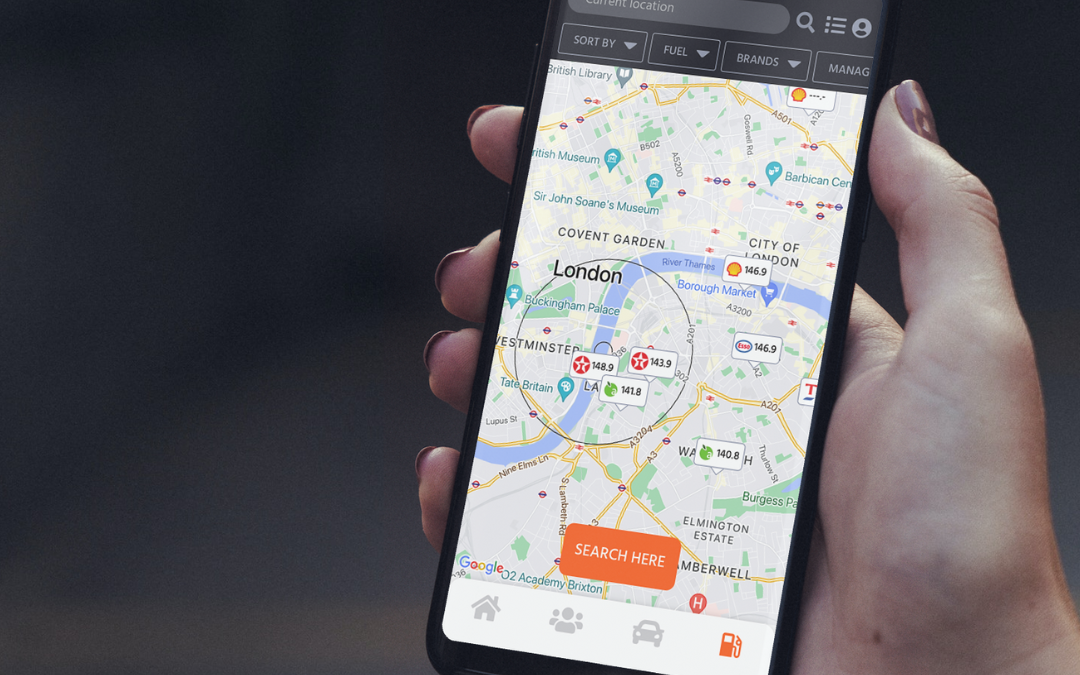
At PetrolPrices we are working and have been since 2005 on offering a more transparent fuel market. We continue to invest in the app and have recently added the Search Here button, making finding prices across the UK even easier. So, if you haven’t got the latest version, please check out the Play Store or App Store. Thank you to everyone that has added a price or written a review. We hope you continue to find value in the information provided within our app and website.

CMA Fuel Price Report: The free app that already compares petrol prices

CMA Fuel Price Report: The free app that already compares petrol prices

Our Statement

The team at PetrolPrices welcome the findings from the CMA Road Fuel Market study, which is exactly why PetrolPrices was formed in 2005, to help motorists compare fuel prices and save money at the pump.

Whilst we welcome the report and are encouraged about the findings, as a free of charge service already the PetrolPrices website and app already exist without any expense to the taxpayer.

PetrolPrices was founded in 2005 and helps over 1.5 million motorists a month save money on fuel.
We show prices for all brands of fuel stations across the UK and obtain data on Petrol, Diesel and Premium grades from the fuel stations and our wonderful community of drivers.

Our free app is available on both iOS and Android, plus we have a free website if you don’t wish to use the app. 

Study reveals Volkswagen drivers are the messiest

Study reveals Volkswagen drivers are the messiest

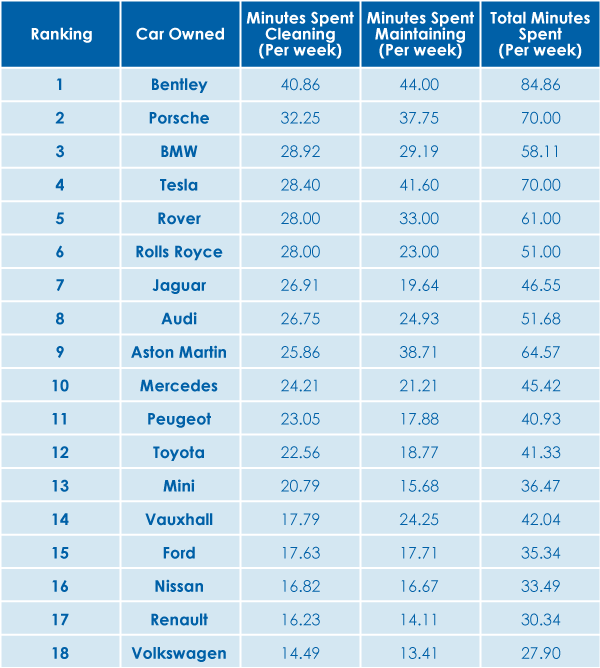
Car finance company, Go Car Credit, reveal Volkswagen (VW) drivers are the messiest, spending the least time cleaning their cars (14 minutes / week).

Renault and Nissan drivers were not far behind, spending roughly 16 minutes per week cleaning their vehicles, 20% less than the national average.

As well as being messy, VW drivers may also neglect vehicle upkeep, as VW drivers were found to spend the least amount of time maintaining their vehicles.

Bentley car drivers are the cleanest, spending twice as much time cleaning their cars than the average person. Bentley owners spend 40 minutes per week cleaning their car compared to just 20 minutes from the average UK car driver.

With the season of spring-cleaning upon us, Go Car Credit was keen to find out which car drivers are the cleanest and which were the messiest. Surveying 1000 car owners, the data revealed Bentley drivers were also the most car proud, spending 50% more time cleaning and maintaining their cars than cleaning their own homes. Bentley drivers also spend the most time maintaining their vehicles (44 minutes per week compared to 19 minutes of the average driver).

The survey also found that men spend 25% more time cleaning their cars than women (18 minutes compared to 22 minutes per week).

Other key findings include:

  • VW owners spend the least time cleaning their cars (14 minutes / week)
  • Londoners are the cleanest car owners (27 minutes / week)
  • Mini drivers spent 4 times as much time cleaning their homes than their cars
  • The average UK car driver spends 20 minutes per week cleaning their car

Looking at differences between the owners of specific car brands, the research revealed that Aston Martin drivers were the most car proud, spending 84% more time cleaning and maintaining their cars than cleaning their homes (64.57 minutes compared to 25.86 minutes).

Keen to uncover which cars are the cleanest, Go Car Credit created a ranked table of car brand owners and the time they spend cleaning and maintaining their cars:

Which drivers are messiest?

Although Volkswagen drivers were the least clean, spending on average 14 minutes per week cleaning their cars, Mini drivers were the most house-proud car owners. They showed the biggest difference, spending over 4 times as much time cleaning their homes than their cars (20 minutes cleaning their cars compared to 114 minutes cleaning their homes per week).

Looking at regional difference, Londoners were the cleanest car owners, spending 27 minutes per week cleaning their vehicles, spending 7 minutes more than the national average of 20 minutes per week. The South-East spends the least time cleaning their cars, dedicating only 15 minutes per week to cleaning their vehicles. House-proud Scotland saw the biggest difference, spending 108 minutes cleaning their homes compared to 17 minutes cleaning their cars each week.

As a result of the study, Go Car Credit launched a competition to find the UK’s messiest car. Go Car Credit’s Marketing Manager Hayley O’Connor said; “We wanted to see just how messy people let their cars get and if a VW driver would come out on top.”

UK drivers submitted photographs of their messiest vehicle interiors to Go Car Credit’s Facebook page. Following a selection process by a panel of judges from Go Car Credit, it can now reveal the winning entry came from Tammy from Norfolk with her Vauxhall Astra.

The winning image contained empty McDonald’s packaging, lateral flow tests, empty drinks bottles, sweet and crisp wrappers, an ice cream stick, discarded clothing, magazines, and paper towels.  Hayley continued: “We found a whole range of messy motorists. We recommend car drivers take care of their vehicles for health and safety reasons.”

When is the best day to take your driving test?

When is the best day to take your driving test?

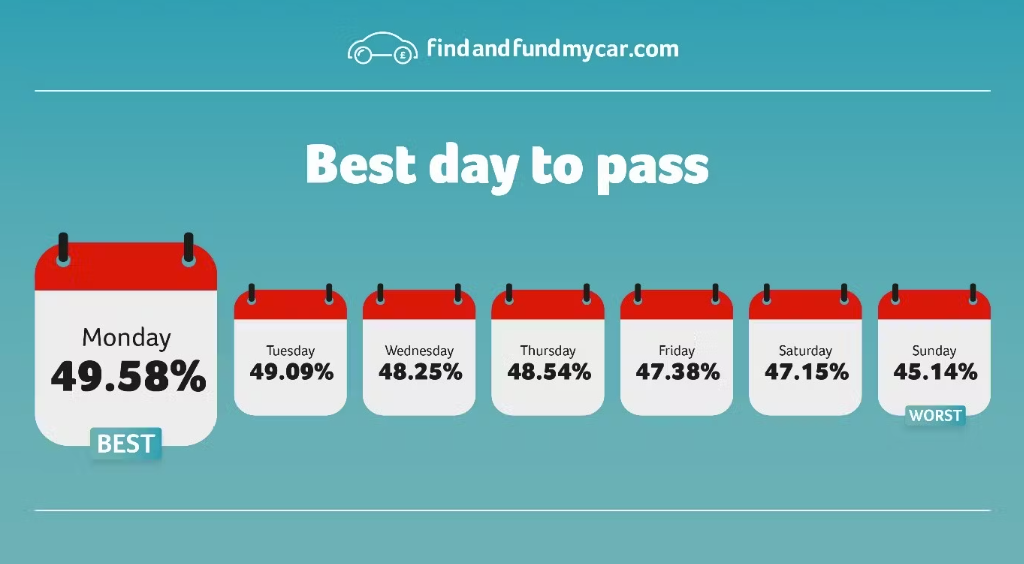
According to research by findandfundmycar.com driving test pass rates vary for different days of the week. Road use may fluctuate throughout the working week. Mondays can be chaotic with morning traffic and lunchtime rushes, as can Fridays for the same reasons, whereas the weekends might be quieter unless significant events like a football match are on.

Driving and Vehicle Standards Agency (DVSA) statistics show that, surprisingly, Monday is the day you are most likely to pass your driving test, with it having a 49.58% pass rate – just 0.49% higher than the runner-up, Tuesday. In stark contrast, the worst day to book your test is Sunday, with a pass rate of 45.14% – 4.44% less than Monday.

Here are pass rates for the days of the week:

Monday – 49.58%

Tuesday – 49.09%

Thursday – 48.54%

Wednesday – 48.25%

Friday – 47.38%

Saturday – 47.15%

Sunday – 45.14%

Driving Test: When is the best day to take your driving test?

When is the best month to book your driving test?

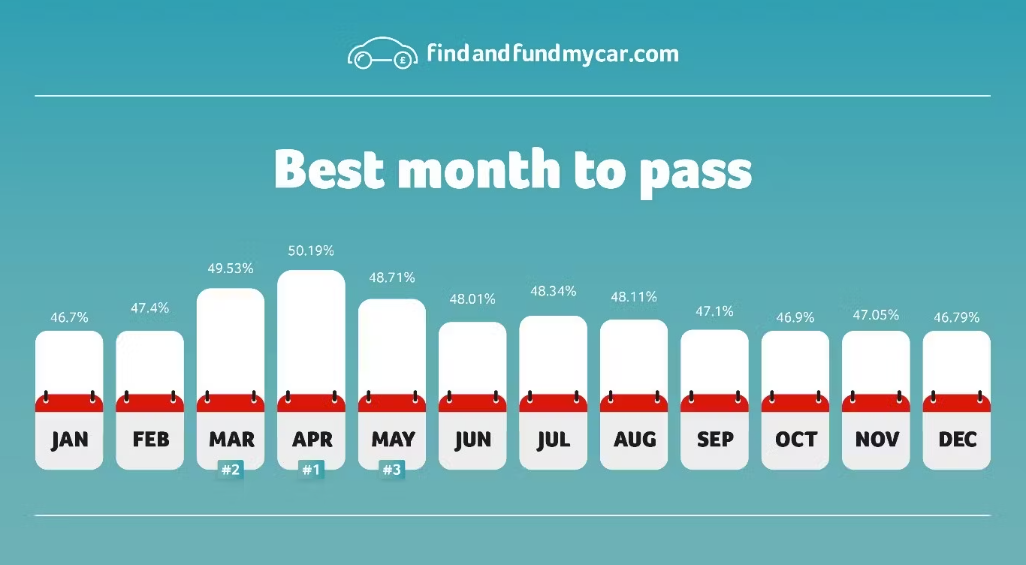
Statistics from the DVSA point towards April as the best month to book your driving test, while January has emerged as the worst month.

April has a pass rate of 50.19%, with March and May coming in second and third with 49.53% and 48.71%, respectively. On the opposite end of the scale, January has a pass rate of 46.7%.

The list of pass rates is as follows:

April – 50.19%

March – 49.53%

May – 48.71%

July – 48.34%

August – 48.11%

June – 48.01%

February – 47.4%

November – 47.05%

September – 47.1%

October – 46.9%

December – 46.79%

January – 46.7%

Which season is best for booking your driving test?

Due to March, April and May having the highest pass rates, spring is the best overall season for booking your driving test. Spring leads summer by slightly over 1%, while winter and autumn complete the order thanks to a score of 47.59% and 46.81%, respectively.

Here are the results for each season:

Spring – 49.17%

Summer – 48.01%

Winter – 47.59%

Autumn – 46.81%

Which day of the month is best for booking your driving test?

So, we have the best day of the week and month for booking our tests. At this point, we could easily call it a day and claim that any Monday in April would be the best for your driving test – but that’s not enough.

For the most significant statistical advantage, we wondered if there was any merit around which day of the month you should be looking to book your test. Spoiler alert, there is.

Across all the possible days of the month, the 24th has come out as being the most successful day for booking your test. The 24th has a pass rate of 49.53%, with the 1st following closely behind with a rate of 49.46%. It’s interesting to note that both these days sit on opposite sides of the month, with the remaining days floating around the 47-48% mark.

Driving Test: When is the best month to book your driving test?

So, which day should I book my driving test?

This information confirms that Monday, April 24th is the most statistically advantaged day for passing your driving test. Of course, this isn’t to say that booking your test for this day will guarantee a pass, but it could potentially tip the odds ever so slightly in your favour.

This day and date combination has already gone for 2023, with it not being seen again until 2028 or 2034.

You can find more driving information and guidance from findandfundmycar.com

Unleaded and Diesel Prices are Starting to Rise

Unleaded and Diesel Prices are Starting to Rise

There has been a noticeable shift in fuel prices in the past few months, particularly for unleaded petrol and diesel. After experiencing a downward trend since the beginning of the year, fuel prices have recently stabilised and even risen.

Diesel prices have witnessed a considerable decline, falling from 163 pence per litre (ppl) at the start of the year to 145ppl, indicating an 11% reduction. Surprisingly, larger supermarket chains were slow to adjust their prices, and the smaller brands initially led the decrease. However, Asda has once again emerged as the supermarket with the lowest fuel prices. Membership company Costco has the lowest average diesel price of any brand. Notably, both Asda and Costco exhibit greater consistency in their pricing across the country than other brands.

Shell and bp have been identified as having the highest average prices, excluding motorway service stations. It is important to recognise that pricing at certain bp and Shell forecourts may be determined by individual site owners rather than the brands themselves. Consequently, the price variation among their forecourts tends to be higher.

Unleaded Price Changes

Unleaded petrol prices have also experienced a decline throughout the year, at a more gradual pace than diesel. Starting from slightly over 149ppl at the beginning of the year, the current price is around 142ppl, representing a reduction of nearly 5%. The variation in prices among different brands and sites has been relatively consistent.

Similar to the diesel scenario, Asda remains the frontrunner among supermarkets in terms of offering the lowest prices for unleaded petrol. However, on average, Harvest Energy slightly undercuts Asda’s prices. Meanwhile, Costco continues to offer the best overall value for those holding a membership card.

Shell and bp have been identified as having the highest average prices, excluding motorway service stations. It is important to recognise that pricing at certain bp and Shell forecourts may be determined by individual site owners rather than the brands themselves. Consequently, the price variation among their forecourts tends to be higher.

The State of the Market

So, what does all this mean? The decrease in fuel prices has primarily been driven by a drop in crude oil prices and intensified competition among providers. However, the reduction at the pump did not align with the rapid decline in crude oil prices earlier in the year. Only 35% of the diesel pump price is directly related to the refined oil product, with 53% comprising VAT and excise duty, 3% attributable to renewables, and the remaining 9% divided between transport costs and retailer margins.

Prices cannot continue to decline indefinitely, and they appear to have stabilised both at the pump and in terms of crude oil prices in the short term. Currently, crude oil is trading at around $77 per barrel, having reached a low of $72 per barrel earlier this month. To put this into perspective, crude oil began the year at $86 per barrel, resulting in an overall decrease of 11%. These figures can provide an indication of the potential direction of pump prices in the future.

The reduction in price variation among brands and regions is positive news for drivers, as it promotes more consistent pricing across the board. Nonetheless, there are still opportunities for significant savings within short distances and across different brands. For instance, on average, Asda offers a 5ppl price advantage over bp, resulting in a savings of £3 on a single tank of fuel.

As fuel prices continue to change, it is essential for consumers to stay informed and consider their options to make the most cost-effective choices at the pump.

Motorway EV Charging is Falling Short

Motorway EV Charging is Falling Short

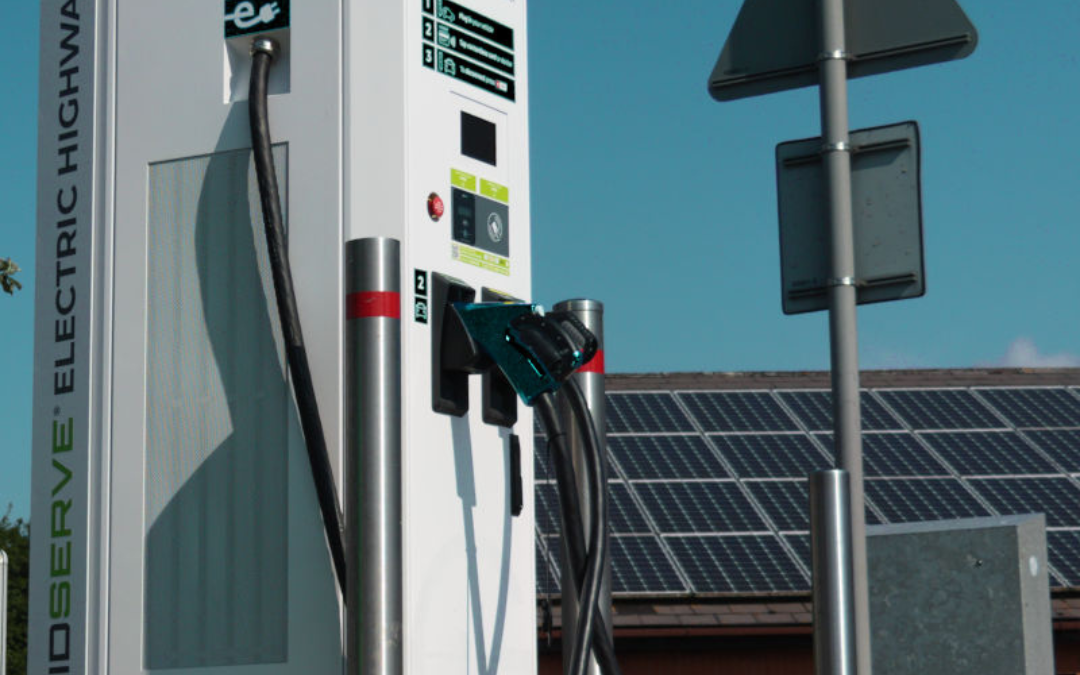
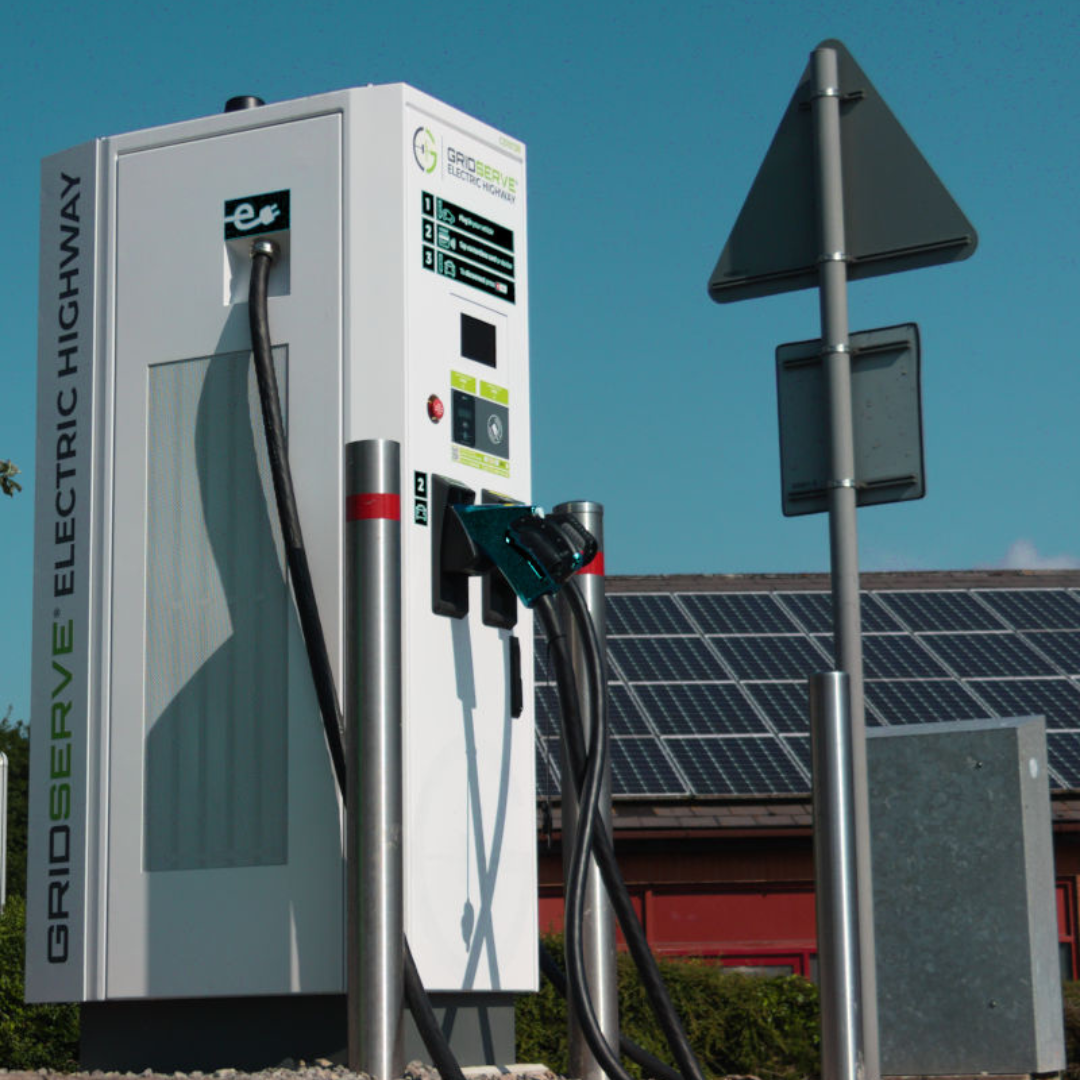
New research conducted by the RAC reveals that the government looks unlikely to meet its target of having six or more rapid or ultra-rapid electric vehicle chargers at every motorway service area in England by the end of 2023. Only 27 of 119 motorway services reviewed by the RAC currently have the target number of chargers. The RAC’s research found around 400 high-powered charging units at motorway services capable of charging 682 electric cars simultaneously.

When looking at the number of connectors these devices have, there is an average of nearly four of the most commonly used CCS (Combined Charging System) connectors and just under two CHadeMO connectors used predominantly by the Nissan Leaf.

Six motorway services in England don’t have any high-powered chargers. These are Leicester Forest on both sides of the M1, Tebay South on the M6, Carlisle Northbound on the M1, Strensham Southbound on the M5 and Barton Park on the A1(M).

EV Charger

The government’s “Taking Charge: the electric vehicle infrastructure strategy”, published in March 2022, set out an intention to accelerate the roll-out of high-powered chargers on the strategic road network through the £950m Rapid Charging Fund to give EV drivers confidence in the ability to undertake longer journeys. The document states, “We will ensure that every motorway service area has at least six rapid chargers by the end of 2023, with some having more than 12.” Currently, only six services in England have more than 12 such devices. These are Exeter on the M5, Rugby on the M6, Reading East and West on the M4, Thurrock on the M25 and Wetherby on the A1(M).

The government expects around 300,000 public chargers of all speeds as a minimum by 2030 and more than 6,000 high-powered chargers along strategic roads by 2035.

RAC EV spokesperson Simon Williams said: “Our findings show there is much work to be done before the end of the year if the government’s target of having six high-powered chargers at every motorway service area is to be met.

“Installing these types of units is not straightforward as connecting to the electricity grid is expensive and time-consuming, but clearly more needs to be done to make this process simpler than it is currently.”

“As a lack of charging facilities is rapidly becoming one of the most widely quoted reasons for drivers not going electric, all parties involved in making installations happen must work together to overcome this obstacle.

“With approaching 1m battery electric vehicles on the road and the Government having a goal of 80% of new cars sold by 2030 being zero-emission, it’s critical that the country’s charging network grows proportionately, particularly at the fastest end of the charging spectrum.”